How to Read Venice Collateral Shows in 2026
Collateral exhibitions shape Venice Biennale week as much as national pavilions do, but only if you know how to separate real urgency from polished overflow
Start by dropping the idea that collateral shows are secondary
People who talk about Venice as if the main exhibition and national pavilions tell the whole story are usually visiting too quickly or repeating the hierarchy that the city itself encourages. In practice, Biennale season is distributed across foundations, palazzi, church complexes and temporary institutional alliances that sit just outside the official frame while shaping it at every turn. The right starting point is the official Biennale Arte 2026 page, not because it contains the whole map, but because it establishes the public script against which everything else is reacting. Collateral shows matter when they clarify, contradict or intensify that script. If they merely borrow traffic from it, they are filler with better architecture.
In 2026 the distinction is especially important because Venice is once again operating under pressure from politics, tourism and institutional reputation management. artworld.today has already tracked some of that atmosphere in its report on Biennale protests and crisis. Collateral shows become crucial in seasons like this because they are often where institutions can move faster, take stranger risks or avoid the flattening effect of official consensus. They can also, of course, become luxury overflow for sponsors who want Biennale adjacency without curatorial courage. Reading them well means learning to tell those two modes apart.
Look first at who is producing the show and what the host site adds
A collateral exhibition is never just the artist list. It is a compact between organizer, venue and season. Ask who is paying, who is hosting and whether the site changes the meaning of the work. If the answer to the last question is no, you may be looking at an expensive traveling display that happens to be in Venice. Site matters here more than in almost any other international art event because the city keeps offering spaces heavy with ecclesiastical, civic or aristocratic memory. A good collateral show uses that weight instead of hiding from it.
Sanya Kantarovsky's Basic Failure at Palazzo Loredan is a good example. The venue's book-lined interiors and scholarly authority do not just frame the work. They sharpen its preoccupation with guilt, damaged innocence and inherited systems of judgment. Likewise, institutions such as the Fondazione In Between Art Film matter not only because they bring ambitious work to Venice, but because they have built recognizable curatorial languages that shape expectations before you enter. When the producer's identity and the site's atmosphere work against each other productively, pay attention.
Judge scale by concentration, not by square footage
Venice trains visitors to confuse exhaustion with significance. A huge exhibition in a grand building can still be conceptually thin, while a few rooms can reorder an entire day. The more useful test is concentration. How much pressure does the show generate per room, per work, per idea? Are you moving through a sequence of decisions, or through a branded environment whose main achievement is confidence? Many collateral exhibitions try to win by looking expensive, which is understandable in a city where logistics alone can feel theatrical. But cost is not the same as necessity.
This is where pacing helps. Do not attempt collateral shows as a checklist between vaporetto stops. Spend enough time to notice whether the work keeps complicating your first impression or whether it announced everything in the doorway. If the wall text is doing most of the labor, the show may be more concept than exhibition. If the site is doing most of the labor, the organizers may be leaning on Venice as stage set. Strong collateral exhibitions create a third thing in which artwork, curatorial framing and setting sharpen each other until the visit feels denser on exit than on entry.
Use the season's institutional themes as a diagnostic tool
The Biennale season always produces recurring themes whether organizers admit it or not: migration, extraction, spirituality, surveillance, ecology, labor, repair, memory. The question is not whether a collateral show addresses one of these themes, because most of them do. The question is what kind of relation the work has to the theme. Is it illustrating a position that already circulates comfortably in curatorial language, or is it discovering a form equal to the problem? This is one reason artists with more unruly visual vocabularies often fare well in Venice. They can resist the city's tendency to turn every conflict into atmosphere.
Take the current conversation around artist support and institutional risk. EMMA's new long-term support model for P. Staff, Tarik Kiswanson, Jenna Sutela and Eglė Budvytytė, reported by artworld.today earlier in this batch, matters in Venice because several such artists circulate through biennial ecosystems that depend on their labor while underfunding its conditions. When you encounter a collateral show, ask what material system made it possible. Did the exhibition arise from sustained backing, or from one last round of heroic improvisation by artists and curators expected to survive on prestige? The answer does not dictate quality, but it often explains the show's level of freedom or strain.
One more test helps: ask whether the collateral show changes your reading of the official exhibition or merely parallels it. The best examples send you back into the Giardini or Arsenale with altered expectations. They reveal a blind spot, deepen a recurring motif or make the main show's compromises easier to see. If a collateral event can only be praised in isolation, with no effect on how you understand the broader season, its importance may be narrower than the invitation suggested. Venice is a networked ecology. The most valuable side exhibitions behave like active arguments inside that ecology, not decorative annexes.
That is also why documentation matters. Save the floor plan, photograph the installation logic, and note what information the organizers foreground. Some collateral exhibitions are better on the page than in the room, while others become flat the moment they are translated into a press release. Comparing those two versions tells you a lot about institutional confidence. A show that survives only as publicity is probably borrowing authority from Venice. A show that remains complex even in memory has done the harder work of building an experience that exceeds its own framing.
Read audience behavior without mistaking crowding for importance
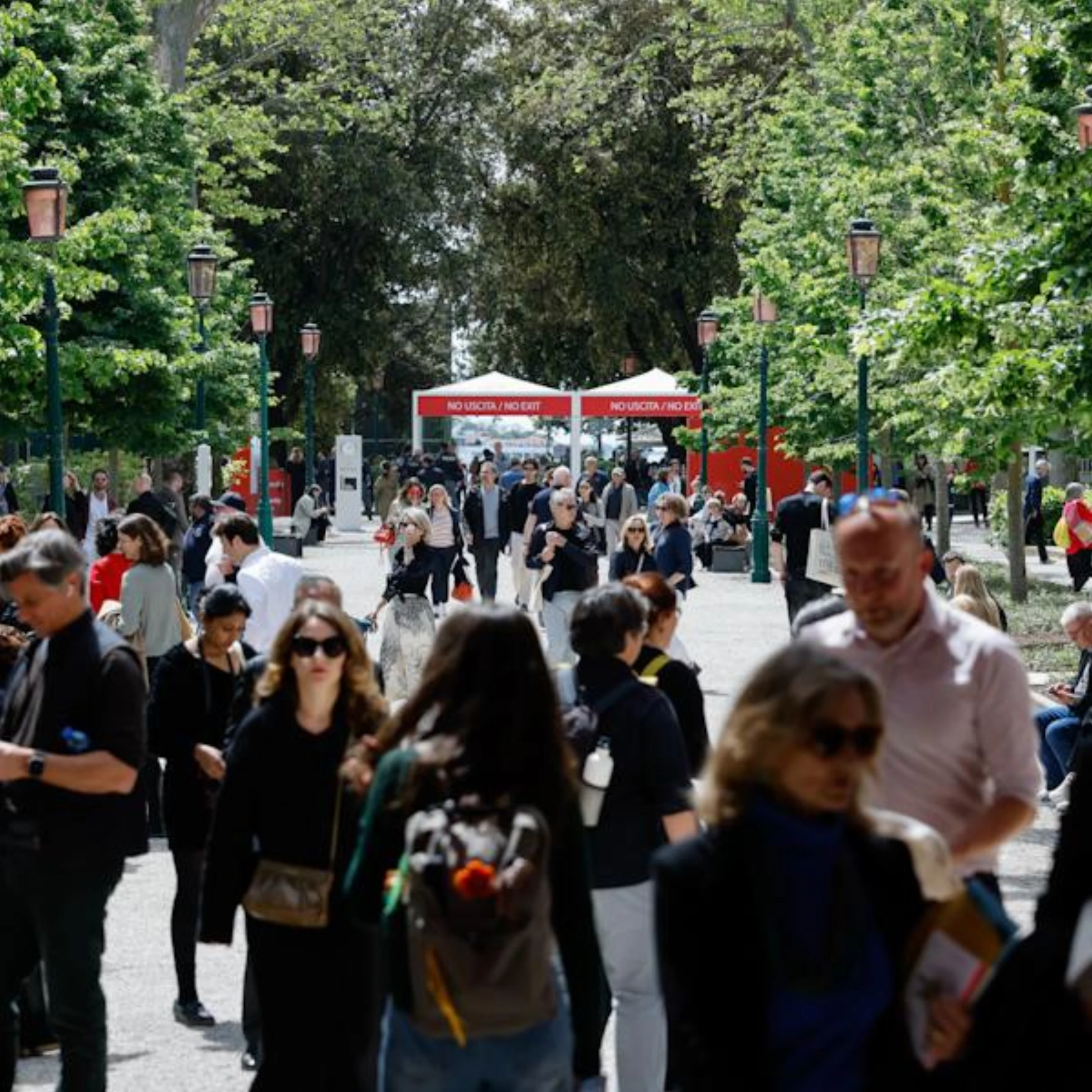
Venice is a city of queues, leaks and rumor. Crowds tell you something, but rarely the thing you first think. A packed collateral show may indicate real urgency, smart scheduling, a photogenic installation or simply a location close to other must-sees. Instead of counting bodies, watch how bodies behave. Are people moving quickly toward the image they already know, or lingering because the work keeps resisting consumption? Are conversations specific, awkward and searching, or are they mostly about who funded the project and who attended the dinner? Social density can be useful evidence, but only if you treat it as one clue among several.
Also notice what happens at the edges of the room. The strongest collateral exhibitions often create secondary zones of attention: visitors doubling back, reading carefully, comparing works, sitting longer than planned. Weak ones produce an efficient flow in and out. Everyone gets the shot, everyone agrees the site is beautiful, nobody seems changed by the encounter. Venice offers too much beauty for beauty alone to count as a critical achievement. A collateral show earns its place when it reorganizes the tempo of attention inside a city designed to scatter it.
Keep a small scorecard so your memory does not collapse into mood
By the second day, Venice can turn into a haze of stone floors, church light and overheard certainty. The cure is a simple scorecard. After each collateral show, write down five things: what the host institution added, which work stayed with you, what theme the show claimed, what theme it actually staged and whether you would still care about it outside Venice. That last question is brutal and necessary. Some exhibitions live entirely off the city's aura. Others reveal capacities in artists or institutions that deserve attention anywhere.
Finally, remember that Venice rewards stamina but punishes indiscriminate enthusiasm. You do not need to see every collateral event to understand the season. You need to identify the handful that reveal something the official structures cannot quite hold: a different pace of looking, a more precise institutional wager, a stronger relation between site and subject or a truer account of the pressures artists are under. Once you find those, the city begins to sort itself. The side shows stop looking secondary, and Venice starts to read as what it really is: a struggle over who gets to define seriousness in public.
If you do this consistently, patterns emerge fast. You begin to see which organizers use Venice to think harder and which use it to look larger. You start recognizing when a palazzo is carrying a mediocre show, when a supposedly minor venue contains the sharper argument and when a collateral event is quietly more alive than the official structures around it. That is the real reason to learn how to read these exhibitions. Venice is not only a place where art gets displayed. It is a place where institutional desire gets exposed. Collateral shows are often the cleanest place to watch that exposure happen, provided you arrive ready to judge more than the invitation list.