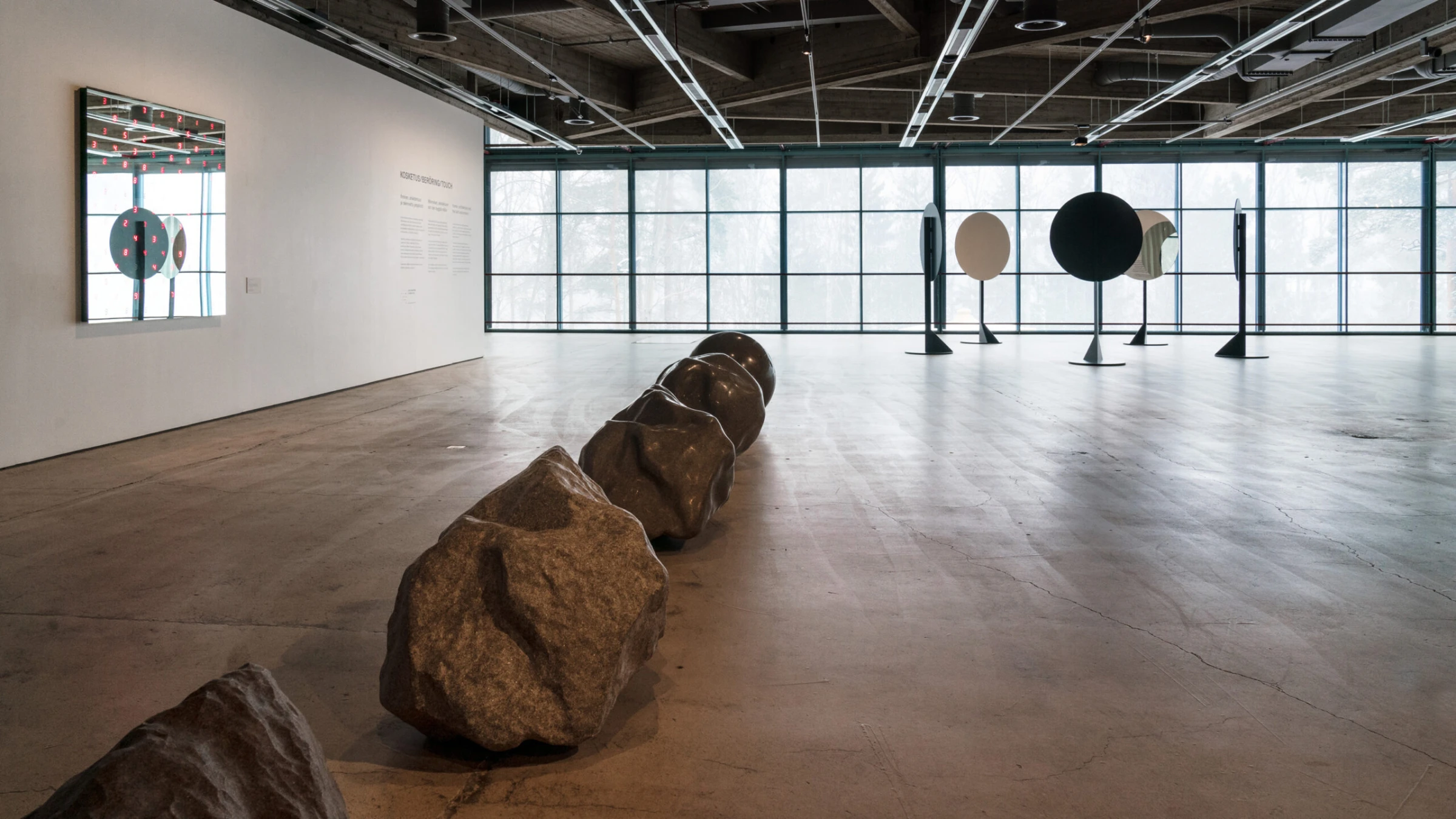
EMMA Bets on Artist Support Instead of Safe Programming
Espoo Museum of Modern Art is backing four mid-career artists with stipends, health insurance, acquisitions and production support through 2030
EMMA is treating artist support as infrastructure, not public relations
Espoo Museum of Modern Art has announced one of the more serious museum-backed artist support schemes to appear in Europe this year, and the reason it matters is simple: it tries to fund the conditions of artistic work rather than just the final spectacle. According to EMMA's exhibition program, EMMA will support P. Staff, Tarik Kiswanson, Jenna Sutela and Eglė Budvytytė over the next several years through acquisitions, direct production support, a one-year part-time stipend and a year of health-insurance coverage. The program ends not with a press release but with mid-career survey exhibitions in 2029 and 2030, the sort of long horizon museums often praise and rarely finance. That combination makes this less a branding exercise than a test of whether an institution can still intervene meaningfully in artists' material lives.
The structure matters because each piece answers a different failure in the contemporary art economy. Acquisition money supports the artist's market and archive. Production funding covers the expensive practical labor that exhibitions offload onto artists. A stipend buys time, which is usually the first thing to disappear when artists begin teaching too much, freelancing too much or traveling too often to stay solvent. Health insurance addresses the blunt fact that many internationally visible artists remain precarious in daily life. EMMA is not pretending one museum can solve structural inequality. It is, however, acknowledging that the old model of inviting artists into an institution and rewarding them with exposure alone has become indefensible.
Why mid-career artists are where institutional rhetoric usually breaks down
EMMA director Krist Gruijthuijsen described the mid-career stage as both fascinating and unstable, and that diagnosis is sharper than it first sounds. Early-career support attracts philanthropic romance because it promises discovery. Late-career retrospectives come with canon-building prestige. Mid-career artists often get neither halo. They may be critically established, included in biennials and museum shows, and still unable to convert that visibility into durable economic footing. That contradiction sits at the center of the current art system, especially for practices that do not map neatly onto the most conservative segments of the market.
The four artists EMMA selected all make work that is legible internationally but not easily reduced to a decorative commodity. P. Staff works across film, installation and language with a severity that resists easy consumption. Tarik Kiswanson has built a practice around migration, inheritance and embodiment. Jenna Sutela moves between biological systems, language and computation. Eglė Budvytytė has long treated choreography, ecology and voice as interlocking forms. These are not marginal names. They are exactly the sort of artists museums publicly celebrate while private financial pressure quietly punishes them. EMMA is betting that museums should back the difficult middle of a career rather than congratulate themselves for displaying it at low cost.
The museum also gains something by taking this position. EMMA is Finland's largest art museum, and its institutional profile gives it enough scale to model behavior for smaller museums that claim they are too constrained to do more. Gruijthuijsen's criticism of "safe, riskless programmes" is not abstract. It is an attack on a museum culture that has grown timid under audience metrics, board anxiety and the steady professionalization of caution. In that context, a long-term support model functions as a curatorial statement about what museums are for. Either they help sustain artistic thinking before it becomes legible as success, or they become elegant venues for underwriting trends already ratified elsewhere.
The Venice connection shows how institutions rely on artists before they adequately support them
Three of the four artists in EMMA's cohort are appearing in or around the Venice Biennale cycle, which underlines another contradiction in the field. Museums and foundations depend on artists to generate prestige on the biggest international stages, but the cost of reaching those stages keeps moving downward onto the artists themselves. Shipping, fabrication, travel, studio rents, assistants and research time all compound, while fees remain thin and honor attached to visibility does not pay invoices. EMMA's plan recognizes that museums often benefit from artists' international circulation long before they meaningfully share the burden of producing it.
There is another reason this initiative feels unusually credible: EMMA has tied support to acquisition and exhibition rather than pretending care can exist outside the museum's curatorial commitments. Too many institutions separate welfare language from programming decisions, as if being kind to artists were one department and building history were another. EMMA is effectively saying the opposite. If these artists matter enough to shape the museum's future exhibitions, they matter enough to support in the years before those exhibitions open. That logic sounds obvious, yet it cuts against the way museums often budget, where construction, marketing and visiting numbers remain easier to defend than the slower work of sustaining an artist's practice between headline moments.
It also sets up a more honest relationship to public money. Municipal and state funders routinely ask cultural institutions to demonstrate impact, but impact is usually measured after the fact through footfall or educational outcomes. Artist support schemes like this ask a harder question upfront: what kind of ecosystem does a public museum believe it exists to maintain? If the answer includes living artists with rent, insurance and research costs, then the budget should show it. If the answer does not, then the museum is really in the business of display alone. EMMA's structure gives other public institutions a blueprint for making that distinction legible.
For curators, the program may also change how exhibitions are built. Long-term support allows for projects that are less reactive and less overdetermined by shipping deadlines or temporary market momentum. It creates room for risk that is formal as well as economic. An artist who knows a museum is staying in the conversation across several years can build a body of work with more continuity and less panic. That does not guarantee better art, but it improves the conditions under which better art might happen. At a time when so many institutions complain about the homogenization of contemporary programming, backing artists before the final checklist stage is one of the few ways to address the problem at its source.
Jenna Sutela told The Art Newspaper that the program appealed because it offers continuity and reflection in a field that rarely does either. That point deserves attention. The contemporary art system likes urgency because urgency looks productive. It fills calendars, fairs, triennials and social feeds. But serious work often requires intervals where artists can test, fail, pause and reframe. A museum willing to support those intervals is doing something more ambitious than exhibition planning. It is protecting the time in which a body of work changes shape. If that sounds basic, that is an indictment of the system, not of the idea.
What this model could change, and where its limits are
There is a temptation to celebrate any museum support experiment as evidence of moral renewal. That would be too easy. EMMA's initiative helps four artists, not a generation, and it depends on a funding mix that includes the Saastamoinen Foundation, the city of Espoo, the Finnish state and the museum's own fundraising. Not every institution can reproduce those conditions. The program also benefits artists who already possess a degree of visibility, which makes sense strategically but leaves open the question of how museums should respond to less established practitioners facing the same economic grind. Scale and selectivity are not flaws so much as reminders that even the better institutional solutions arrive with boundaries.
Still, the model alters the conversation. It forces directors, boards and funders to explain why acquisition budgets, capital campaigns and spectacle-driven programming remain easier to finance than artist health, time and continuity. It also offers a practical language for future museum philanthropy. A donor can understand what a stipend does. A civic funder can understand why production support preserves cultural value. A museum can explain why touring mid-career surveys builds more than visitor numbers. If EMMA succeeds, its greatest impact may not be rhetorical inspiration but administrative imitation.
There is a related lesson here for biennial culture too. Museums love to celebrate artists once they arrive on international platforms, then act surprised by the private fragility that got them there. artworld.today's recent coverage of Venice's institutional strain showed how much contemporary prestige depends on under-acknowledged labor. EMMA's scheme does not resolve that system, but it does put money and time behind the people asked to sustain it. That is more substantial than another season of speeches about resilience from institutions that still budget as if artists can absorb every shock indefinitely.
What comes next is the harder part: whether other institutions decide that supporting artists as people is a central function rather than an optional gesture. The field already knows the problem. Gruijthuijsen said institutions are stuck with old assumptions about what support looks like, and the artists quoted in the report described a permanent condition of instability beneath public recognition. EMMA has now put a more credible answer on the table. If similar museums continue with symbolic fees and short-term fanfare after this, the excuse will no longer be lack of imagination. It will be lack of will.