How to Read a Portrait: A Guide to the History and Language of Portraiture
From Botticelli profiles to contemporary self-portraits, a guide to the visual codes, gestures, and conventions that make portraiture one of art's most enduring genres
Why Portraiture Has Endured for Centuries
Portraiture is one of the oldest and most persistent genres in Western art, and for good reason. The desire to record how a person looked, to preserve a likeness beyond the span of a human life, and to communicate identity to others through visual means is fundamental to how cultures organize memory. From Egyptian funerary masks to Roman busts, from Renaissance profile portraits to contemporary digital self-representations, the portrait has continuously adapted to new materials and technologies while preserving its core function: to make a person present to viewers who cannot see them directly. The current exhibition at the Gemaldegalerie in Berlin, which pairs portraits from Botticelli to Tamara de Lempicka, provides an opportunity to examine the visual language that has governed this genre across five centuries.
Understanding how to read a portrait requires attention to the conventions that artists have used to communicate identity, status, and character. These conventions are not arbitrary. They evolved over centuries, shaped by the materials available, the social structures that commissioned portraits, and the cultural expectations of both artists and sitters. Once you learn to recognize these codes, portraits that might seem like straightforward likenesses reveal themselves as carefully constructed performances, full of information about the society that produced them.
The Language of Pose and Profile
The most basic element of portraiture is the pose. In Renaissance Italy, Filippo Lippi popularized the strict profile portrait, which presented the sitter in a manner derived from ancient Roman coins and medals. This pose emphasized the outline of the face, the elegance of the nose and chin, and the richness of clothing and jewelry, but it prevented the viewer from making direct eye contact with the subject. It was a pose designed to communicate status and lineage rather than psychological intimacy. Rogier van der Weyden in the Northern Renaissance preferred the three-quarter profile, which allowed the viewer to see more of the face and to meet the sitter's gaze, creating a more personal and immediate connection. The tension between these two approaches, the profile that announces rank and the three-quarter view that invites engagement, has shaped portrait painting for centuries.
By the 16th century, Titian had popularized the three-quarter-length portrait, which showed the sitter from the waist up, allowing for more elaborate poses, gestures, and settings. This format became the standard for court portraiture across Europe. The full-length portrait, which showed the entire body, was reserved for monarchs and the highest-ranking nobility. The size of the canvas, the elaborateness of the setting, and the richness of the clothing all communicated the sitter's place in the social hierarchy with a precision that was immediately legible to contemporary viewers.
Clothing, Accessories, and Social Codes
Clothing in portraiture is never just clothing. It is a code. In the Gemaldegalerie exhibition, Anthonis Mor's portrait of Duchess Margaret of Parma uses the richness of her gown, the scale of the canvas, and the directness of her gaze to communicate royal authority. Giambattista Moroni's portrait of Don Gabriel de la Cueva uses similar strategies, demonstrating how portraiture served as a form of political communication between competing courts and noble families. Learning to read these codes means paying attention to the materials depicted, the quality of the fabrics, the presence of insignia and orders, and the relationship between the sitter's clothing and the conventions of their time and place.
Accessories carry their own meaning. A book signals literacy and learning. A glove, removed and held in the hand, signals ease and social confidence. A window opening onto a landscape suggests that the sitter owns or controls the land beyond. A skull or hourglass, common in 17th-century portraiture, reminds the viewer that even the most powerful sitter is subject to mortality. The National Gallery in London provides excellent examples of how these conventions developed across different European schools of painting.
The Self-Portrait as Statement
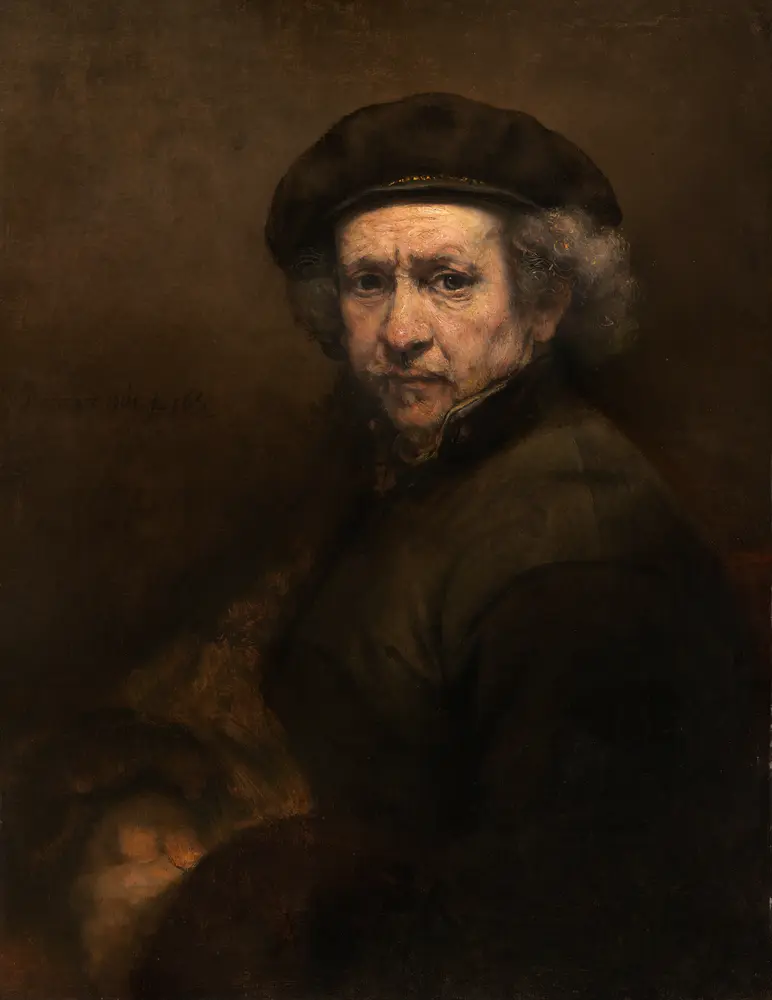
Self-portraiture has always served a dual purpose: it allows artists to practice their craft without the expense of a model, and it allows them to position themselves within the artistic traditions of their time. Rembrandt's self-portraits, which trace his trajectory from a confident young painter to an aging master facing bankruptcy, are among the most sustained self-examinations in the history of art. Anna Dorothea Therbusch, one of the few women admitted to the Prussian Academy of Arts in the 18th century, used her self-portrait to present herself as an intellectual, surrounding herself with books and instruments that challenged the assumption that women painters were merely decorators. For an overview of self-portraiture traditions, the Uffizi Galleries in Florence hold one of the most significant collections of artist self-portraits in the world.
In the modern era, self-portraiture expanded beyond likeness into a vehicle for exploring identity itself. Maria Lassnig's body-awareness paintings, which depict her own physical sensations rather than her outward appearance, challenge the assumption that a portrait must show what a person looks like. The current Kunsthaus Zurich exhibition pairing Lassnig with Edvard Munch demonstrates how self-portraiture can become a tool for existential investigation, a way of using the self as a subject for understanding the human condition.
Intimacy and the Private Portrait
Not all portraits were designed for public display. The Gemaldegalerie exhibition includes a section on family, friendship, and intimacy that reveals a very different tradition. Sofonisba Anguissola's portrait of her mother, Bianca, shows a woman engaged with her daughter's work rather than posing formally for a commission. Eugen Spiro's portrait of his wife from 1929 captures a private moment of affection. These works served as personal mementos rather than public statements, and they reveal a tradition of portraiture that valued psychological truth over social performance. Portraits of the deceased, also included in the exhibition, served a different kind of memorial function, offering a final image of someone who had passed.
The private portrait tradition has its own conventions, though they are less rigidly codified than those of court portraiture. Intimate portraits tend to be smaller in scale, more informal in pose, and more attentive to the sitter's expression than to their clothing or accessories. They often show the sitter in a domestic setting rather than against a neutral background, and they frequently depict the subject engaged in an activity rather than simply posing. The Rijksmuseum in Amsterdam holds outstanding examples of this tradition, particularly in the work of 17th-century Dutch painters.
How the Digital Era Transformed Portraiture
The questions that the Berlin exhibition raises about identity, self-presentation, and the reading of faces are not confined to painting. The selfie, the profile picture, and the video call have created a world in which everyone is both a portraitist and a sitter, making dozens of visual decisions every day about how to present themselves to an audience. The conventions that took centuries to develop in painting, the careful choice of pose, angle, lighting, and setting, are now compressed into seconds, but the underlying logic remains the same. We still use these visual tools to communicate who we are, where we belong, and what we want others to see. The Tate in London has explored this connection in recent exhibitions that trace the portrait tradition from painting to photography to digital media.
Understanding the history of portraiture gives us a vocabulary for understanding the images we make and consume every day. When you choose a profile picture, you are making decisions about pose, lighting, and setting that would have been recognizable to a Renaissance painter. When you crop a photograph to show your face in three-quarter profile rather than full face, you are drawing on conventions established by artists like Rogier van der Weyden. The difference is that today everyone has access to the tools of portraiture, and the stakes of self-presentation are both more democratic and more complex than they have ever been. The relationship between painting and photography has been central to portraiture since the medium was invented in the 19th century. Early photography adopted the conventions of painted portraiture, using the same poses, settings, and lighting that painters had developed over centuries. Julia Margaret Cameron's photographic portraits from the 1860s deliberately imitated the look of Renaissance paintings, using soft focus and dramatic lighting to create images that were meant to be read as art rather than documentation. As photography became more accessible, painted portraiture increasingly distinguished itself through scale, material, and the physical presence of the artist's hand, while photography took over the functions of record-keeping and commemoration that painting had once served. Understanding this history helps explain why painted portraits continue to matter in an age when a photograph can be taken in seconds. A painted portrait is not a more accurate likeness but a more considered one, the result of hours of observation and decision-making that no camera, however sophisticated, can replicate. For more on how artists have used their own image as a medium, see the artworld.today guide to Van Gogh's signatures, which traces how one painter used self-portraiture as a form of artistic self-inscription.
The Berlin exhibition, by showing how these conventions developed, helps visitors understand not only the history of portraiture but also the visual culture they inhabit right now. For those interested in exploring how portraiture intersects with contemporary art practice, the recent Brancusi exhibition at the Neue Nationalgalerie offered a parallel case study in how an artist's self-presentation through sculpture and photography shaped the reception of their work. And for a broader look at how visual conventions travel across art forms, the artworld.today feature on Trevor Paglen examined how contemporary artists work at the intersection of visual culture, surveillance, and portraiture.