Why Van Gogh Signed His Paintings Simply as Vincent
A new study reveals Van Gogh signed only 16% of his canvases, used red paint for most signatures, and chose his first name for deeply personal reasons
The Surprising Numbers Behind Van Gogh's Signatures
Vincent van Gogh created around 1,000 paintings, of which 840 survive. Of these, only 133 bear a signature, or in two cases just an inscribed title. This represents merely 16% of his canvases, an unusually low proportion for a 19th-century artist. His colleague Paul Gauguin signed 60% of his paintings, perhaps an indication of his overbearing confidence. These figures come from a new study by Amsterdam-based art historian Julia Engelmayer, published online by the Van Gogh Museum, which offers the first detailed investigation into why and how Van Gogh used his signature across his entire career.
The study, titled Simply Vincent: An Overview of Van Gogh's Signed Paintings, reveals that Van Gogh is unusual not only in how rarely he signed but in that he signed with just his first name. This practice was not accidental or casual. It reflected deep personal tensions within his family and practical considerations about how his name functioned across the different cultures where he lived and worked, from the Netherlands to Belgium to France.
Why Only Vincent, Not Van Gogh
Van Gogh had two reasons for signing with only his first name. The first was personal. His relations with most of his family, and particularly his father, were strained throughout his adult life, though he remained close to his brother Theo, who supported him financially and emotionally. In a December 1883 letter to Theo, Vincent wrote that "in character I'm quite different from the various members of the family, and I'm actually not a Van Gogh." This sense of alienation from his own surname drove him to distance himself from the family name on his canvases, creating a visual identity separate from the lineage he felt disconnected from.
The second reason was practical. Only the Dutch can easily pronounce his family name, with its guttural "ogh." The English tend to say "Gof," the Americans "Go," and the French "Gog." As Vincent explained in March 1888 in another letter to Theo, he wanted just his Christian name to appear in a Belgian exhibition catalogue. It should be "the way I sign it on the canvasses, i.e. Vincent and not Vangogh, for the excellent reason that people here wouldn't be able to pronounce that name." The decision to sign as Vincent was thus both an act of rebellion and an act of accessibility.
The Predominant Colour: Red
Another surprise in Engelmayer's study is the predominant colour Van Gogh used for his signatures: red. This appears on 75 of the 133 signed works, just over half. It was uncommon for artists of the period to sign in such an eye-catching colour, since signatures were typically meant to identify authorship without competing with the composition. Since Van Gogh was a reticent signer, it may seem curious that when he did sign, he used an almost overbearing colour.
The explanation lies in Van Gogh's fascination with colour contrasts and complementary colours, a theory he studied extensively. In his Seascape near Les Saintes-Maries-de-la-Mer (June 1888), he admitted that he was playing with arresting hues: "There's a very outrageous red signature, because I wanted a red note in the green." Red and green are complementary colours, directly opposite each other on the colour wheel. The signature was not just a mark of authorship but a compositional element, a deliberate chromatic intervention in the painting itself that demonstrates how Van Gogh thought about every mark on the canvas.
Angled Signatures and the Horseshoe V
Most artists sign their work horizontally, but over half of Van Gogh's signatures are set at an angle, often around 45 degrees. A striking example is Portrait of Dr Felix Rey (January 1889), depicting the doctor who treated him after he mutilated his ear in Arles. Engelmayer suggests that sometimes angled signatures are "intended to create imbalance and a sense of unrest" in his striking compositions, reflecting the psychological turbulence that characterized both his work and his life.
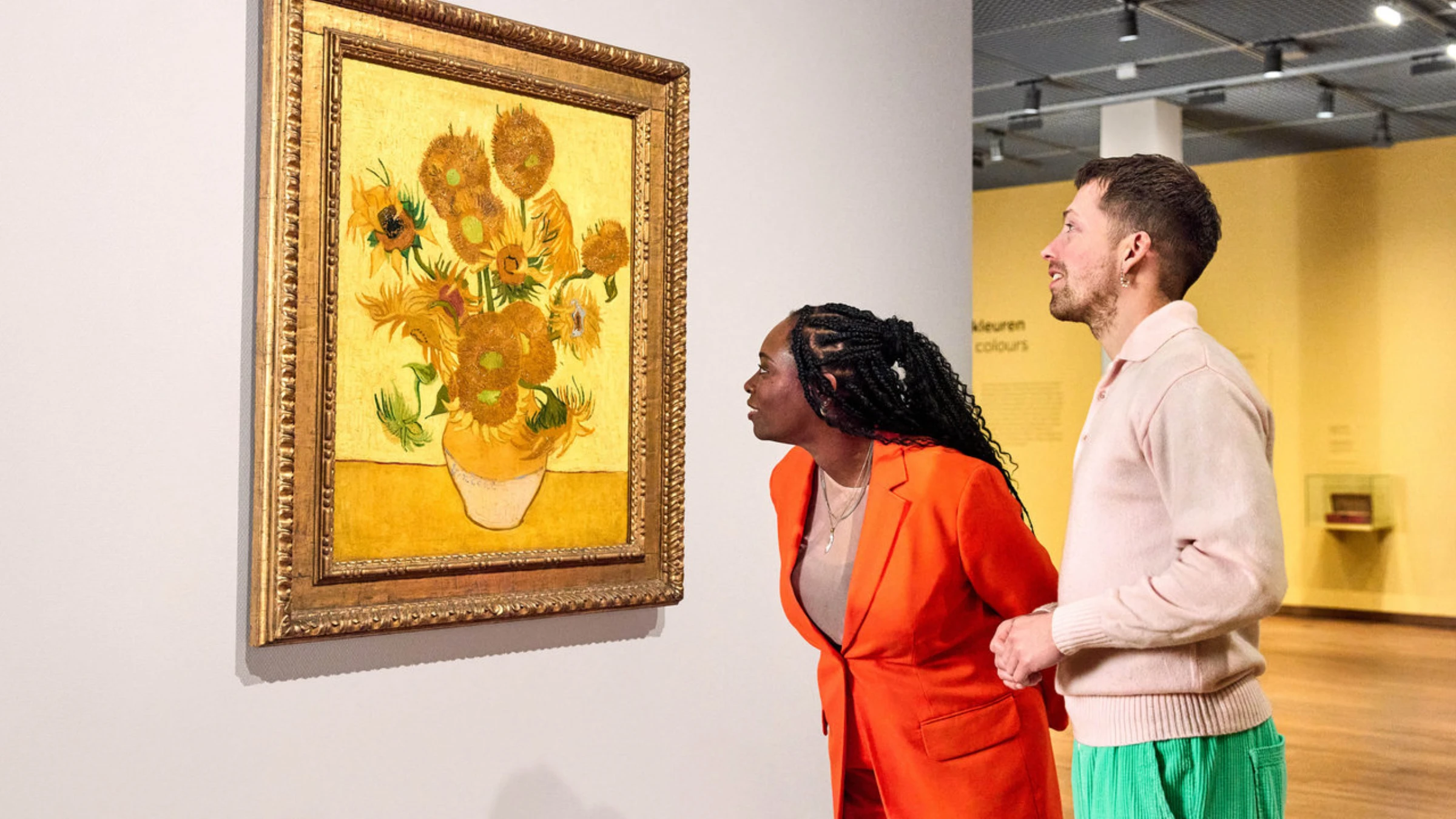
Another distinctive feature is Van Gogh's use of a horseshoe-shaped V in 31 paintings from his Arles period. Examples include a portrait of his friend Joseph Roulin entitled The Postman (January 1889) and his famous Sunflowers series (1888), now housed at the National Gallery in London. This stylized V became a personal marker, as recognizable to those who know his work as the paintings themselves, and it evolved throughout his career from a simple letter into a deliberate artistic motif.
Where Van Gogh Placed His Signatures
Most of Van Gogh's signatures appear in the corners of his canvases, but very occasionally he would sign an element within the actual composition. On his sunflower paintings, he proprietorially inscribed his signature on the pot, emphasising that the sunflower was his own special motif. On Van Gogh's Chair (December 1888), the signature is placed on a curious box at the back of the composition, the meaning of which remains obscure since it is unclear whether it contains sprouting onions or flower bulbs.
These embedded signatures suggest that when Van Gogh did sign, he thought of the signature as part of the painting rather than an external addition. The contrast with conventional practice, where signatures sit apart from the composition in a corner, reflects his broader refusal to separate art from life. For Van Gogh, even the act of signing was an artistic decision, one that could reinforce the painting's meaning or add a layer of personal symbolism.
When and Why Van Gogh Signed
There were two main reasons why Van Gogh signed a painting. The first was when he was particularly pleased with a work and believed it might possibly sell. The second was when it was a gift for a friend or family member. Both reasons connect signing to a sense of completion and purpose, making the unsigned paintings all the more poignant in retrospect.
Many paintings now regarded as his masterpieces were never signed. These unsigned works include Starry Night (June 1889), now at New York's Museum of Modern Art, perhaps the most famous painting in the world. Other unsigned masterpieces include The Night Cafe (1888) at the Yale University Art Gallery and The Sower (1888) at the Van Gogh Museum in Amsterdam. The absence of a signature on these works adds a layer of melancholy to their history, suggesting that Van Gogh himself did not recognize them as his finest achievements.
The Timeline of Van Gogh's Signatures
Although Van Gogh's earliest oil paintings date from 1882, he only began adding signatures in 1884. He signed 17 works in Nuenen, where he lived with his parents. It was in Paris, where he stayed with Theo from February 1886 to February 1888, that he was most prolific in signing, with 57 paintings. Based in the world's art capital, Van Gogh pursued his hope of exhibiting and selling his work, though sales eluded him.
After his move to Arles in the south of France, he signed 50 paintings, but fewer in the last few months following the ear mutilation in December 1888. At the asylum at Saint-Remy-de-Provence, signing became rare, with only seven paintings. At the end of his life, during his short stay in Auvers-sur-Oise under the care of Dr Paul Gachet, he signed only one of his 73 paintings. The declining frequency of signatures traces the arc of his artistic ambition and his deteriorating mental state, from the hopeful Paris years to the final weeks when he produced some of his most powerful work but no longer bothered to claim it with his name.
The Red Vineyard and the Only Sale
As Vincent wrote to Theo in August 1888 from Arles: "I'd begun to sign my canvases, but I soon stopped; it seemed too silly to me." This may have been a way of telling Theo that he was becoming increasingly despondent about selling his work. In fact, the only identified painting Van Gogh ever sold during his lifetime was completed ten weeks later, The Red Vineyard (November 1888), now at the Pushkin Museum in Moscow. It remained unsigned, a quiet rebuke to the notion that commercial success and artistic achievement move in tandem.
Today, when a Van Gogh painting comes up for sale at Christie's or Sotheby's, the auction houses go out of their way to stress if it is signed. For those with the funds, few things impress guests more than owning a canvas with the simple inscription, Vincent. The irony would not have been lost on the artist, who sold one painting in his lifetime and signed it with a name he did not fully claim as his own. The Van Gogh Museum's study reminds us that behind every signature lies a story of ambition, alienation, and the complicated relationship between an artist and his own name, and that the absence of a signature can speak as loudly as its presence.
Engelmayer's research also opens new avenues for authentication and provenance studies. The detailed catalogue of Van Gogh's signatures, including their colour, placement, angle, and stylistic features, provides a reference work that could help identify forged signatures on works falsely attributed to the artist. At a time when Van Gogh remains one of the most faked artists in history, with authentication disputes regularly making headlines, the systematic documentation of his signing habits offers a valuable tool for scholars, collectors, and authentication committees. The study confirms that Van Gogh's signatures were as individual and deliberate as his brushwork, and that understanding them is essential to understanding the man who painted them.