How to Read Abstract Painting: A Guide for Curious Viewers
A practical guide to understanding abstract painting, from color field and geometric abstraction to gestural expression and strategies for looking critically
What Abstract Painting Actually Is
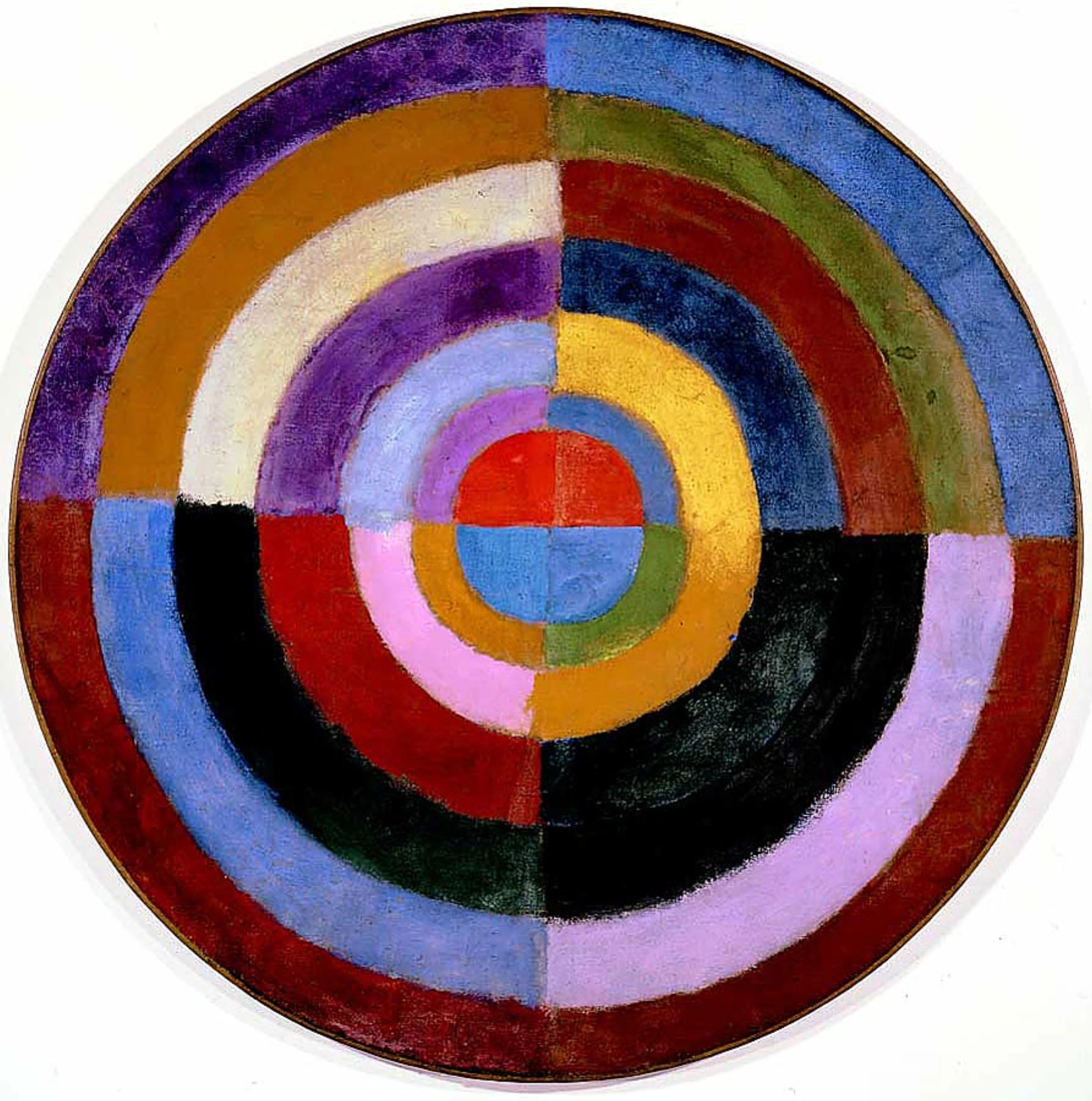
Abstract painting is art that does not attempt to depict the visible world. Instead of showing you a landscape, a face, or a still life, it uses color, shape, line, texture, and composition to create meaning. This sounds simple enough, but the experience of standing in front of an abstract painting can be disorienting, especially if you are accustomed to looking at art for what it represents rather than what it does. The first thing to understand is that abstract painting is not a single style. It is a broad category that encompasses geometric hard-edged work, gestural expressionism, color field painting, minimalism, and everything in between. Robert Delaunay's Premier Disque, painted in 1913, is often cited as one of the first fully abstract works in Western art, a circle of concentric color rings with no reference to observable reality. It looks simple, but it was radical for its time, and it opened a door that generations of painters have been walking through ever since.
The history of abstract painting is usually traced to the early 20th century, when artists in Europe and Russia began experimenting with non-representational forms. Wassily Kandinsky, Frantisek Kupka, Hilma af Klint, and Kazimir Malevich each arrived at abstraction through different routes, but they shared a conviction that art could express ideas and emotions without depicting objects. Malevich's Black Square, painted in 1915, was perhaps the most extreme statement of this conviction, a single black quadrilateral on a white field that declared the end of representation and the beginning of a new artistic language.
The Major Movements and What They Were Doing
To read abstract painting with confidence, it helps to know the major movements and what they were trying to achieve. Geometric abstraction, practiced by artists like Piet Mondrian, Theo van Doesburg, and later Joseph Albers, uses precise mathematical forms and primary colors to create order and harmony. Mondrian's grid paintings, with their black lines and blocks of red, blue, and yellow, are the most recognizable examples. They look austere, but they represent a deeply held belief that pure form and color could express universal truths.
Abstract Expressionism, which emerged in New York in the 1940s and 1950s, took a radically different approach. Artists like Jackson Pollock, Willem de Kooning, and Mark Rothko used scale, gesture, and color to create works that were immersive and emotional. Pollock's drip paintings are records of physical movement, Rothko's color fields are meditations on depth and luminosity, and de Kooning's slashed canvases are tensions between figuration and abstraction held in unstable balance. What they shared was a commitment to the canvas as an arena for action and feeling rather than a surface for depiction.
Color field painting, associated with Rothko, Helen Frankenthaler, Morris Louis, and Kenneth Noland, used large expanses of unmodulated color to create atmospheric, contemplative experiences. The staining technique Frankenthaler developed, pouring thinned paint directly onto unprimed canvas, allowed color to soak into the fabric, creating soft edges and a sense of depth that seemed to come from within the painting itself. These works reward slow looking. They do not yield their meaning quickly, and they are best understood as paintings you spend time with rather than paintings you decode.
Strategies for Looking at Abstract Painting
So how do you actually read an abstract painting? Start with the physical facts. What is the scale of the work? A painting that is six feet tall affects you differently than one that is twelve inches tall. Pollock's poured canvases require you to move along them, scanning left and right, while Agnes Martin's subtle grid paintings demand you stand still and let your eye adjust. The relationship between your body and the painting is part of the content.
Next, attend to color. Not what the colors represent, but how they interact. Are they complementary, creating vibration at the edges where they meet? Are they analogous, sliding smoothly from one to the next? Are they saturated and intense, or muted and atmospheric? Mary Heilmann, whose death was announced this week, was a master of color interaction. Her paintings used color the way a musician uses harmony, creating sequences and contrasts that produce emotional effects without naming the emotions directly. As The Art Newspaper noted in its obituary, Heilmann brought joy, emotion, and freedom to abstract painting, reshaping how we think about Minimal and Post-Minimal art.
Then look at the surface. Is it smooth or textured? Are brushstrokes visible, or has the artist worked to eliminate them? A painting by Brice Marden, with its smooth encaustic surfaces and looping linear forms, asks to be read differently than a painting by Frank Auerbach, where the paint is piled so thick it casts shadows. The surface is not incidental. It is part of how the painting means.
Finally, consider the composition. Is it symmetrical or asymmetric? Does it have a center, or is the interest distributed across the whole surface? Geometric abstraction often uses symmetry and grids to create stability, while gestural abstraction tends toward asymmetry and all-over composition. Neither approach is inherently better, but they produce different kinds of attention and different relationships between the viewer and the work.
The Question of Meaning in Non-Representational Art
The most common question about abstract painting is: what does it mean? The honest answer is that it means what it does. A Rothko painting means the experience of standing in front of it and letting color wash over you. A Mondrian means the dynamic tension between vertical and horizontal lines, between blocks of color and empty white space. A Heilmann means the way her titles, her color choices, and her loose, gestural brushwork combine to tell a story without narrating one.
This does not mean abstract painting is purely subjective or that any interpretation is as good as any other. Abstract paintings are made with specific intentions, within specific historical contexts, using specific materials and techniques. Understanding those intentions, contexts, and techniques enriches your experience of the work. But the work itself does not decode to a single meaning. It is designed to produce an experience, and that experience is the content.
The best way to develop your eye for abstract painting is to look at a lot of it, in person when possible. reproductions flatten texture, reduce scale, and distort color. Standing in front of a painting at the Museum of Modern Art, the Whitney Museum, or the Dia Beacon, or the San Francisco Museum of Modern Art is a fundamentally different experience from looking at an image on a screen. The physical encounter with the work, its scale, its surface, and its color in real space is where abstraction lives and where it can be most fully understood. Museums and galleries provide the essential context for this encounter, and the best institutions design their installation choices, from wall color to lighting to sequencing, to support the kind of sustained attention that abstract painting requires.
Common Misconceptions and How to Move Past Them
One persistent misconception is that abstract painting is easy, that anyone could do it. In fact, the best abstract painters spent decades developing their craft, their eye, and their conceptual framework. Heilmann trained as a ceramicist at UC Berkeley under Peter Voulkos before she ever picked up a brush in New York. Rothko painted representational works for years before arriving at his color field format. Mondrian's grid paintings were the result of a decades-long process of simplification that began with naturalistic landscapes. The apparent simplicity of abstraction is usually the result of rigorous distillation, not a lack of skill.
Another misconception is that abstract painting is dead, that it was a modernist project that has been superseded by conceptual art, installation, and digital media. In fact, abstract painting remains one of the most vital and continuously evolving practices in contemporary art. Artists like Heilmann, Laura Owens, Mark Bradford, Julie Mehretu, and Etel Adnan have expanded the language of abstraction in ways that connect it to personal narrative, political critique, and cross-cultural exchange. The idea that abstraction is a closed chapter reflects a narrow reading of art history that privileges certain movements and certain voices over others.
The most productive approach to abstract painting is to treat it as a conversation. The painting offers something, color, form, scale, surface, title. You bring something, attention, patience, curiosity, willingness to sit with uncertainty. The meaning is not in the painting alone or in you alone. It emerges in the encounter between the two. That is what makes abstract painting endlessly rewarding and endlessly challenging. It asks you to participate in making meaning rather than simply receiving it. Learning to do that is not a matter of expertise. It is a matter of practice.
The next time you stand in front of an abstract painting and feel lost, remember that the feeling is part of the process. Abstract painting asks you to slow down, to look carefully, and to tolerate uncertainty long enough for the work to reveal itself. That patience is a skill, and like any skill, it gets better with practice. Start with the physical facts, move through color and surface, and let the meaning emerge from the encounter. The painting is waiting for you.