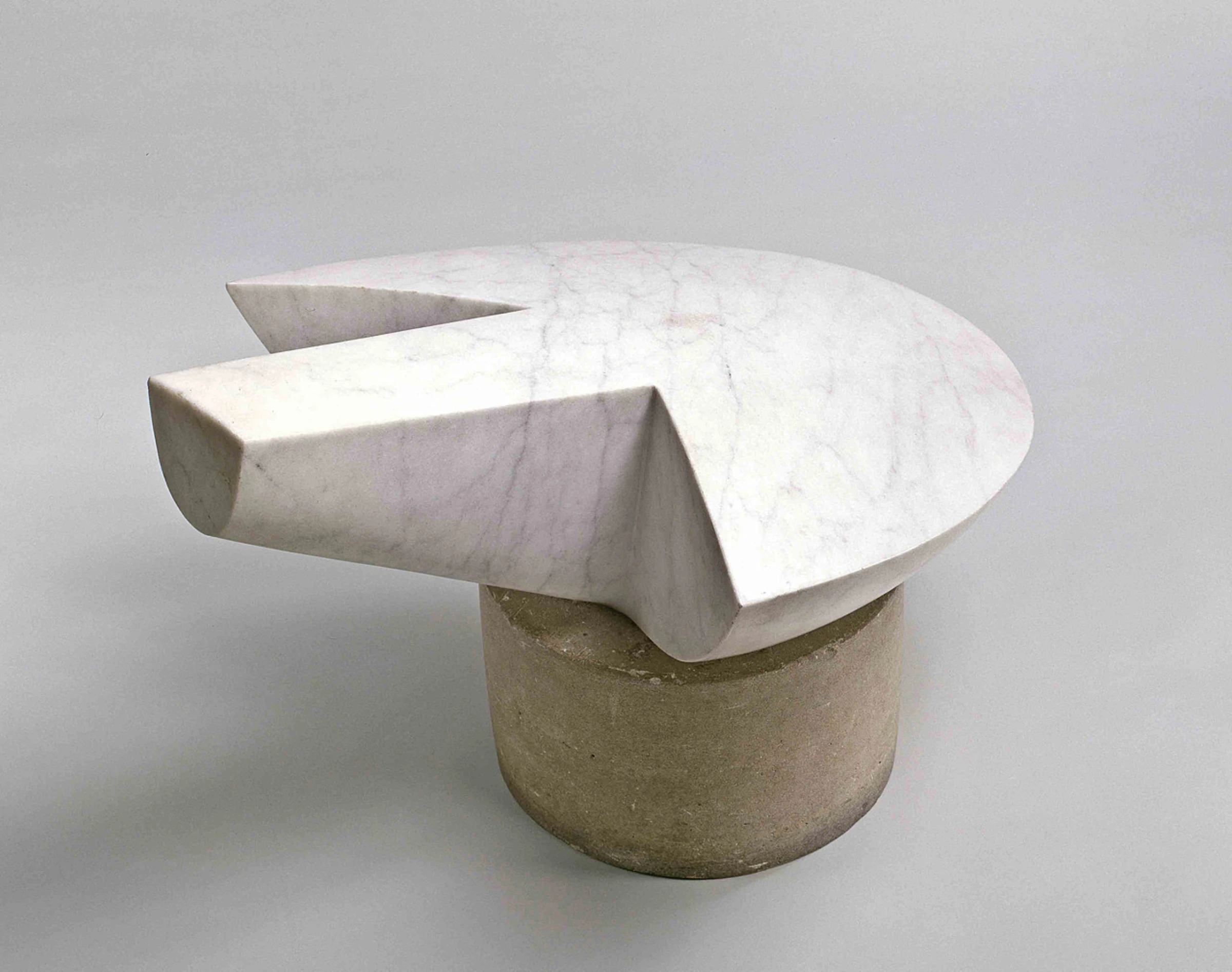
Brancusi Gets His First Major German Show in 50 Years
Neue Nationalgalerie and Centre Pompidou team up for 150-plus works including a partial reconstruction of the sculptor's Paris studio
A Sculptor Rediscovered in Berlin
Constantin Brancusi (1876-1957) is getting the kind of attention that a figure of his stature should command but has not always received outside France. The Neue Nationalgalerie in Berlin, in cooperation with the Centre Pompidou in Paris, has mounted the first major exhibition of Brancusi's work in Germany in over 50 years. With more than 150 sculptures, photographs, drawings, films, and rarely seen archival materials from the Centre Pompidou and other public and private international collections, the exhibition offers the most extensive survey of Brancusi's multifaceted work to date. The show runs through the summer and fall of 2026 at the iconic Mies van der Rohe building in Berlin, a setting whose own modernist severity provides a fitting architectural frame for Brancusi's reduced forms. The building itself, with its glass walls and open plan, creates an environment where sculpture can be seen in natural light that changes throughout the day, a condition Brancusi himself considered essential to the experience of his work.
The exhibition includes key works such as The Kiss, Bird in Space, Sleeping Muse, and Endless Column alongside a partial reconstruction of Brancusi's legendary studio, shown outside of Paris for the first time since its bequest to the French state in 1957. The studio reconstruction is particularly significant: Brancusi carefully arranged his sculptures in his Montparnasse workspace, treating the studio itself as a total artwork. Visitors to the Neue Nationalgalerie can now walk through a version of that carefully staged environment, experiencing the relationships between works as the sculptor intended them to be seen. The reconstruction also includes Brancusi's own photographs of the studio, which show how he used changing light conditions to alter the appearance and mood of his sculptures throughout the day. These photographs reveal an artist who was not only a sculptor but also a photographer and filmmaker of considerable skill, using those media to document and extend the sculptural experience.
From Romania to Paris and Beyond
Brancusi began his career with traditional academic training in Romania before developing his own distinctive style in Paris starting around 1907. His arrival in Paris coincided with the ferment of early modernism, but Brancusi refused to align himself with any single movement. He rejected Auguste Rodin's influence despite a brief assistantship in the older sculptor's studio, choosing instead to carve directly from stone and wood rather than model in clay for bronze casting. This decision placed him outside the dominant sculptural practice of his time and established the terms for a career built on reduction and material honesty. The break with Rodin was not merely a technical preference but a philosophical position: where Rodin built form through accumulation and gesture, Brancusi sought it through subtraction, carving away until what remained was the essential core of the subject.
His organic forms, progressively reduced to their essential volumes, established him as a pioneer of sculptural abstraction in the early 20th century. His continuous search for an artistic ideal is reflected in the formal variations of a few central motifs, played out across decades and across materials including bronze, marble, plaster, and wood. A single subject like Bird in Space generated more than 20 versions over the course of 30 years, each one a distinct exploration rather than a replica. The same is true of The Kiss, Sleeping Muse, and the Endless Column, motifs that Brancusi returned to repeatedly, each time adjusting angle, material, scale, and surface treatment. The Berlin exhibition traces this process of variation across more than a century of work, allowing viewers to see how the same basic form generates radically different results when translated from limestone to polished bronze, or from tabletop scale to monumental column.
Brancusi masterfully employed pedestals, light, movement, photography, and film to stage his sculptures. He photographed his own studio obsessively, documenting how light moved across surfaces at different times of day. These photographs, many of which are included in the Berlin exhibition, reveal an artist who understood that a sculpture's context was as important as its form. The pedestals Brancusi carved for his works were not neutral supports but integral elements of the sculptures themselves, a radical break from the convention of treating the base as separate from the artwork. This integration of object and support has influenced sculptors from Carl Andre to Donald Judd and remains one of the most consequential aspects of his practice, one whose implications are still being worked out in contemporary sculpture.
The Christie's Hook and MoMA's Parallel Display
The ARTnews feature that drew renewed English-language attention to Brancusi this spring noted that even Nicole Kidman could not resist the pull of his work. The actress visited Christie's galleries at Rockefeller Center and found herself captivated by Danaide (1913), a bronze and gold leaf sculpture that was offered at auction. The short film Christie's produced captures the same quality that the Neue Nationalgalerie exhibition aims to convey: the immediate, sensual authority of Brancusi's surfaces, the way polished bronze and carved marble seem to generate their own light. The Danaide auction and its celebrity staging was a useful reminder that Brancusi's work, despite its historical distance, retains a power to arrest viewers who encounter it without prior preparation.
The Neue Nationalgalerie show is not the only institution turning to Brancusi this year. The Museum of Modern Art in New York has mounted its own display of Brancusi's oeuvre and studio, drawing from its substantial holdings. MoMA's relationship with Brancusi goes back to the museum's early years, and the institution has long been a key site for the reception of modernist sculpture in the United States. The simultaneous attention from two major institutions on opposite sides of the Atlantic suggests a reconsideration of Brancusi's place in the canon, one that moves him from a specialized interest into broader public awareness. The fact that both institutions are choosing to emphasize the studio alongside the works signals a shift in how museums present modernist sculpture, moving away from isolated object display toward a more contextual approach that includes process, environment, and the artist's own staging decisions. For visitors who have only seen Brancusi's work in reproduction, the studio reconstruction offers a chance to understand how the sculptures functioned as an ensemble, each work responding to and modifying the others in a carefully composed spatial arrangement that Brancusi maintained and adjusted for decades.
Why Brancusi Still Matters
The exhibition is curated by Klaus Biesenbach and Maike Steinkamp of the Neue Nationalgalerie, with Ariane Coulondre and Valerie Loth from the Centre Pompidou. It is made possible by FREUNDE der Nationalgalerie, the major support organization for the institution, and is held under the joint patronage of Frank-Walter Steinmeier, President of the Federal Republic of Germany, Emmanuel Macron, President of the French Republic, and Nicusor Dan, President of Romania. That level of diplomatic backing signals how seriously European cultural institutions take Brancusi's legacy, and the collaboration between a German museum and a French one, incorporating works from a Romanian-born artist who spent his career in Paris, is itself a statement about how cultural heritage crosses national boundaries in ways that politics often cannot.
While Brancusi's work has always been respected by scholars and curators, the broader public in Germany has had limited exposure to it. The Neue Nationalgalerie explicitly frames the exhibition as corrective, noting that while Brancusi's work is widely recognized in France, the artist remains relatively unknown to the broader German public. This is a remarkable gap given Germany's own powerful sculptural tradition, from Wilhelm Lehmbruck to Joseph Beuys, and the exhibition aims to fill it by giving Brancusi the attention he deserves in a country where his influence has been felt but his work rarely seen in depth.
What makes Brancusi contemporary is not influence on a single school or movement but his demonstration that reduction is not the same as simplification. His Bird in Space is not a bird with parts removed. It is a proposition about what sculpture can be when it stops describing the world and starts operating on its own terms. The famous customs case of 1927, when US officials classified a Bird in Space as a manufactured metal object rather than a work of art, subjecting it to a 40 percent tariff, reads today as a parable about how radical reduction confuses systems built on recognition. The case went to trial, and Brancusi won, with the court ultimately acknowledging the work as fine art. That decision has become a touchstone in discussions about what counts as art and who gets to decide, a question that has lost none of its urgency in the century since.
The Berlin exhibition, with its studio reconstruction and 150-plus works, gives viewers the chance to trace how Brancusi arrived at that proposition through decades of variation and refinement. The supporting programme of artistic and academic events, all free and open to the public, extends the conversation beyond the gallery walls. For anyone interested in the trajectory of modern sculpture, from the early carved heads to the late polished bronzes, this is the exhibition of the year, and likely the most complete Brancusi show that will be mounted in our lifetime.