Ukraine’s Museums Took the Blast Too
Damage at NAMU, the Chornobyl Museum and other Kyiv sites shows again that attacks on Ukrainian culture are part of the war’s logic, not collateral noise.
The point of striking museums is not symbolic by accident. It is symbolic on purpose.
Russia’s latest assault on Kyiv damaged the National Art Museum of Ukraine, the Ukrainian National Chornobyl Museum, the Ukrainian House exhibition hall, the Taras Shevchenko Institute of Literature and other cultural sites alongside homes, markets and civic infrastructure. Artnet’s reporting makes clear that this was not a marginal footnote to a military event. The cultural damage belongs at the center of the story because wars over territory are also wars over memory, legitimacy and the right to narrate a people to itself. When windows, skylights, walls and stored collections are hit, the target is not simply property. It is the institutional machinery that keeps history visible.
Ukraine’s museums have lived with this logic for years. They have hidden works, sent material abroad, reinforced buildings and developed emergency routines that no museum should need in peacetime. Those measures show competence and resolve, but they should not be romanticised. A museum forced into constant defensive posture is being diverted from scholarship, display, education and care into survival management. Every strike drains time, staff energy and public attention. The miracle is not that institutions are unharmed. It is that they still function at all.
The weekend attack again exposed the asymmetry at the heart of cultural preservation in wartime. Curators can wrap objects, move crates, close galleries and fortify glass. They cannot stop a missile. That means every successful act of protection takes place inside a broader structure of vulnerability. Once we understand that, the language of collateral damage stops being adequate. Repeated attacks on cultural sites do not merely happen near museums. They make museums newly fragile as public memory systems.
NAMU and the Chornobyl Museum show two different kinds of cultural harm
At the National Art Museum of Ukraine, the 40,000-work collection reportedly remains safe, but the institution’s 130-year-old building suffered heavy blows to windows, skylights and plaster and has closed indefinitely while authorities assess the damage. That matters because architecture is not separate from collection care. Light, moisture and temperature stability are part of whether art can be displayed, studied and preserved. Even when objects survive the blast itself, the damaged shell around them can generate secondary conservation crises. A closed museum also loses public time, revenue, educational momentum and the ordinary civic rhythm that keeps culture embedded in daily life rather than emergency discourse.
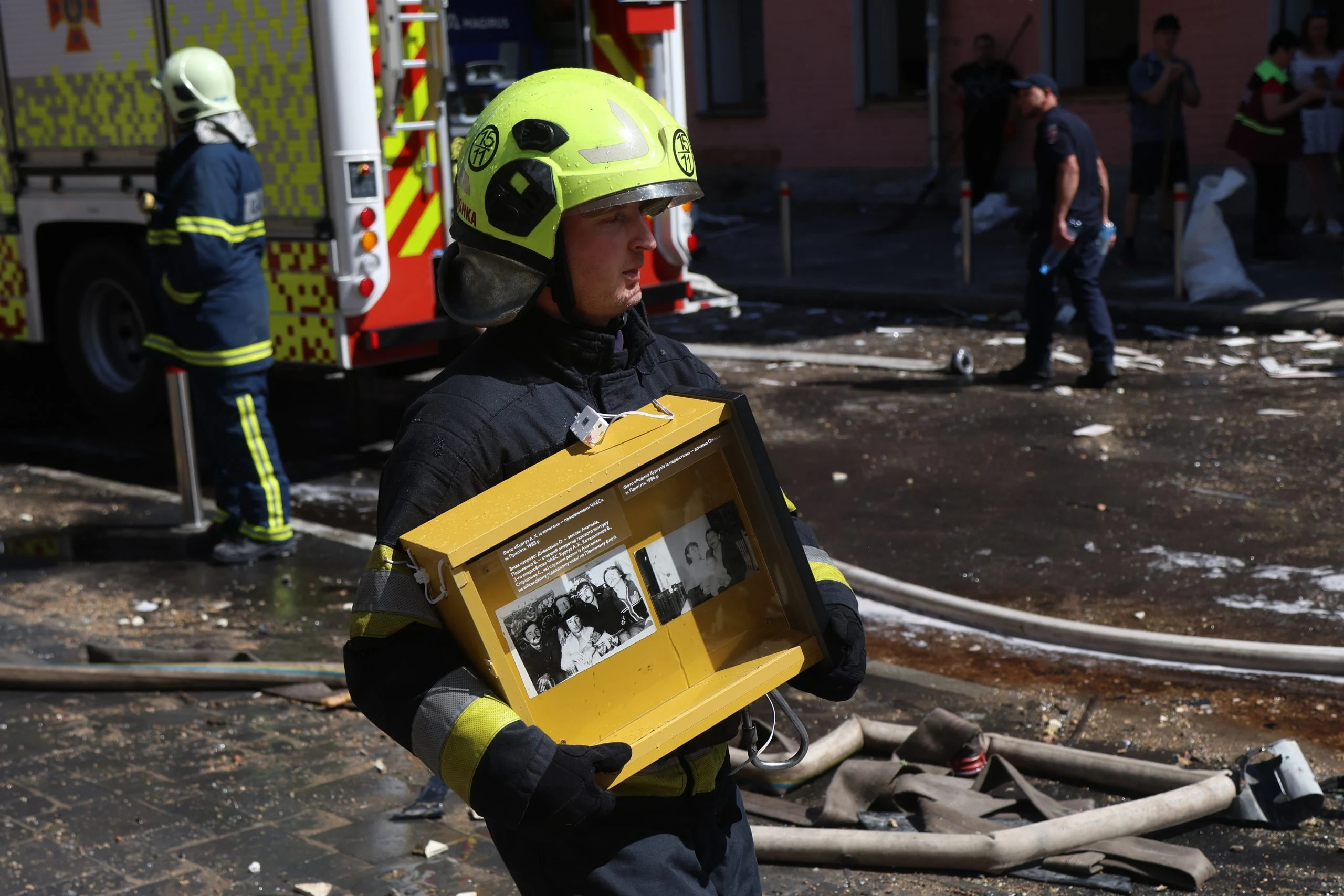
The Chornobyl Museum represents another layer of meaning. According to Ukrainian officials cited in the Artnet report, the strike effectively destroyed a newly renovated institution dedicated to preserving the history of the 1986 nuclear catastrophe and its aftermath. That is not just one more museum closed by war. It is an attack on a site devoted to documenting one of the region’s defining state traumas, a place where secrecy, disaster and political memory are already the subject. Ihor Klymenko’s line about Russia once covering up the truth of Chornobyl and now striking the institution that preserves it is sharp because it identifies continuity. Control over memory remains part of the method.
The rescue of roughly 40 percent of the Chornobyl Museum’s stored collection, including work by Maria Prymachenko and the Ukrainian flag raised at Chornobyl in 2022, is an act of institutional courage. But we should be careful about the stories we tell around rescue. Heroism is real. It is also what people are forced into when basic cultural security has collapsed. The proper response is admiration joined to anger, not admiration used as a substitute for naming the violence clearly.
Cultural infrastructure is part of civilian infrastructure
There is a temptation in wartime reporting to split hospitals, schools and housing from museums, as though the latter belong to a secondary register of concern. That hierarchy is too neat. Museums, archives and literary institutes are civilian infrastructure because they shape how a society teaches itself, argues with itself and transmits continuity across generations. A strike on a museum is not equivalent to a strike on a residential tower, but neither is it a luxury loss to be discussed only after the urgent damage is done. Societies under attack need food, shelter and medicine. They also need evidence of themselves.
Ukraine has understood this for years. That is why institutions have continued to mount exhibitions, share collection stories and insist that cultural life remains active even under bombardment. Such persistence is not decorative morale management. It is part of national defense in the broadest sense. An occupied or terrorised public is easier to dominate if its memory institutions disappear, its artists scatter permanently and its cultural record becomes inaccessible except through exile.
This also explains why international museum solidarity must go beyond statements. Loans, conservation partnerships, emergency materials, training, digital storage support and sustained public attention all matter more than generic expressions of concern. Readers may remember artworld.today’s earlier coverage of the pressure on Russian memory institutions. The Ukrainian case is starker because the threat is kinetic, but the through-line is the same: control over institutions of memory is a cultural and political objective, not a side issue.
The rebuilding question starts before the bombs stop
One of the hardest truths about cultural damage in war is that repair planning cannot wait for peace. Conservation assessments, emergency documentation, claims records, temporary relocations and building stabilisation all need to begin immediately because moisture, exposure and displacement create new losses after the strike itself. For NAMU, the closure period will be about more than replacing broken fabric. It will require deciding how and when to make the building safe, how to protect the collection during uncertainty and how to preserve public trust when normal visitation is impossible.
The same is true at smaller sites such as galleries, markets and literary institutes caught in the same attack radius. Large national museums draw headlines, but urban cultural ecosystems depend on a mesh of institutions with less visibility and thinner reserves. When windows shatter at a market newly designated as heritage or a gallery that has just opened a project, the financial and psychological consequences can be severe. War damage does not need to destroy a place outright to interrupt its future.
International funders should therefore think beyond the spectacular ruined facade. What Ukraine needs is patient support for the mundane middle zone between emergency salvage and grand reconstruction: glazing, environmental controls, packing, transit, legal documentation, digital cataloguing and staff retention. Those are the invisible systems that keep cultural life from hollowing out while the war continues.
Why these attacks must be read as attacks on the future
The easiest mistake outsiders make is to treat cultural damage as a matter of past loss. A museum hit by missiles seems to represent endangered history, and it does. But the deeper wound is future-facing. Every time an institution closes, scales back or diverts its energy into crisis management, the public loses future exhibitions, future scholarship, future educational encounters and future occasions to tell a national story on its own terms. Cultural destruction narrows what tomorrow’s citizens will be able to inherit directly.
That is why the language used by Ukrainian officials is so forceful. They are not describing isolated accidents. They are describing an attempt to damage the continuity of cultural self-recognition. A country asked to defend itself militarily is also being asked to defend archives, walls, memories and symbolic places that let the idea of the country remain concrete. Museums are where a people can encounter itself outside propaganda and outside immediate survival. To hit them is to try to thin that encounter out.
The response should be equally clear. The latest strike on Kyiv did not merely interrupt museum operations. It attacked the institutions through which Ukraine stores public memory, proves historical continuity and imagines life after war. That is why preserving them matters now, not later. The future that reconstruction will one day promise can only be rebuilt if the memory infrastructure survives enough of the present to remain legible.
One more point deserves emphasis. The institutions hit in Kyiv are not interchangeable symbols that can simply be folded into a general reconstruction narrative later. Each one holds a different piece of Ukraine’s cultural argument: fine art, literary memory, urban heritage, exhibition infrastructure, disaster history. When several are damaged in a single strike cycle, the cumulative effect is not additive but compounding. Staff are stretched across multiple emergencies, visitors are cut off from several kinds of public culture at once, and the city’s confidence in ordinary cultural continuity is shaken. That is why documentation, stabilization and international support have to move at the speed of the damage rather than at the speed of diplomatic routine.
This pattern of targeting memory is not exclusive to this latest cycle of attacks, but it is being perfected. By disrupting the physical sites of memory, an aggressor does more than damage stone; they create a vacuum of continuity. International bodies like the Blue Shield have long worked to protect cultural property in conflict zones, but as the nature of warfare shifts toward hypersonic systems and drone swarms, the threshold for what is considered a protected site is effectively lowered. When the National Art Museum of Ukraine is forced to close indefinitely, it is a signal that the city’s cultural heart is being put into a forced coma, delaying the process of recovery and reintegration long after the missiles stop falling.