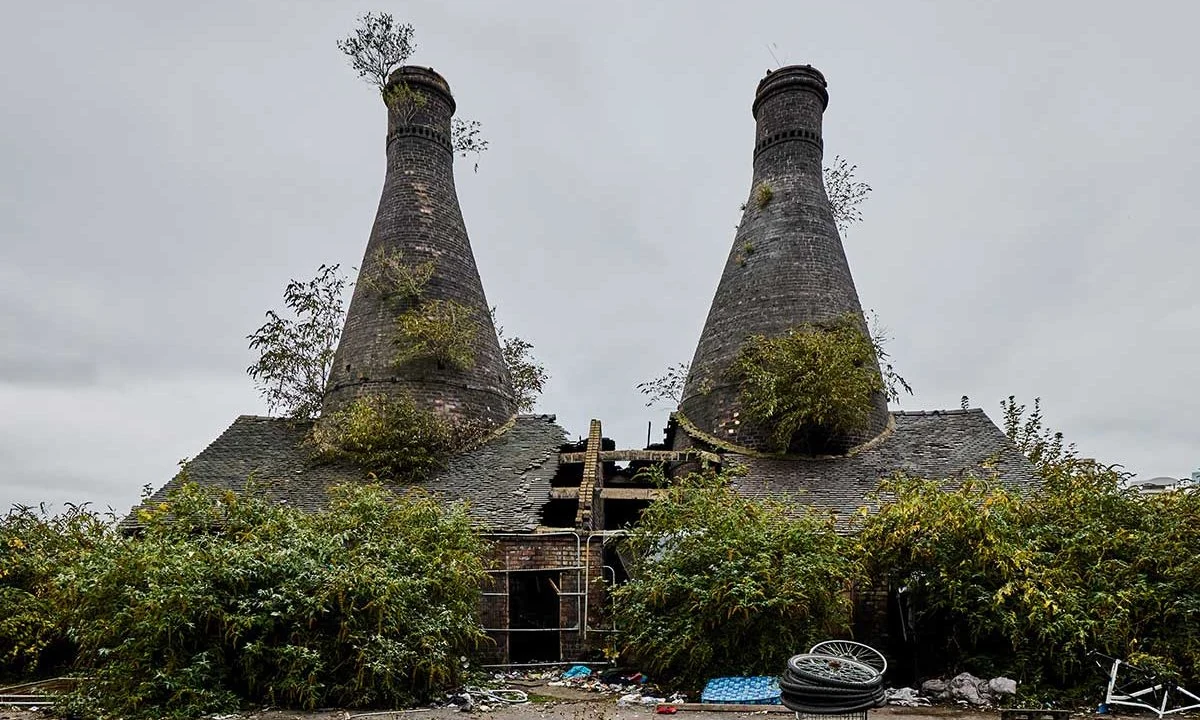
Stoke-on-Trent Declares a Heritage Emergency
Stoke-on-Trent says £325 million is needed to rescue its collapsing ceramics landscape, turning a local preservation fight into a national cultural test.
Stoke-on-Trent Has Finally Said the Quiet Part Out Loud
Stoke-on-Trent has stopped pretending that ordinary maintenance can save the landscape that made it famous. As The Art Newspaper reports, the city council has issued an emergency appeal for support to rescue the industrial fabric of the Staffordshire Potteries, warning that dozens of buildings tied to Britain's ceramics history are slipping into irreversible decline. The numbers are blunt. More than 275 listed buildings, 22 conservation areas and over 1,500 locally significant sites sit inside the city, with at least 16 major heritage assets already formally classed as at risk. The council says around £325 million will be needed over the next decade, including as much as £150 million for the Chatterley Whitfield colliery complex alone. That is not a heritage footnote. It is a declaration that one of Britain's most important craft geographies has been left to rot long enough.
The emergency matters beyond local pride because Stoke is not an obscure provincial case. Wedgwood, Spode and Royal Doulton helped define the city's global reputation, and the bottle ovens, pot banks and factory compounds that remain are the physical evidence of that history. Lose the buildings and you do not simply lose picturesque industrial shells. You lose the spatial record of how labor, design, manufacturing and export once combined to make ceramics central to British cultural and commercial identity. The council is therefore asking central government, funders and investors to treat the city's built heritage as a national responsibility rather than a niche local burden.
The Potteries Became World Famous. Their Ruins Now Expose a Policy Failure
What makes the Stoke case so damning is the contrast between symbolic importance and practical neglect. The city entered its centenary year in 2025 with renewed attention, yet the celebratory mood only sharpened the comparison with places that have protected ceramics more seriously. Jon Rouse pointed directly to Sèvres, Limoges, Icheon and Jingdezhen as examples of ceramics centers that enjoy stronger national recognition, investment and institutional framing. Those places understand that craft heritage is not sentimentality. It is infrastructure, education, tourism, research and industrial memory braided together.
Stoke has fragments of that ecosystem, and some of them are genuinely strong. Middleport Pottery has shown that adaptive reuse can keep an industrial site alive without bleaching out its working-class texture. The redevelopment of the Spode site has likewise offered a more practical model of mixed creative and commercial reuse than the usual fantasy that heritage can be saved by museumification alone. But those islands of progress now sit inside a wider field of collapse. Forty-seven bottle ovens survive from a historic total of around 2,000. That ratio tells you almost everything.
Why the £325 Million Ask Is About More Than Bricks
The best part of the council's argument is that it refuses to reduce restoration to nostalgia. The point is not to embalm Stoke as a heritage park for visitors in search of soot-darkened romance. It is to stop visible dereliction from becoming the permanent civic language of a city that already absorbed the collapse of ceramics, coal and steel employment. When abandoned pot banks crumble in plain sight, residents are being told every day that the outside world no longer considers their history worth investing in. That symbolic message has economic consequences. It affects confidence, private investment, education and the credibility of any attempt to present Stoke as a serious cultural destination.
There is also a governance issue hiding in the weeds. Much of the industrial heritage sits in private hands, which means preservation collides with ownership structures that often lack either capital or long-range purpose. Photographer Phil Crow, whose project Fortyseven documents the last remaining ovens, notes that listed status can trap owners between regulatory obligation and financial incapacity. Specialist repairs are expensive, and neglect accelerates quickly once roofs fail, masonry opens and fire risk rises. In other words, the market will not fix this on its own. That is precisely why the emergency has to be named as political, not merely technical.
The Strongest Futures for Stoke Will Mix Memory, Use and Local Control
There are reasons not to treat the city as doomed. The council has already committed more than £6.5 million toward safeguarding the Wedgwood Institute, Burslem Indoor Market and other key assets, while plans for Queen's Theatre and Hanley Town Hall suggest a willingness to imagine cultural and mixed-use futures instead of sterile preservation. Stoke's recent World Craft City designation gives the city another platform from which to argue that ceramics heritage belongs in a contemporary creative economy, not just in commemorative literature. If the city can convert that designation into a stronger case for UNESCO Creative Cities attention, the emergency may yet become leverage rather than epitaph.
The bigger risk is that regeneration rhetoric will save shells while emptying out the labor history that gave them meaning. Post-industrial cities are routinely offered a familiar deal: preserve the skyline, import flexible cultural branding and hope cafés plus apartments will substitute for a serious civic economy. Stoke needs something tougher. Restored buildings have to support education, apprenticeships, small manufacturers, archives, museum interpretation and public access if they are going to carry the Potteries story honestly. Otherwise the city will be left with a polished version of remembrance that flatters visitors while severing heritage from the working knowledge that made it matter in the first place.
Still, a rescue shaped only from above would repeat older mistakes. Andy Perkin of the Potteries Heritage Society is right to insist that local people have to be part of the long-term structure, not decorative consultees wheeled in after funders arrive. Industrial heritage projects fail when they become extraction machines for consultants, developers or prestige branding. They work when residents, craftspeople, historians and small cultural organizations can shape the uses that follow stabilization. We saw a related lesson in our recent coverage of how institutions lose legitimacy when they dodge public stakes. Preservation without public ownership of meaning is only half a strategy.
Britain Now Has to Decide What Kind of National Treasure It Means
The Stoke appeal lands so sharply because it converts a local maintenance problem into a test of national seriousness. Britain has long enjoyed the prestige of its ceramic history in the abstract. Museums, collectors and design histories all trade on that prestige. The harder question is whether the country will fund the places where that history was actually made, especially when those places sit outside the easiest tourist and donor circuits. If the answer is no, then the national story about valuing craft starts to look suspiciously selective.
That is why the council's phrase "heritage emergency" should not be heard as rhetoric. It is an accurate description of what happens when significance outruns maintenance for too long. Buildings do not wait for policy cycles. Roofs fail, kilns are demolished without explanation, fires cut through already weakened sites and each loss makes the surviving landscape harder to read. Stoke-on-Trent is asking for money, yes, but also for a decision. Either Britain treats the Potteries as active cultural infrastructure worth saving at scale, or it accepts that one of its defining craft landscapes will survive mainly as archive, anecdote and regret.
The city has reached the point where incremental sympathy is useless. What it needs now is a funding settlement, a coherent planning framework and a preservation strategy blunt enough to admit that sentiment has been abundant while stewardship has been thin. If that comes together, Stoke could still turn its ruins into a harder, more honest model of cultural regeneration. If it does not, the next generation will inherit a story about the Potteries with fewer and fewer places left to stand in it.
There is a wider lesson here for British cultural policy. The state is often happy to celebrate design history once it has been safely transferred into museum collections, coffee-table publishing and export branding, but far less willing to fund the messy landscapes where that history was produced. Stoke exposes that hypocrisy because its heritage is too large, too damaged and too entangled with class politics to be hidden behind one flagship museum. Saving the Potteries will require accepting that industrial culture is not secondary to fine-art prestige. It belongs in the same national conversation as major galleries, stately houses and metropolitan landmarks. If ministers and funders are serious about regional culture, this is where they can prove it with money rather than sentiment.
The decision will also shape how younger artists and designers understand the relation between craft history and contemporary practice. If the surviving factories, institutes and civic buildings continue to collapse, Stoke risks teaching future generations that industrial knowledge matters only once it has been detached from its place of making. That would be a severe cultural loss. Ceramics is not merely a chapter in decorative arts history. It is a living field of techniques, labor struggles, material science and regional identity. Preserving the Potteries therefore supports present-tense cultural production as much as historical remembrance.
There is no shortage of language available to describe Stoke's importance. What has been missing is a funding model proportionate to that importance. If national bodies continue to ask the city to prove its worth through ever more reports, partnerships and branding exercises before serious capital arrives, the process itself will become part of the damage. Emergency means the evidence stage is over. The surviving buildings have already made the argument. The question now is whether Britain can still recognize cultural infrastructure when it appears in brick, kiln and workshop form rather than in the polished vocabulary of metropolitan redevelopment.