Sanya Kantarovsky Opens a Venice Show Against Easy Redemption
At Palazzo Loredan in Venice, Sanya Kantarovsky turns guilt, childhood and damaged spirituality into one of Biennale season's harsher side shows
Basic Failure lands in Venice as a collateral show with real bite
During Biennale season, Venice fills with side exhibitions that want some of the traffic without much of the risk. Sanya Kantarovsky's Basic Failure, now open at Palazzo Loredan, is not one of them. The show arrives with the atmosphere of a collateral event and the psychic pressure of something less eager to please. Kantarovsky has installed paintings and sculptural interventions around images of children, damaged sanctity, shame and vulnerability, using Venice's religious and architectural density not as décor but as an irritant. The official presentation at the Istituto Veneto di Scienze, Lettere ed Arti runs through 22 November, giving the season one of its less marketable and more memorable propositions. The artist's own profile at kaufmann repetto confirms the broader trajectory behind the show: a painter whose work has steadily grown in institutional reach without losing its emotional abrasiveness.
Kantarovsky has built a career on figures who look both intimate and unstable, as if memory had painted them after sleep but before explanation. In Venice that instability acquires extra force. The show title points to failed translation, failed care and the residual guilt that shadows both. Kantarovsky links the phrase to psychoanalysis and, in the Guardian interview, to the parent's inevitable inability to satisfy the child completely. In a city where Christian iconography saturates facades, chapels and civic ritual, that emotional grammar becomes larger than biography. Failure is not just personal embarrassment here. It becomes theological atmosphere, social inheritance and a condition of looking.
Why Kantarovsky matters in a Biennale ecology crowded with statements
Biennale weeks reward artists who can produce immediate symbolic clarity. The press cycle likes positions that can be summarized fast, photographed cleanly and repeated without much residue. Kantarovsky works against that economy. His paintings tend to produce recognition first and interpretation later, if at all. A child shielding a face, a toy panda treated like a ruined relic, a fallen centaur suspended between myth and slapstick: these are not images that flatten willingly into message. They ask for a longer, stranger kind of attention, and that stubbornness is part of why the Venice context suits him.
That resistance matters in 2026 because Biennale-adjacent art is increasingly legible before it is experienced. Visitors arrive with advance narratives, fair gossip and the pressure to turn every room into content. Kantarovsky offers a reminder that ambiguity can still function as structure rather than atmosphere. The figures in Basic Failure do not present themselves as symbolic ambassadors for some larger curatorial thesis. They feel bruised by contradictory impulses: attraction, guilt, tenderness, humiliation, prayer, withdrawal. In Venice, where so many exhibitions seek moral or geopolitical scale, that concentration on the awkward interior life of images can feel almost radical.
Kantarovsky's Venice show also benefits from the fact that the work is not trying to summarize itself for the season. Viewers who arrive hunting for the one-line takeaway may find the exhibition withholding, but that withhold is productive. The paintings keep slipping between tenderness and accusation, between caricature and grief. Even the show's title sounds both self-lacerating and diagnostic, as if artistic failure were not an exception but the condition under which meaning is produced. In a city thick with declarative curatorial statements, that refusal to become a slogan gives the work unusual staying power.
There is a market story here too, though it should remain secondary to the art. Galleries have every reason to value painters who can command institutional respect while producing recognizable iconography, yet Kantarovsky has not simplified the work to meet those incentives. His figures still look awkward, overworked and psychically split. That choice matters because Venice routinely flatters artists into monumental coherence. Kantarovsky instead keeps embarrassment inside the picture. He lets the body sag, wince and shield itself. That resistance to polish is part of what makes the exhibition feel timely rather than merely tasteful.
There is also the question of timing. Kantarovsky is no longer emerging, but he remains one of those artists whose importance is often registered in whispers rather than broad institutional consensus. The Guardian notes his recent rise through shows in Turin, Zurich and Tokyo. This Venice presentation pushes that trajectory forward without sanding off what makes the work difficult. For art-world audiences used to equating prominence with polish, the show serves a useful corrective. Kantarovsky's paintings still feel risky because they are willing to look unresolved, even faintly abject, at the moment when many artists are encouraged to look brand-consistent.
The Palazzo Loredan setting sharpens the show's theology of embarrassment
Palazzo Loredan is not a neutral box, and Kantarovsky seems to understand exactly how to use that. The old interiors, dark floors and rooms lined with books make the exhibition feel less like an installation dropped into Venice than a conversation with a site already crowded by historical authority. According to the official event description, the show focuses on the human figure and themes of spirituality, alienation and vulnerability. Those terms could sound generic elsewhere. In this building they narrow into something more exact: the drama of what happens when private shame enters rooms built for institutional dignity.
The relation to Venice's religious image culture is especially sharp. Churches and devotional pictures across the city train visitors to read gestures through doctrines of guilt, mercy and redemption. Kantarovsky borrows some of that visual pressure while denying the comfort of resolution. Faces hide, bodies slump, creatures fall, and the paintings seem to remember shame more vividly than salvation. That does not make the work anti-religious so much as unwilling to let inherited forms of grace tidy up psychic damage. For a city built on ceremonial splendor, that is a quietly subversive stance.
It is also worth watching how younger painters respond. Kantarovsky has shown that figuration can stay narratively open without dissolving into atmosphere or retreating into deadpan irony. His paintings remain social, but not illustrative; literary, but not staged like book covers. In an art market still crowded with figurative work calibrated for instant legibility, this kind of pressure-cooked ambiguity feels increasingly rare. Venice gives that difference a wider audience, and Basic Failure makes a strong case that Kantarovsky deserves it.
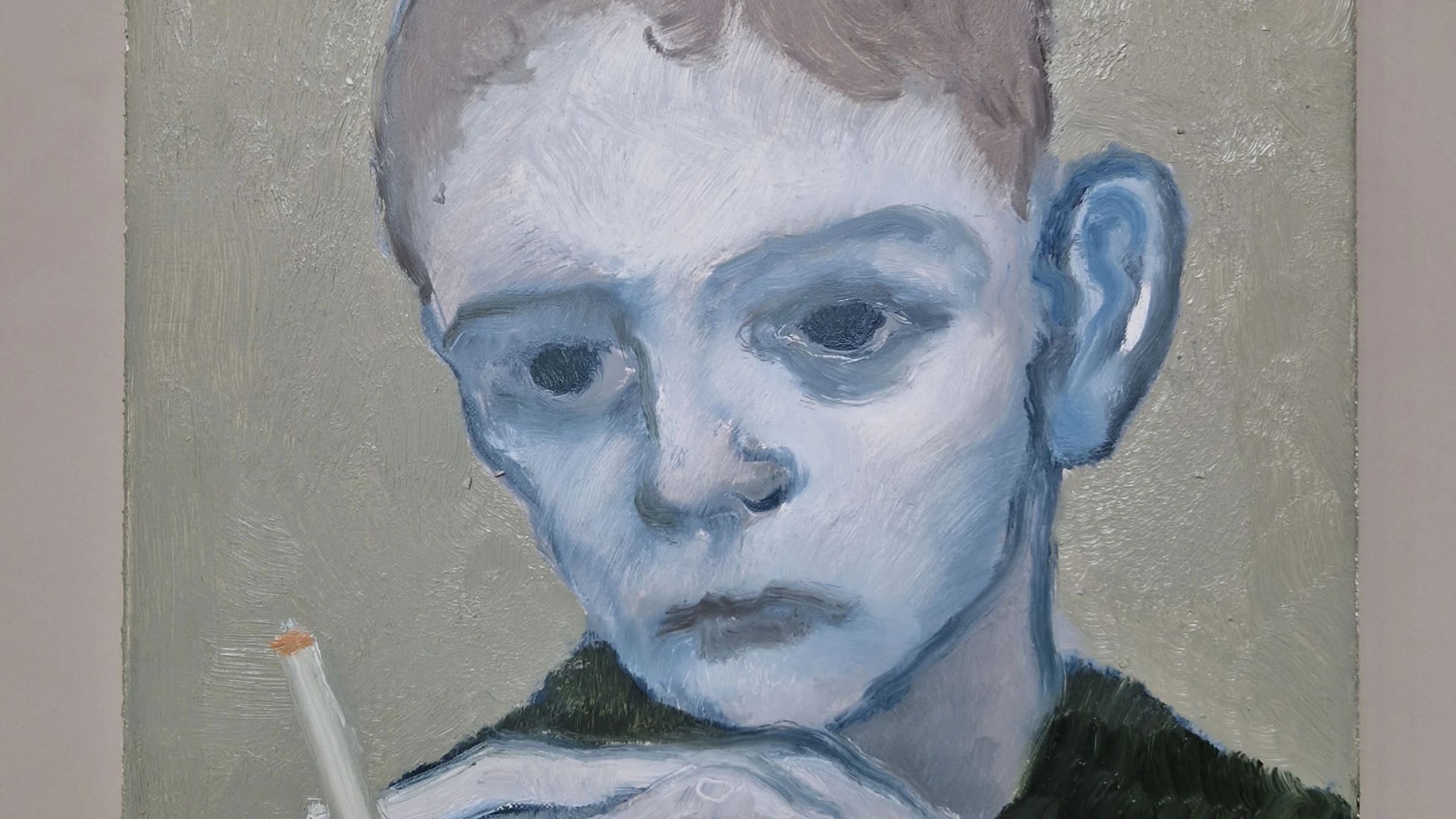
The specific works described in the Guardian piece suggest an artist calibrating tone very carefully. Boy With Cigarette offers a pale, uneasy child whose fingers curl around an unlit cigarette with a tenderness that feels both comic and fatalistic. The recreation of a Renaissance bust marked by the body of a dead spider turns devotional beauty into a scene of contamination. Death of a Centaur expands that emotional field onto a larger scale, producing a mythic image that still reads as socially embarrassed, as if transcendence had tripped on the way out. Kantarovsky repeatedly stages moments when grandeur and indignity occupy the same frame.
What this side show says about Venice right now
Venice this year has already produced its share of institutional tension and political theater, much of it recorded in artworld.today's earlier report on Biennale protests and crisis management. Against that backdrop, Basic Failure does not read as escapism. It reads as a subtler account of brokenness, one that treats moral damage as something embedded in ordinary looking rather than only in public slogans. That distinction is useful. Not every serious exhibition needs to reproduce the declarative style of institutional politics. Sometimes it is enough to show how guilt, fear and longing remain stored in bodies, gestures and inherited images.
Kantarovsky himself told the Guardian that he listens to the painting like a Ouija board. The phrase sounds whimsical until you see what it permits. It suggests an artist willing to follow ambiguity rather than discipline it too early. That method can easily collapse into mannerism, but here it appears to keep the work alert to surprise. The paintings do not merely illustrate ideas about psychoanalysis or religion. They seem to discover those ideas while resisting them, which is why they retain tension after the first interpretation arrives.
That may be the most useful standard for reading the show. Not whether every image yields a stable interpretation, and not whether the exhibition can stand in for the season, but whether it keeps thought active after you leave the room. Basic Failure does. It reopens questions about culpability, tenderness and the comic edge of humiliation without settling them into statement pieces. Venice offers plenty of exhibitions that tell viewers what position to admire. Kantarovsky offers something rarer: a show that keeps uncertainty morally charged, visually exact and difficult to forget once the city's noise closes back over it.
What comes next is less a market question than an institutional one. Will museums treat this Venice outing as evidence that Kantarovsky deserves bigger, riskier contexts, or will they continue to value him mainly as an artist people in the know already admire? Basic Failure makes the safer path look inadequate. It shows an artist using Venice not to become grander, but to get stranger and sharper inside a city already overloaded with cultural theater. That is harder to monetize than spectacle, but it is also what gives the exhibition its afterlife. Long after visitors forget the smoother collateral shows of the season, Kantarovsky's wounded figures are likely to keep needling them.