Borghese Expansion Plan Meets Roman Backlash
Rome's Borghese Gallery wants more room for visitors, but heritage critics say a new annex would damage one of Italy's most intact cultural settings
Rome's most controlled museum experience could become a construction site
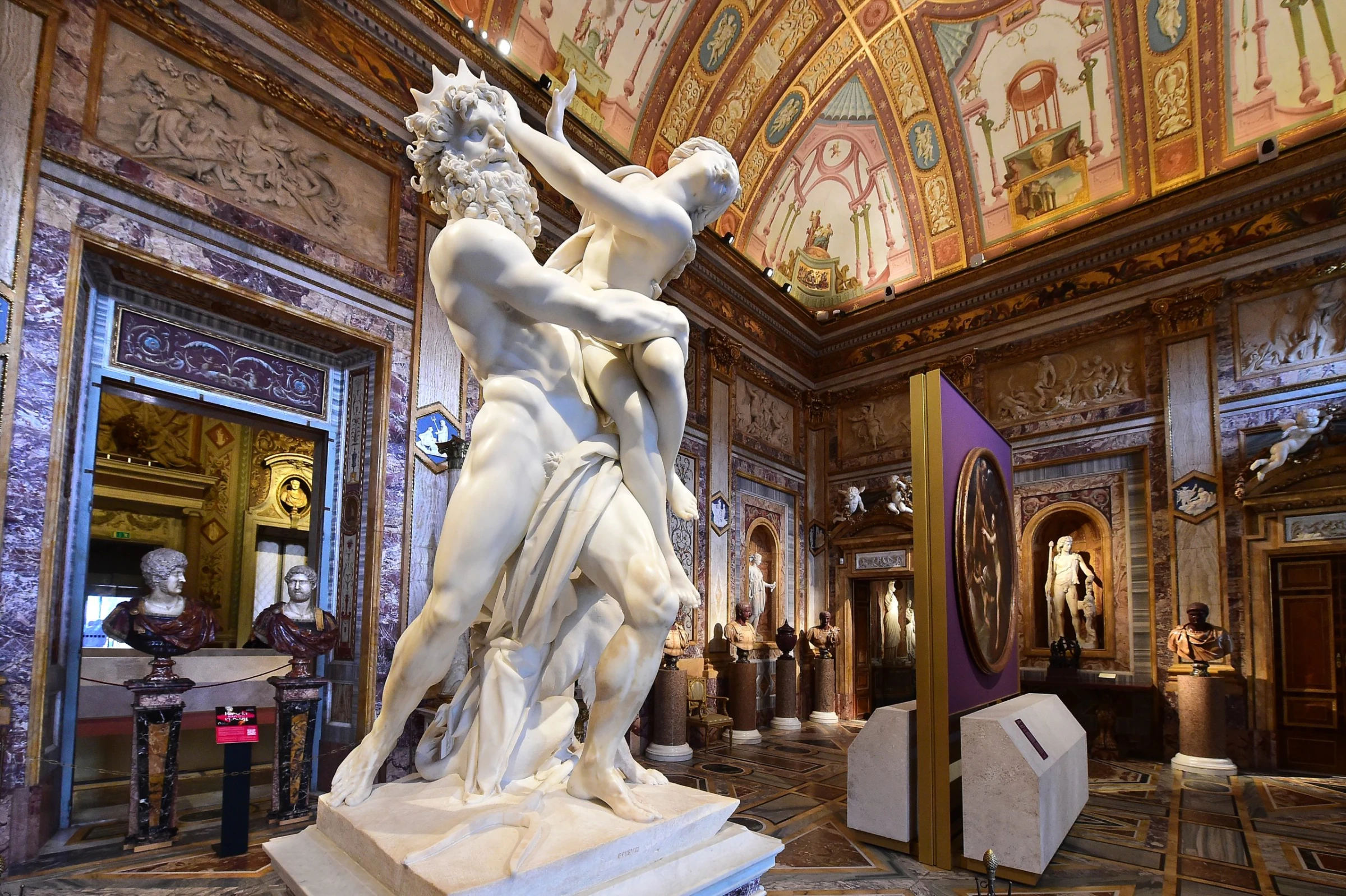
The Galleria Borghese has built its modern reputation on controlled scarcity. Timed entries, strict two-hour visits and an unusually intimate relationship between masterpiece and viewer have turned the Roman villa into one of Europe's rare museums where crowd management still feels like part of the aesthetic experience rather than an afterthought. That is why the institution's emerging plan to build an adjacent facility has triggered such immediate resistance. According to Artnet News, the museum wants more space to show works in storage and to accommodate a larger public. Critics hear something harsher: a demand that one of Italy's most coherent museum environments submit to tourism logic.
The proposal is still at an early stage. Earlier this year the 17th century institution commissioned an engineering feasibility study, and a press conference is expected on May 19. A museum spokesperson described the process as purely administrative for now, which is bureaucratic language for saying the political weather is being tested before the real battle begins. Yet in a city like Rome, the distinction between administrative and symbolic action rarely holds for long. Once expansion is floated around a landmark embedded in a historic garden, the argument quickly stops being technical. It becomes a referendum on what kind of cultural infrastructure Italy still believes is worth protecting from itself.
The Borghese case is really about whether capacity should outrank character
The museum's practical case is easy to understand. Visitor demand has risen sharply. Artnet reports that the Borghese welcomed more than 630,000 visitors in 2025, roughly 25 percent more than in 2015, while its present capacity remains capped at 360 visitors admitted in staggered time slots. The logic of expansion follows from that mismatch. Rome's tourism economy continues to intensify, museums everywhere want to activate hidden holdings, and administrators are under steady pressure to translate public attention into visible access. More rooms promise more tickets, more breathing space and a more flexible exhibitions calendar.
But the Borghese is not a neutral shell that can be efficiently scaled up. It is a designed totality: villa, gardens, route, collection and atmosphere locked together over centuries. Works by Bernini, Caravaggio, Titian, Correggio and Raphael are not simply housed there. They are encountered through an architecture of pacing, compression and release that newer museum planners cannot reproduce by adding a useful box next door. The current limitations are frustrating, but they are also constitutive. To visit the Borghese is to submit to a spatial order that disciplines the museum body. Expansion threatens to convert that discipline into throughput.
This is what heritage groups are reacting to when they reject the project before detailed plans are even public. Their concern is not nostalgia for inconvenience. It is the suspicion that once a site begins to justify alteration through visitor volume, every subsequent decision tilts toward optimization. Extra capacity becomes the metric that explains parking, signage, retail, circulation and programming. The museum may still talk about scholarship and access, but the built result often reads like a service upgrade for tourism first and an art historical judgment second.
The official Galleria Borghese website still presents the museum through the language of the historic villa, its collection and its temporary exhibitions, not through the promise of a future campus. That gap between the institution's inherited identity and its possible development agenda is central to the backlash. Critics are not opposing an ordinary capital project. They are opposing a shift in what the museum imagines itself to be.
Critics are using unusually blunt language because the site is unusually fragile
Opposition has formed quickly and publicly. Friends of Villa Borghese, a nonprofit, denounced the proposal on Facebook and called for the idea to be stopped outright. Tomaso Montanari, who has spent years making himself a sharp public critic of heritage compromise in Italy, framed the plan as part of a broader culture of expansionism. His line about the logic of a hypermarket is effective because it names the fear precisely: that museum administrators now speak the language of growth even when dealing with places whose value depends on scale, proportion and historical restraint. The insult lands because everyone understands the alternative. A hypermarket exists to process bodies. The Borghese exists to slow them down.
Rome City Council has tried to cool the temperature, noting that no final decision has been taken and that technical and economic evaluations still lie ahead. That reassurance matters less than officials may hope. Once the public imagines a new structure touching the villa's setting, abstract feasibility language cannot restore trust. Italian heritage politics has taught observers that projects often arrive wrapped in modest administrative phrasing before revealing the scale of their architectural ambition. Skepticism is therefore rational, not reactionary.
The most revealing fact in the entire dispute may be that both sides are using the language of preservation. The museum says more space is needed to properly present works long held in storage and to manage crowds without degrading the visit. Opponents say the expansion would degrade the very environment that gives the museum its legitimacy. Neither side is arguing for neglect. They are arguing about what exactly deserves to be preserved: object access or site integrity, latent collection value or the hard-won wholeness of the place itself.
Even the museum's exhibition program complicates the expansion argument. Recent shows, including the Louise Bourgeois exhibition at the Borghese, have demonstrated that the villa can host contemporary interventions precisely because the historical setting is so charged and specific. The institution's distinctiveness comes from friction between old container and new reading. If expansion weakens that charge, the museum may gain square footage while losing the condition that makes ambitious programming matter.
Italian museums are under pressure to modernize, but not every masterpiece wants a growth strategy
The Borghese fight belongs to a larger European pattern. Major museums are expected to do everything at once: increase attendance, broaden public programming, activate storage, host contemporary interventions, satisfy tourists, maintain scholarly credibility and remain photogenic enough for digital circulation. Expansion is the standard managerial response because it promises to solve contradictory demands with square footage. Yet in old cultural landscapes, square footage is never neutral. Every meter built near a historic villa or garden rewrites the balance between artwork, patronage history and the urban imagination.
Italy is especially exposed to this tension because its museum holdings are so deeply fused with historic fabric. In places like Rome, Florence and Venice, institutions are rarely stand-alone containers. They are often inseparable from villas, palazzi, ecclesiastical complexes and streetscapes whose meaning exceeds the objects they contain. That makes conventional museum-growth rhetoric unusually clumsy. A temporary exhibitions annex or visitor center that might seem uncontroversial elsewhere can look like a conceptual error when applied to a site whose authority depends on not behaving like a modular cultural campus.
There is also a more uncomfortable possibility. Perhaps the Borghese's popularity is evidence not that it needs to expand, but that the city and the Italian state need to think harder about distribution. If demand for concentrated masterpieces is overwhelming, the answer may be better coordination across Rome's museum network, stronger interpretation elsewhere and investment in the many institutions that tourists still treat as secondary. Building more at the Borghese is the quickest response because it chases the crowd where the crowd already is. It may also be the laziest.
Rome already contains multiple museum ecosystems competing for attention, from Capitoline collections to ecclesiastical sites and state museums whose holdings are no less serious than the Borghese's. A credible public-cultural strategy would ask how those institutions can share demand rather than treating expansion at the city's star venue as the only imaginable fix. Growth at the flagship often looks efficient because it does not require re-educating the visitor. It simply rewards the existing hierarchy.
What the May 19 presentation needs to answer
When the museum presents more details, the essential questions will not be architectural style points. They will be institutional questions. What exactly is the new building for: permanent display, temporary exhibitions, visitor services or storage access? How would circulation between structures work without reducing the villa to a premium chamber in a larger entertainment complex? What heritage reviews would govern the intervention? How would the project affect the gardens, vistas and experience of arrival? And perhaps most importantly, what problem cannot be solved through programming, reservations policy or networked collaboration rather than construction?
If the museum cannot answer those questions with unusual precision, opposition will only harden. The burden is on administrators because the Borghese is not short on atmosphere, prestige or attendance. It is short on patience for being treated like a scalable venue. Heritage campaigners already sense that Rome's tourism pressures are pushing institutions to confuse more with better. Unless the forthcoming plan can show a level of conceptual humility rare in contemporary museum development, critics will have the stronger case.
The Borghese has always staged an argument about art and power inside a perfectly calibrated envelope. Bernini's drama, Caravaggio's violence and Scipione Borghese's collecting ambition all make sense there because the building keeps them in tension rather than in sprawl. That is the real standard any expansion must meet. Not whether more people can be moved through the system, but whether the place remains itself after management has finished improving it. Too many museum projects fail that test. Rome has every reason to be suspicious before the drawings are even on the table.