Why the Return of Rauschenberg's Pelican Matters More Than Nostalgia
The first reimagining of Robert Rauschenberg's 1963 dance Pelican shows how difficult it is to revive cross-disciplinary work without draining away the risk that made it radical.
Pelican returns at a moment when cross-disciplinary art is everywhere and danger is scarce
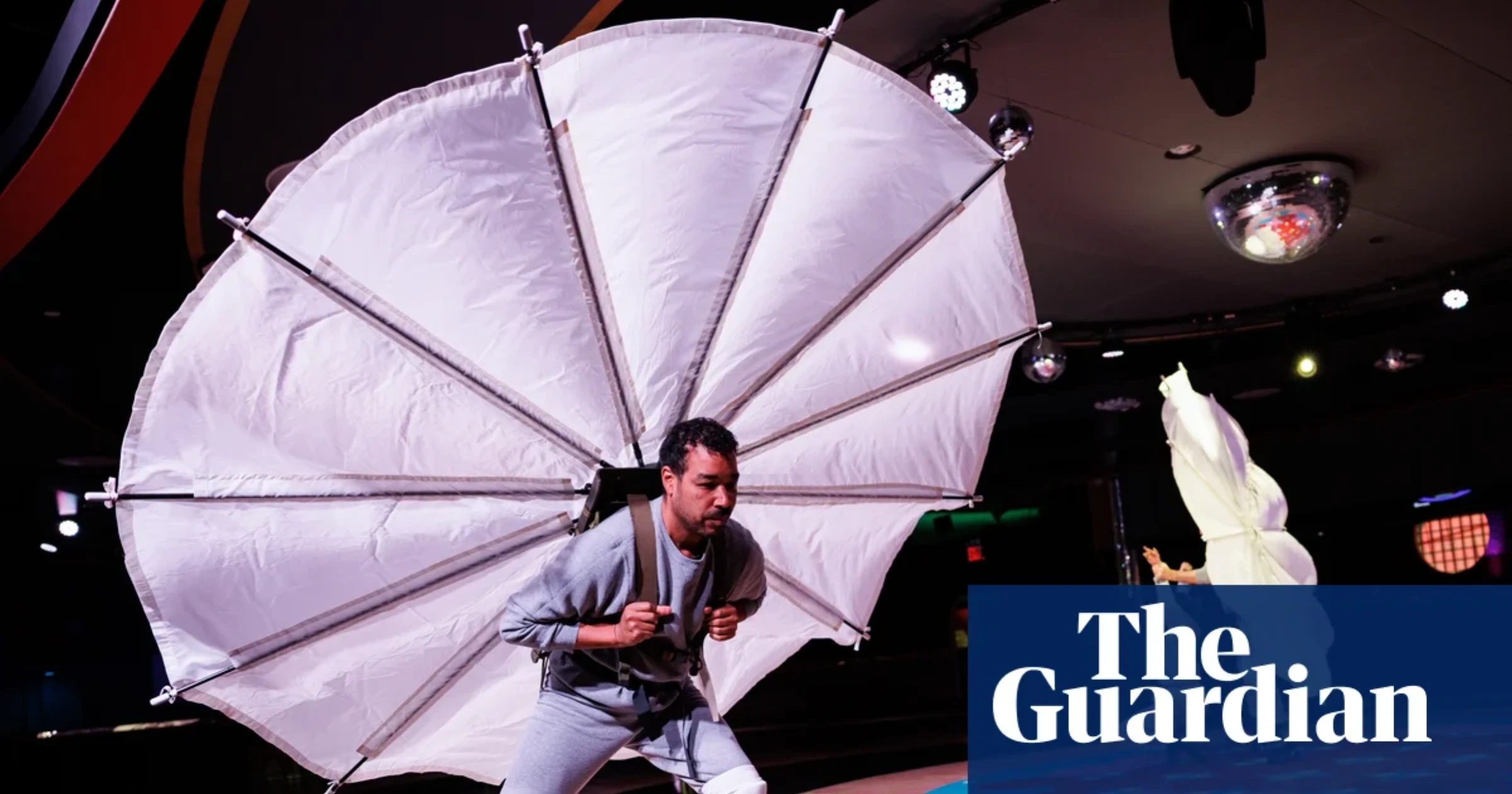
The first reimagining of Robert Rauschenberg's 1963 dance Pelican, staged last week by the Trisha Brown Dance Company at Xanadu in Brooklyn, would be news on archival grounds alone. The piece has long hovered in art history as a half-mythic event: two men on roller skates, one ballerina on pointe, parachutes on their backs, and Rauschenberg himself performing at a moment when downtown experimentation still felt lawless rather than professionally managed. But the revival matters for a harder reason. As the Guardian's account of the restaging makes clear, the work still tests what institutions and artists mean when they invoke collaboration across art forms.
We now live in a culture sector saturated with the rhetoric of interdisciplinarity. Museums court performance, choreographers work in gallery contexts, and every biennial seems eager to blur mediums. Yet much of that work is administratively tidy. It arrives insured, mediated, and translated into familiar audience pathways. Pelican belongs to a more reckless lineage. Its core image is not simply crossover. It is imbalance. The dancers must trust skill, speed, and each other under conditions where collision is a real possibility rather than a metaphor. That makes the piece unusually resistant to the smooth institutional language of innovation.
The restaging matters because it treats archival fragments as live problems, not as sacred instructions
According to the Guardian report, only a short film clip and a handful of black-and-white photographs survive of the original piece. The new production drew on archival materials from Rauschenberg and Trisha Brown while allowing choreographer Tara Lorenzen and performers Ashley Hod, Rashaun Mitchell, and Silas Riener to fill the gaps. That methodology deserves attention. Too many revivals confuse fidelity with obedience, as if the goal were to imitate a lost event so perfectly that history would stop feeling lost. Here the stronger approach seems to have been forensic rather than devotional: learn what can be known, acknowledge what cannot, and rebuild the work in a way that keeps uncertainty active.
That approach is especially apt for Rauschenberg, whose practice repeatedly embraced contingency, found structures, and collisions between forms. The artist's own work across painting, sculpture, dance, and performance was never about preserving medium boundaries. It was about keeping different systems in play long enough for something unstable to happen. A revival that over-stabilized Pelican would therefore betray the piece even if it reproduced every visible element correctly. The question is not whether the new staging looked like 1963. It is whether it restored the work's relationship to risk.
The venue helps. Staging the benefit at Xanadu, a roller rink in Brooklyn, prevented the work from being fully absorbed into the decorum of a black-box theater or white-cube museum. The rink's social and physical associations matter. They restore the wheels to the center of the event, making skill and hazard visible rather than symbolic. A pristine institutional setting might have made the piece legible as heritage. Xanadu let it remain strange.
Rauschenberg's dance work still exposes how much museums prefer his objects to his instability
Rauschenberg has been canonized so thoroughly through the language of combines, transfers, and postwar experimentation that it is easy to forget how deeply involved he was with dance. His long proximity to Merce Cunningham, Trisha Brown, and the broader downtown scene was not peripheral to his art. It was one of the places where his thinking about movement, chance, and support structures became most concrete. Pelican is therefore not a quirky side project. It is a key to understanding how Rauschenberg imagined the relationship between visual form and embodied action.
That matters because museum narratives still tend to make performance look supplementary when an artist's saleable objects have become the more stable route to canonization. The archive of photographs and stories around Pelican has often served as evidence of Rauschenberg's adventurous spirit while the actual challenge of the work remained safely in the past. Reviving the piece interrupts that comfort. It asks institutions and audiences to confront an artwork that cannot be reduced to wall real estate, cannot be fully collected, and does not yield its meaning to a single frozen image.
This is one reason the restaging feels newly timely. In an era when so many institutions want movement without disorder and participation without unpredictability, Pelican shows a tougher model. Bodies are not there to illustrate an idea cleanly. They are there to negotiate it in public. That tension links the piece, oddly enough, to the demands made by artists such as Julio Le Parc, whose work likewise insists that viewers and institutions surrender some control if participation is going to mean anything.
The hardest part of any revival is deciding what must remain unresolved
Archival performance revivals often fail in one of two ways. They either embalm the work, treating every surviving trace as sacred, or they update so aggressively that the original piece becomes a pretext for a contemporary commission. The reports from Xanadu suggest that this staging attempted a narrower and more interesting path. It preserved the structural stakes of roller skates, pointe work, and parachute apparatus while admitting that the work's undocumented intervals had to be invented anew. That is not a compromise. It is a recognition that some works survive only if incompleteness is built into their afterlife.
What remains unresolved in Pelican is also what keeps it alive. The piece does not settle into one disciplinary identity. It is dance, sculpture, theatrical event, and historical citation all at once. Its images are memorable, but its logic is not reducible to images. That is why it continues to attract artists who want to test the border between visual art and choreography without being trapped by either field's conventions.
There is also a useful warning here for institutions hungry to mine their archives for programming. Not every historical performance should be revived, and not every revival deserves applause simply for happening. The strongest justification is not commemorative sentiment. It is whether the work can still produce a live problem for the present. Pelican can. It asks what collaboration costs, how danger is staged, and whether reconstruction can remain genuinely open ended.
What this revival proves is that some 1960s experiments still feel less domesticated than today's branded boundary-crossing
One of the striking things about Pelican is how little it resembles the corporate language that now surrounds so much interdisciplinary programming. There is no tidy promise of innovation, no sleek mediation of audience outcomes, no flattening of difference into a sponsor-friendly atmosphere. There are skates, bodies, instability, and a stubbornly odd commitment to making an absurd idea actually work. That may be why the piece still feels fresh. It emerges from a period whose myths are overfamiliar, yet the work itself has not been fully metabolized by contemporary culture.
For the Trisha Brown Dance Company, the benefit was more than a historical exercise. It was a demonstration that archival performance can be rigorous, collective, and alive without pretending to erase time. For viewers, it offered a glimpse of an avant-garde that did not fear difficulty or embarrassment. And for museums, it should function as a reminder that genuine cross-disciplinary work often looks messier than the polished experiences now sold under that banner.
The revival of Pelican therefore matters well beyond one night in Brooklyn. It reminds us that the archive is not only a store of evidence. It is a field of unresolved propositions. Rauschenberg left behind one of the best of them: an artwork that can still wobble, still threaten to spill, and still make risk look like a form of intelligence. That is not nostalgia. It is a standard.