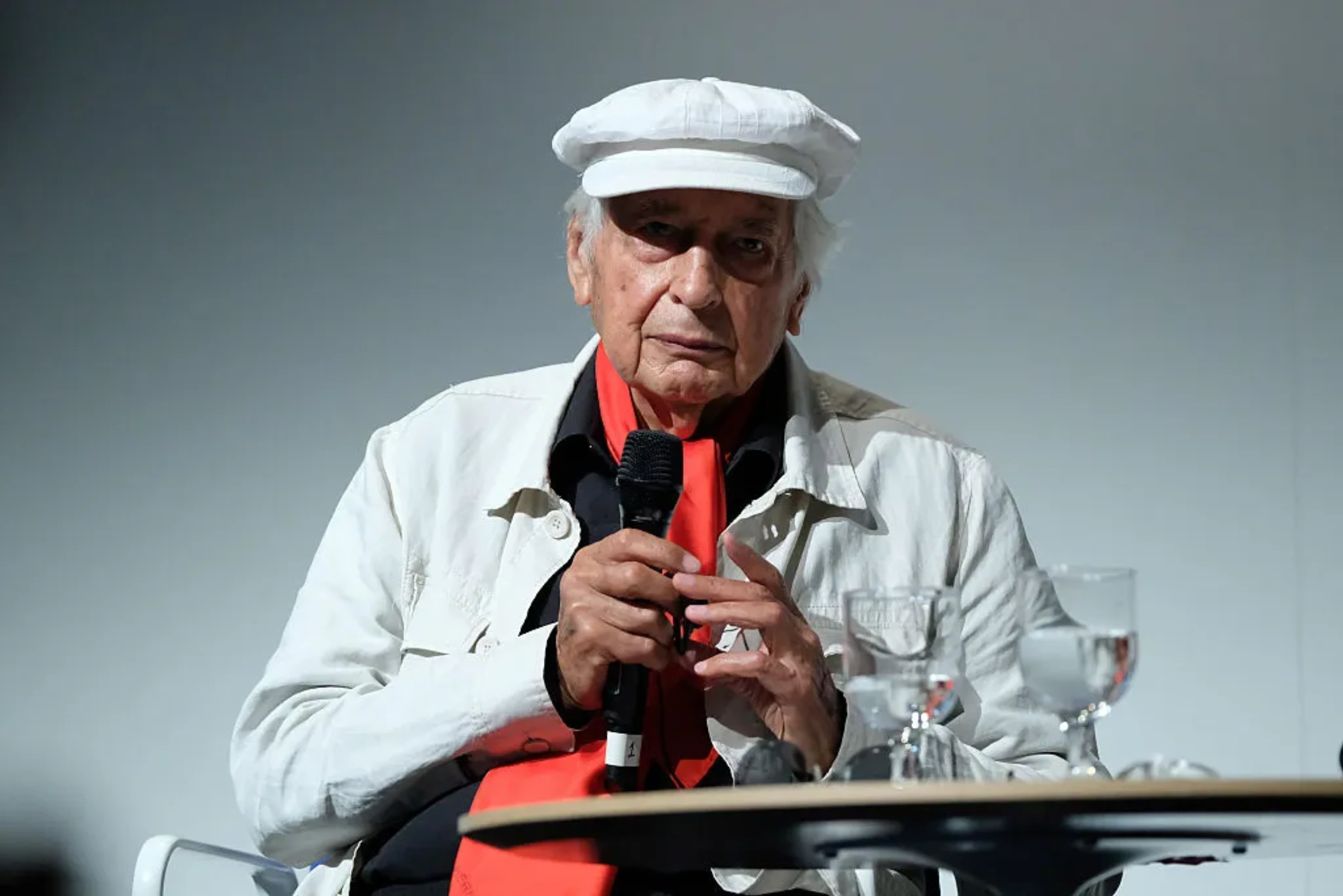
Julio Le Parc's Death Closes a Career That Refused Passive Looking
Julio Le Parc, who has died at 97, spent decades turning movement, instability, and viewer participation into a political and perceptual argument against static authority.
Julio Le Parc mattered because he made perception itself political
Julio Le Parc's death at 97 closes one of the longest and most quietly radical careers in postwar art. The headline version, as ARTnews notes in its obituary, is clear enough: an Argentine-born pioneer of kinetic and optical art, winner of the Grand Prize for painting at the 1966 Venice Biennale, and a figure whose work reached major institutions including Tate Modern. But the real reason Le Parc matters is sharper than the standard account of shimmering surfaces and participatory environments. He spent more than six decades attacking the idea that art should sit still, speak from above, or grant authority to a single ideal viewpoint.
That attack was formal and social at once. Light, reflection, suspended elements, and repeated modules in Le Parc's work were not merely pleasing effects. They were devices for unsettling habits of looking. The viewer had to move. Perception had to shift. Certainty had to loosen. Optical instability, in his hands, became a democratic proposition. If no one position yielded the whole image, then spectatorship itself could become active rather than obedient. That may sound lofty, but it is why Le Parc's work still feels more alive than much of the tame "immersive" art that followed. He did not flatter the viewer. He implicated the viewer.
His career shows how abstraction and politics were never truly separate
Le Parc was born in Mendoza in 1928 and eventually moved to Paris, where he became associated with Groupe de Recherche d'Art Visuel, the collective better known as GRAV. The group's experiments in light, movement, and public participation have often been narrated as a clean break from easel painting and individual authorship. That is true as far as it goes. But what matters is the moral charge behind the experiments. GRAV did not want art to remain a theater of passive admiration controlled by experts. It wanted to disrupt the hierarchy between object, institution, and audience, a goal that now feels newly relevant in museums still struggling to make participation mean more than branded entertainment.
Le Parc's political commitments sharpened that ambition. He was not a formalist who accidentally brushed against social questions. He understood perception as part of social organization. Systems teach people where to stand, what to value, and how to behave. Art that forces movement and disorientation can therefore act as a countertraining device. It reminds viewers that authority is staged, not natural. This helps explain why the lucidity of his structures never tipped into neutrality. Their discipline served an anti-authoritarian instinct.
That instinct also shaped how his career was received. Le Parc has often sat uneasily inside canonical accounts of postwar art because he does not fit neatly into the heroic narratives favored by the market. He is too collective for pure auteur mythology, too political for comfortable decorative abstraction, and too rigorous to be reduced to spectacle. Yet precisely those qualities now make him look stronger. In a moment when institutions keep reaching for audience activation while avoiding real challenges to control, his work exposes the difference between participation as method and participation as marketing.
The Venice Biennale prize was important, but it was not the whole story
Winning the top painting prize at the 1966 Venice Biennale gave Le Parc undeniable international prestige, yet it can also distort the way his achievement is remembered. Biennale prizes compress careers into a single institutional blessing, as if the work became important because a jury finally said so. In Le Parc's case the opposite reading is more useful. The prize mattered because it showed that a major art apparatus could, for one moment, reward an artist who was actively destabilizing the conventional terms of pictorial authority. The honor was real. The friction between the work and the structure awarding it was just as meaningful.
That friction continued across later museum contexts. When institutions such as Tate or large international surveys presented Le Parc, they were not merely adding a kinetic elder to the historical record. They were importing work that reorganizes viewers physically. Good Le Parc installations do not behave like wall labels in material form. They alter pace, invite hesitation, and make the body part of the interpretive system. That is one reason they have continued to resonate with younger audiences without needing the hollow language of innovation.
The art market, by contrast, has often known how to profit from the visual pleasure of Le Parc's work more easily than from its challenge to static spectatorship. Reflective mobiles and luminous environments photograph beautifully. They also fit neatly into the broader demand for work that reads immediately from a distance or on a screen. But Le Parc's best pieces still resist full capture in reproduction. Their intelligence sits in contingency: what happens when you move, when light shifts, when the object refuses to settle into one definitive image. That experiential remainder is part of why his reputation has endured.
He now looks like a corrective to the contemporary addiction to immersion
One useful way to understand Le Parc's legacy is to place it against the current museum obsession with immersion. The term has become so degraded that it often means little more than scalable atmosphere, digital projection, or visitor-friendly spectacle. Le Parc offers a harder standard. He created environments that could be sensuous and pleasurable, but they never reduced the viewer to a consumer of effects. Movement was not there simply to entertain. It was there to make the conditions of seeing unstable and shared.
That distinction matters because many institutions now want the traffic benefits of participatory art without accepting its more destabilizing implications. They want visitors to engage, photograph, circulate, and spend, but not necessarily to question the structures arranging their experience. Le Parc's work belongs to an earlier and more demanding lineage. It treats perception as a site of emancipation, not simply as a source of content. In that sense, his death should prompt more than affectionate tribute. It should force a re-evaluation of how much contemporary museums have softened the political charge of participation.
His example also clarifies a basic confusion in present-day curating. Participation is not the same thing as interactivity, and interactivity is not the same thing as critique. A room that responds to your movement can still leave power relations untouched. Le Parc understood that the point was not to dazzle people into compliance with a clever system. It was to make the system itself unstable enough that the viewer sensed alternatives. That is why his work still feels intellectually sharp rather than nostalgically futuristic.
There is also a historiographic lesson here. Le Parc's continued visibility helps undo the lazy split between Latin American art and the supposed main line of European postwar innovation. He was never peripheral to the central questions of his era. He was addressing them with uncommon precision. The categories that once kept artists like him oddly compartmentalized now look increasingly provincial. That is good news for art history, though it arrives late.
What survives is not only the work but the demand it makes on institutions and viewers
Obituaries tend to settle artists into exemplary narratives: the pioneer, the innovator, the prizewinner, the generous elder. Le Parc can bear those labels, but they are too neat if they obscure the active challenge in the work. His art insists that seeing is unstable, collective, and contingent. It distrusts fixed authority without collapsing into chaos. That is a rare achievement. Plenty of artists celebrate openness in rhetoric. Fewer build it so convincingly into form.
For institutions, that means Le Parc remains more than a historical figure to honor. He is also a standard against which participatory claims can be tested. Does an exhibition genuinely reorganize the viewer's relation to the work, or does it simply offer a photogenic environment? Does movement produce awareness, doubt, and discovery, or just throughput? These questions are not abstract. They sit at the center of how museums currently design public experience. Readers interested in that broader institutional shift may find a useful counterpoint in our coverage of Getty's new circulation-first modernization plans, where movement is framed as infrastructure rather than artistic argument.
For viewers, the inheritance is simpler and better. Le Parc leaves behind works that still reward bodily attention and skeptical looking. They remind us that vision is not innocent, that position matters, and that the world changes when we move through it rather than stare at it from a sanctioned point. That insight can sound almost obvious today, which is one mark of how deeply artists like Le Parc altered the conversation. But obviousness should not be mistaken for inevitability. Someone had to build the forms that taught it.
Julio Le Parc did. The shimmer, the drift, the flicker, the delayed recognition, the refusal to let the eye dominate without effort: those were never empty effects. They were a philosophy of spectatorship made material. His death closes a life. It does not close the argument, and museums are still catching up to what he asked of them.