Getty's Renovation Plans Turn Arrival Logistics Into a Cultural Strategy
Getty has revealed the first concrete details of its $600m-$800m campus modernization, making clear that circulation, comfort, and retail are now central to how major museums define public access.
Getty is no longer hiding the fact that visitor experience has become capital expenditure
The Getty Center's newly released modernization details matter because they make visible a shift that has been underway across the museum sector for years. Institutions no longer talk about access only in terms of admission, programming, or scholarship. They talk about queues, vertical circulation, shelter, seating, and where a visitor buys coffee before reaching the galleries. According to The Art Newspaper's report on the new renderings, Getty's revamp will cost between $600 million and $800 million and focus first on how people actually arrive at its hilltop campus. That figure is large, but the deeper story is conceptual. A museum famed for stone, gardens, and panoramic authority is now publicly admitting that friction at the threshold has become part of the institution's meaning.
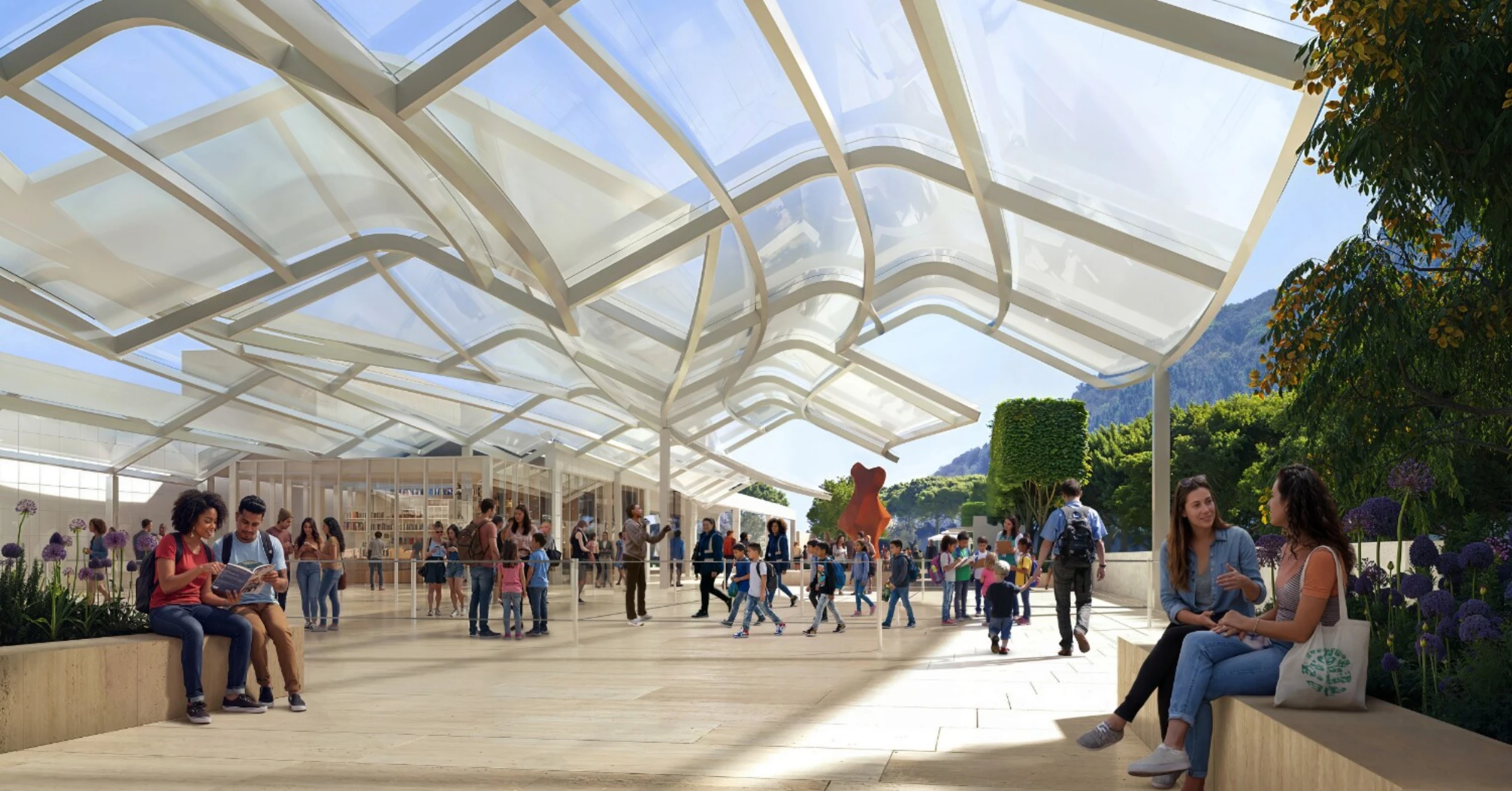
The published details are specific enough to show where Getty thinks its weaknesses are. A new green space and sheltered stairway designed by Gehry Partners will rework the lower tram area. The tram itself, in place since 1997, will be replaced by a system designed by Doppelmayr with more room for passengers. At the top of the hill, Why Architecture is designing a new welcome hall with an expanded bookstore and a new cafe. Read together, those moves are not cosmetic. They describe a museum treating arrival, waiting, orientation, and dwell time as part of the exhibition apparatus rather than as neutral preliminaries to culture.
The renderings show Getty competing on comfort as much as on architecture
The Getty Center has always depended on a carefully staged ascent. Visitors move from freeway Los Angeles to parking structure to tram to Richard Meier's hilltop campus, a sequence that converts logistics into ceremony. But ceremony ages. A system that once felt futuristic can start to feel slow, exposed, or constraining once attendance patterns change and expectations harden. Getty's own April statement on its broader modernization effort framed the project around accessibility, energy resilience, and the visitor experience. Those are not interchangeable goals. Accessibility implies legal and ethical obligation. Resilience implies infrastructure. Experience implies competition. Together they signal a museum that understands itself as both civic landmark and hospitality platform.
That hospitality dimension is worth taking seriously. An expanded bookstore and a new cafe are easy to dismiss as standard amenity upgrades, yet they also reveal how museums now defend relevance. If visitors must spend time moving through a site, the institution wants that time to feel purposeful and comfortable rather than merely delayed. The welcome hall is therefore not a side issue. It is a revenue space, a wayfinding tool, a climate buffer, and a mood-setting device all at once. Readers who have followed our guide to museum infrastructure announcements will recognize the pattern. Building language about access often conceals a larger attempt to reorganize how visitors spend money, attention, and patience.
The choice of designers sharpens the message. Gehry Partners at the lower station and Why Architecture at the summit allow Getty to claim design seriousness without reopening the entire Meier legacy as a battle. The project is not presented as an aesthetic repudiation of the campus. It is framed instead as an operational upgrade to an icon. That is clever institutional politics. Getty gets to modernize circulation while preserving the prestige of the original architecture, treating the campus less as a finished monument than as a platform that requires maintenance and reinterpretation.
The closure schedule reveals how tightly museum planning now follows global event calendars
Getty says the Center will close to the public on 15 March 2027 for a year and reopen in time for the 2028 Summer Olympics in Los Angeles. That timing is not incidental. Museums increasingly stage construction around mega-events, tourist surges, and geopolitical visibility windows. Reopening before the Olympics turns a necessary closure into a reputational opportunity. It tells funders, partners, and city officials that Getty is planning not simply for its own comfort but for an international audience that will arrive in Los Angeles expecting frictionless cultural infrastructure.
That temporal logic matters because it changes how capital projects are justified. A renovation used to be sold as stewardship, deferred maintenance, or curatorial necessity. Now it is also sold as readiness. Institutions present themselves as regional infrastructure within broader urban branding campaigns. Getty's commitment to continue programming at the Getty Villa and through external partnerships during the closure underscores that point. The organization does not want to disappear for a year. It wants to redistribute its public presence, preserving brand continuity while its flagship campus is remade.
The Olympics deadline also imposes discipline. It narrows the room for endlessly expanding wish lists and forces the institution to explain which interventions matter most. Getty has chosen arrival sequence, transit capacity, welcome functions, and resilience. That is revealing. It suggests the biggest problem facing many large museums is not lack of blockbuster content but bottlenecks in how bodies move, wait, and recover once they arrive. In a crowded cultural economy, poor circulation is not a minor inconvenience. It is a reputational liability.
Retail is embedded in the plan because museums now treat commerce as interpretation
The mention of an expanded bookstore deserves more scrutiny than it usually gets in museum coverage. Retail in museum planning is rarely just about selling more things, though that obviously matters. It is about extending the institution's narrative into objects, souvenirs, design editions, and post-visit memory. By placing the bookstore inside a new welcome hall, Getty is effectively moving commerce closer to the beginning of the visit. That changes the rhythm of the day. The store is no longer merely where one exits. It becomes part of how one enters, orients, and imagines the institution.
This is one reason the project belongs in the same conversation as current debates about museum merchandising, branded environments, and audience capture. A bookstore expansion is not neutral. It says the institution expects readers, tourists, and design-conscious visitors to blur together. It also acknowledges that the economics of cultural authority now depend on multiple forms of spending, not just ticketing and philanthropy. Getty remains free to the public, but free entry does not mean a noncommercial environment. It means commercial value is redistributed elsewhere in the visitor journey.
That does not make the plan cynical. It makes it legible. Major museums have learned that good retail can feel like service rather than extraction if it is integrated intelligently. The real question is whether the new welcome hall will support public orientation first and consumption second, or whether those priorities will quietly reverse under pressure to monetize dwell time. That is the sort of distinction renderings cannot answer. The lived experience of the space will.
What Getty is really testing is whether infrastructure itself can become a form of institutional confidence
The strongest reading of this project is that Getty understands maintenance as a public language. Instead of waiting until systems fail or the campus feels dated, it is narrating modernization as stewardship. The official language about accessibility and resilience gives the project a public-spirited frame, while the renderings of green space and new circulation promise emotional ease. Together they propose that a major museum demonstrates seriousness not only through collections and exhibitions but through the competence of its thresholds.
There is another reason this project deserves attention. Getty is using maintenance to defend prestige before obvious failure forces its hand. That reverses the usual museum script, in which infrastructure becomes visible only after complaints, leaks, inaccessible routes, or crowd management headaches pile up. By narrating the work early, Getty is trying to keep control of the meaning of the project. The institution wants the public to read renovation as foresight rather than repair, and that rhetorical framing may prove as valuable as the concrete and steel.
There is a broader lesson here for the field. Museums that built reputations on iconic architecture now face a second generation of questions. Can those campuses absorb larger crowds, different expectations of accessibility, hotter climates, and more explicit demands for comfort? Can they remain beautiful without becoming inconvenient? Getty's answer is to spend heavily before inconvenience hardens into institutional embarrassment. That is expensive, but it may prove cheaper than letting an iconic site feel stubbornly out of date.
The renovation details therefore matter beyond Los Angeles. They show a major institution treating visitor logistics as an intellectual and financial priority, not as janitorial background. If the project succeeds, Getty will have done more than replace a tram. It will have demonstrated that circulation, shelter, orientation, and retail are now central to what cultural access means in practice. If it fails, the field will still have learned something useful: that spending hundreds of millions on the path to the art only works if the path itself earns the public's trust.
For now, the renderings offer a clear signal. Getty believes the next phase of museum competition will be won not only in the galleries but in the spaces before and around them. That is a less romantic story than a new wing or a headline exhibition, but it may be closer to the truth of how institutions hold audiences in 2026. Visitors remember what they see. They also remember whether the place made getting there feel worth it.