Photo London Student Award Signals the Fair's Future
Akanksya Dahal's win shows how Photo London is turning education, curatorial attention and fair visibility into a pipeline for future photographers.
Photo London's student award is a small announcement with larger institutional consequences
Photo London's 2026 student award might look modest beside fair-floor sales talk, celebrity programming and the constant churn of market headlines. That would be a mistake. The fair has named Akanksya Dahal of Ravensbourne University London as this year's winner after a shortlist that also included Anna Bradshaw of Birmingham City University, Bo Fan of London College of Communication and Madison Hafner of Falmouth University. On paper, it is an education-side prize. In practice, it is one of the clearest places where the fair declares what kind of photography it wants to feed into the next stage of public and commercial attention.
The official Photo London shortlist announcement stressed the breadth of practice involved, moving from documentary observation to conceptual staging, portraiture and constructed image-making. That range is important because the fair is not merely rewarding technical competence. It is signaling the kinds of conversations it believes contemporary photography must sustain: identity, memory, illness, queer visibility, domestic fiction and the emotional charge of ordinary scenes. These are not neutral themes. They are curatorial decisions about what deserves seriousness.
In other words, the student award functions as a compact map of the fair's ambitions. Fairs often talk about discovering new talent, but many of them do so in a way that treats emerging artists as future inventory. Photo London is trying to fold that discovery claim into a more structured institutional ecology that includes curators, museum professionals, editors and public programming. The award matters because it shows the fair's attempt to manufacture legitimacy before the market fully prices it in.
The shortlist reveals how contemporary photography is being filtered through care, identity and constructed selfhood
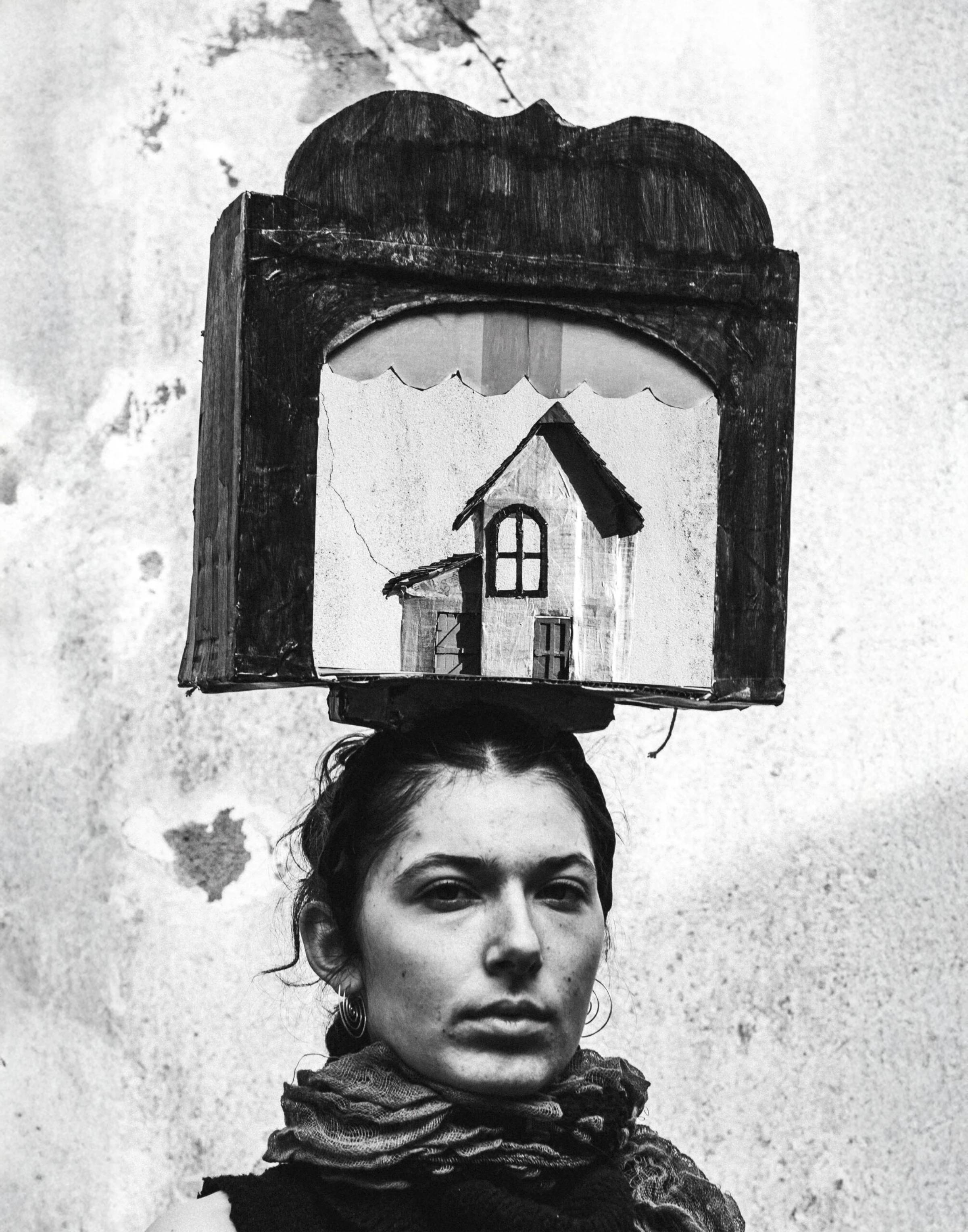
Look closely at the shortlisted projects and a pattern emerges. Anna Bradshaw's I Don't Know Where You Start and I End treats twinhood, illness and identity through a conceptual language tied to psychology and photo therapy. Bo Fan's Wandering In The Desire Room reconstructs memories of queer adolescence in East Asia through self-portraiture and staged scenes of exposure and self-repair. Madison Hafner's Domestic Fictions uses handmade props and altered scale to make domestic space feel unstable and theatrical. Dahal's winning project, A Moment Left Unsaid: Stillness Amidst the Crowd, turns toward documentary and street photography but still seeks emotional density rather than journalistic speed.
These are not random student exercises. They are tightly recognizable languages within a contemporary photography field that increasingly rewards artists who can move between documentary, conceptual and performative modes without being trapped inside one genre. The fair is effectively telling collectors and curators that the future will not be divided cleanly between straight documentary witness and highly staged art photography. The work that matters now often occupies the unstable ground between them.
That has implications for how photography is taught and shown. Institutions like the V&A, represented on the judging panel through curator Lisa Springer, do not simply lend prestige. They help define what kinds of student work appear legible to museums, fairs and eventually acquisition conversations. The judging panel also included Fiona Shields of the Guardian, photographer Mimi Mollica and Kimberly Hoang of the British Red Cross, a mix that combines editorial judgment, photographic practice and visual communication beyond the gallery world. That composition tells you the fair wants emerging photographers who can survive multiple publics.
For the students, that matters more than a resume line. A shortlist at a fair like this places their work in an ecosystem where curators, dealers, collectors and publishers are already primed to scan for future commitments. It is not a guarantee of career stability, of course. But it is a highly visible rehearsal of how artistic legitimacy gets assembled in 2026: through group endorsement, controlled visibility and institutional framing that makes emerging work feel less provisional.
Photo London is strengthening the bridge between education platforms and collector-facing programming
The student award does not stand alone. It sits alongside the fair's wider effort to expand platforms for artists outside the standard gallery roster. The 2026 edition's Positions section, curated by Maria Sukkar, is explicitly dedicated to unrepresented artists and promises direct dialogue with collectors, curators and institutions. Read together, the student award and Positions section form a pipeline. One identifies artists at the education stage, the other builds a bridge for practices that still sit outside formal representation.
That is a smarter structure than many fairs manage. Instead of pretending discovery happens spontaneously on the floor, Photo London is trying to design discovery as a sequence. Shortlist. Prize. Exhibition visibility. Curatorial endorsement. Public talks. Collector access. This is how a fair turns atmosphere into infrastructure. It also helps explain why the move to Olympia matters beyond square footage. As we noted in our report on Photo London's new Olympia setting, the fair's larger home is not just about crowd flow. It gives the organization room to scale sections like Positions and to present development pathways as part of the main proposition rather than an educational sidecar.
The fair's own 2026 materials reinforce this reading. The exhibitors announcement emphasizes expanded sections, a stronger publishing program and a dedicated screening room. The underlying message is that photography's future will be built through multiple modes of encounter, not just booth transactions. The student award fits neatly into that logic. It gives the fair a moral language of support while also helping it identify the next wave of artists who might anchor future sections, publications and sales narratives.
There is a market realism to this too. Emerging photography has become difficult to read because visibility can arrive quickly while durable support often lags behind. A fair that wants to matter in its second decade has to show that it can do more than host one-off enthusiasm. It must convince participants that it can create continuity. Awards and curated platforms are one way of making that promise plausible.
The Olympia setting sharpens that ambition because bigger fair footprints can easily become generic unless the organization fills them with intelligible pathways. Student awards help solve that problem. They give visitors a concrete point of entry into the next generation of work while giving sponsors, curators and schools a reason to see themselves as part of the same ecology. That is not a side feature. It is a way of engineering attention before the fair's headlines move on.
Why Akanksya Dahal's win matters now
Dahal's project seems to have won because it offers a kind of disciplined sensitivity that institutions currently value: patient observation, strong atmosphere and an ability to turn everyday public life into something emotionally precise without pushing it into empty sentiment. That kind of work travels well across editorial, curatorial and collecting contexts. It can be discussed through documentary language, but it also carries the aesthetic control expected of art photography. For a fair trying to define the next generation, that is a strategic choice.
It also says something about the present mood of photography. We are in a moment when loud image cultures coexist with a renewed appetite for stillness, slowness and intimate witness. Dahal's title alone, A Moment Left Unsaid: Stillness Amidst the Crowd, signals a refusal of spectacle. At a fair, that restraint can be an argument in itself. It suggests that new photographic seriousness may depend less on grand statements than on the ability to extract fragile emotional weather from public space.
There is also a broader lesson about photography fairs in London right now. As space gets more expensive and early-career support grows less predictable, fairs are trying to claim relevance by becoming connectors rather than mere marketplaces. That means pulling universities, museum professionals, editors and sponsors into the same pipeline and presenting career formation itself as part of the fair's cultural service. The student award is one of the clearest instruments for that strategy because it packages future possibility into a format that is easy to publicize and easy for stakeholders to rally around.
Seen that way, the award is not only about celebrating one artist. It is about teaching the fair's audience how to read possibility. Visitors are being shown where to look for tomorrow's serious work and which institutional voices already consider that work worth attention. That pedagogical function is underrated, but it is one of the reasons such prizes can shape collecting habits and curatorial curiosity long after the ceremony itself is forgotten.
It may also influence how schools position their own photography programs. Once a fair begins functioning as a visible relay point between higher education and the professional field, tutors and departments start measuring success partly through this kind of recognition. That can be productive when it pushes programs to take contemporary practice seriously, though it can also narrow incentives. Either way, the prize's effects ripple beyond the fair itself.
What comes next is the real test. Student awards are easy to announce and easy to forget unless they connect to sustained institutional follow-through. Photo London has put enough adjacent structures in place that this one could matter beyond the weekend. If the fair continues to integrate education, unrepresented-artist platforms and collector-facing visibility, then the student award will read not as a soft publicity gesture but as a working part of how photography careers are being shaped. That would make it one of the more important minor announcements on the current fair calendar.