Philadelphia Reunites Two Van Gogh Sunflowers
Philadelphia reunites two major Van Gogh Sunflowers paintings in a rare loan show shaped by reciprocity and curatorial focus.
This is a small show with blockbuster stakes
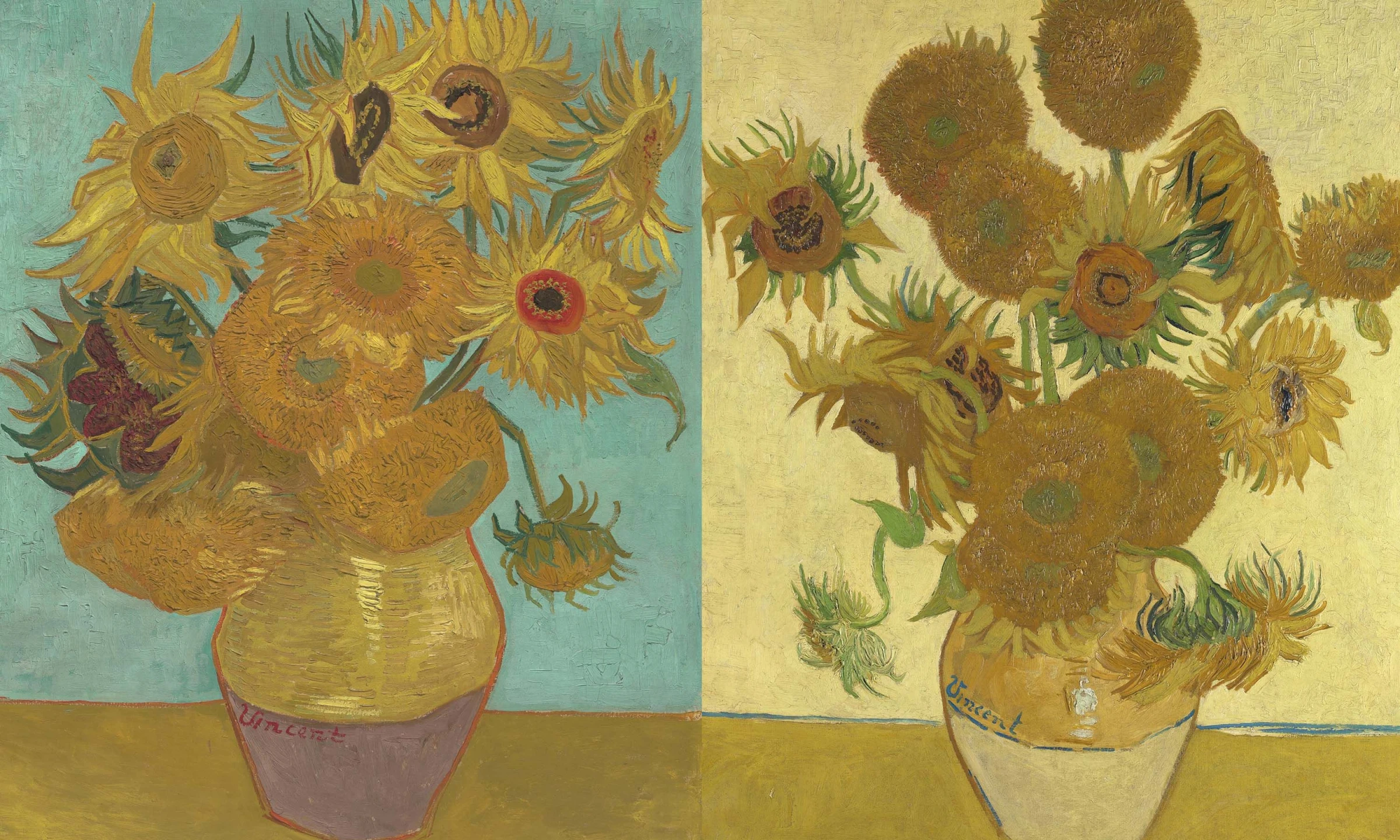
The Philadelphia Museum of Art opens Van Gogh’s Sunflowers: A Symphony in Blue and Yellow on June 6, bringing together two of the artist’s most famous still lifes in a presentation whose scale is modest and whose implications are not. As The Art Newspaper reports, the exhibition reunites the museum’s own January 1889 turquoise-ground Sunflowers with the National Gallery, London’s August 1888 yellow-ground version, a painting that has never before crossed the Atlantic. The rarity of the loan is the immediate headline. The more interesting story is how Philadelphia has turned that rarity into a highly concentrated curatorial argument about sequence, display, and the changing ambitions built into Van Gogh’s sunflower cycle.
The museum’s own exhibition page is spare but telling. It foregrounds curator Jennifer Thompson and identifies the show explicitly as Sunflowers: A Symphony in Blue and Yellow, borrowing the phrase Van Gogh used when imagining a more ambitious grouping of sunflower paintings. That choice matters. Rather than presenting the reunion as simple masterpiece tourism, Philadelphia is framing it as a thought experiment about how these pictures might have functioned relationally. This is exactly the kind of high-value, low-noise exhibition format many museums struggle to pull off. It depends on confidence that two paintings, properly staged, can sustain public attention without being padded by a checklist of lesser works.
That confidence is justified here because Sunflowers paintings do not circulate like ordinary trophy loans. They are too famous, too fragile, and too deeply tied to institutional identity. When one of them moves, the move itself becomes news. When two are placed together, the installation has to do more than flatter visitors with recognizability. It has to offer a reason that the encounter matters now.
The loan is also a lesson in how reciprocity actually works among top museums
According to The Art Newspaper, London’s National Gallery agreed to the loan as part of a reciprocal arrangement after Philadelphia lent its own Sunflowers to the National Gallery’s 2024 exhibition Van Gogh: Poets & Lovers. That point deserves more attention than it usually gets. Major museums like to speak the language of collegial cultural exchange, but reciprocity at this level is a hard currency. Institutions lend their treasures not only because scholarship warrants it, but because trust, precedent, and future leverage are in play. Philadelphia had already taken a reputational and conservation risk by letting its painting travel. The National Gallery is now answering in kind.
This is why the show tells us something about hierarchy in the museum world. Only a small number of institutions can enter such exchanges with paintings whose movement attracts international notice. The National Gallery’s version was acquired in 1924 and, as the article notes, has only rarely been lent abroad. Philadelphia’s picture had not left for loan since the museum acquired it in 1963 until that 2024 London trip. These are not routine transactions. They are carefully negotiated exceptions, and the exceptions reveal which institutions regard each other as credible custodians of irreplaceable works.
For visitors, the diplomatic labor remains invisible. For museum professionals, it is central. Insurance, transport, environmental controls, installation design, scholarly framing, and board-level confidence all sit behind the polite public language of partnership. The value of this show is partly that it makes those hidden structures legible. When a museum manages to stage a display this rare, it is showing not only art historical judgment but institutional standing.
The real argument concerns how Van Gogh may have wanted the pictures to function
Martin Bailey’s account emphasizes the exhibition’s underlying art historical puzzle: what relation Van Gogh imagined between the yellow and turquoise sunflower paintings, and how the pictures fit into his larger plans for decorative groupings. The subtitle A Symphony in Blue and Yellow points back to Van Gogh’s own description of a prospective series of panels. Philadelphia is using the reunion to reopen that question, not to resolve it neatly. That is smart. Too many museum shows overstate what a display can prove. Here the power lies in placing viewers inside a live scholarly conversation about versions, copies, color, and intended arrangements.
The article traces the distinction between the August 1888 originals and the January 1889 copies, as well as Van Gogh’s later idea of constructing a triptych with La Berceuse at the center. The Philadelphia exhibition does not physically recreate that triptych, but the catalogue reportedly explores how such an arrangement might have worked. That restraint is important. A museum can suggest missing historical configurations without turning the gallery into a theme-park reconstruction. The best curatorial installations leave room for uncertainty, allowing viewers to think with the evidence rather than simply consume a conclusion.
Philadelphia’s approach also underlines a broader truth about canonical modern painting: proximity changes interpretation. Reproductions flatten difference. Standing before two Sunflowers paintings that many people know only through books or screens reactivates distinctions of scale, handling, color temperature, and emotional pitch that disappear in reproduction. That is where scholarship and spectacle stop being opposites. The spectacle earns its keep when it restores the material intelligence of looking.
Two paintings are enough because each already carries the weight of an institution
There is a reason museums are often reluctant to build exhibitions around very small numbers of works. Such shows expose every curatorial decision. If the installation is weak, there is nowhere to hide. If the interpretation is thin, the room feels empty rather than austere. In this case the narrowness is the point. The National Gallery painting and the Philadelphia painting each arrive with enormous institutional charge. The London version is one of the defining objects of that museum. Philadelphia’s version is among the crown jewels of its European holdings. Bringing them together creates a dialogue not only between canvases but between museum identities.
The exhibition page’s image credit to both institutions captures that balance. This is not a story of one museum borrowing prestige from another. It is a story of two museums temporarily pooling prestige in order to animate a question that neither picture can ask alone. That is a useful distinction at a time when loan shows can too easily become transactions of raw brand power. Here the brand power is real, but it is in service of a crisp curatorial proposition.
It also helps that Philadelphia has not overstuffed the gallery. A one-room presentation can sharpen attention if the staging is disciplined. The risk, of course, is that audiences expecting a conventional blockbuster may find the scale slight. But museums do not always need more objects. Sometimes they need better framing. We have written before about how Van Gogh loans operate as geopolitical and institutional signals, and this show belongs in that conversation. Its seriousness lies in focus.
What museums can learn from this focused summer blockbuster
Philadelphia’s Sunflowers presentation arrives as a reminder that blockbuster logic does not always require scale, immersive design, or a warehouse of loans. Sometimes the most compelling summer show is one that understands exactly how much rarity it possesses and refuses to dilute it. That is a useful lesson for museums chasing attention in a crowded season. If the work itself is powerful enough, a clean thesis and a near-unrepeatable encounter can outperform a padded exhibition built for volume rather than necessity.
The show also demonstrates how institutions can make reciprocity visible without becoming self-congratulatory. Philadelphia is benefiting from a once-in-a-generation loan, but it has grounded the event in curatorial inquiry and in the museum’s own holdings. It is not simply hosting a guest star. It is using the guest star to illuminate its own Van Gogh and to revisit a longer interpretive problem. That is the difference between a borrowed headline and a real exhibition.
Readers interested in the mechanics behind such presentations may also want to revisit our guide to reading museum strategy through programming signals. Philadelphia’s move is a programming signal of a high order. It says the museum knows the value of concentration, trusts audiences to spend time with two paintings, and understands that a masterpiece loan matters most when it sharpens a question rather than merely inflates attendance. That is a sophisticated use of rarity.
There is a useful caution inside that simplicity. Museums often respond to precious loans by layering on interpretive excess, as if a famous object needs theatrical reinforcement to justify its movement. Philadelphia appears to be resisting that temptation. By keeping the show tight, it invites viewers to spend longer with problems of repetition, color, sequence, and memory than a sprawling checklist would allow. In a season crowded with high-volume programming, that is its own form of confidence. The museum is betting that attention, not abundance, is what makes this reunion feel consequential.
That bet also respects the paintings as objects rather than content units. A concentrated installation slows viewers down, lets the eye register actual differences, and reminds museums that blockbuster appeal does not have to mean sensory overload. In this case the rarity of the encounter is doing enough work already. Philadelphia’s smartest decision may simply be that it knows when to stop adding and start letting two great canvases argue with each other in public.