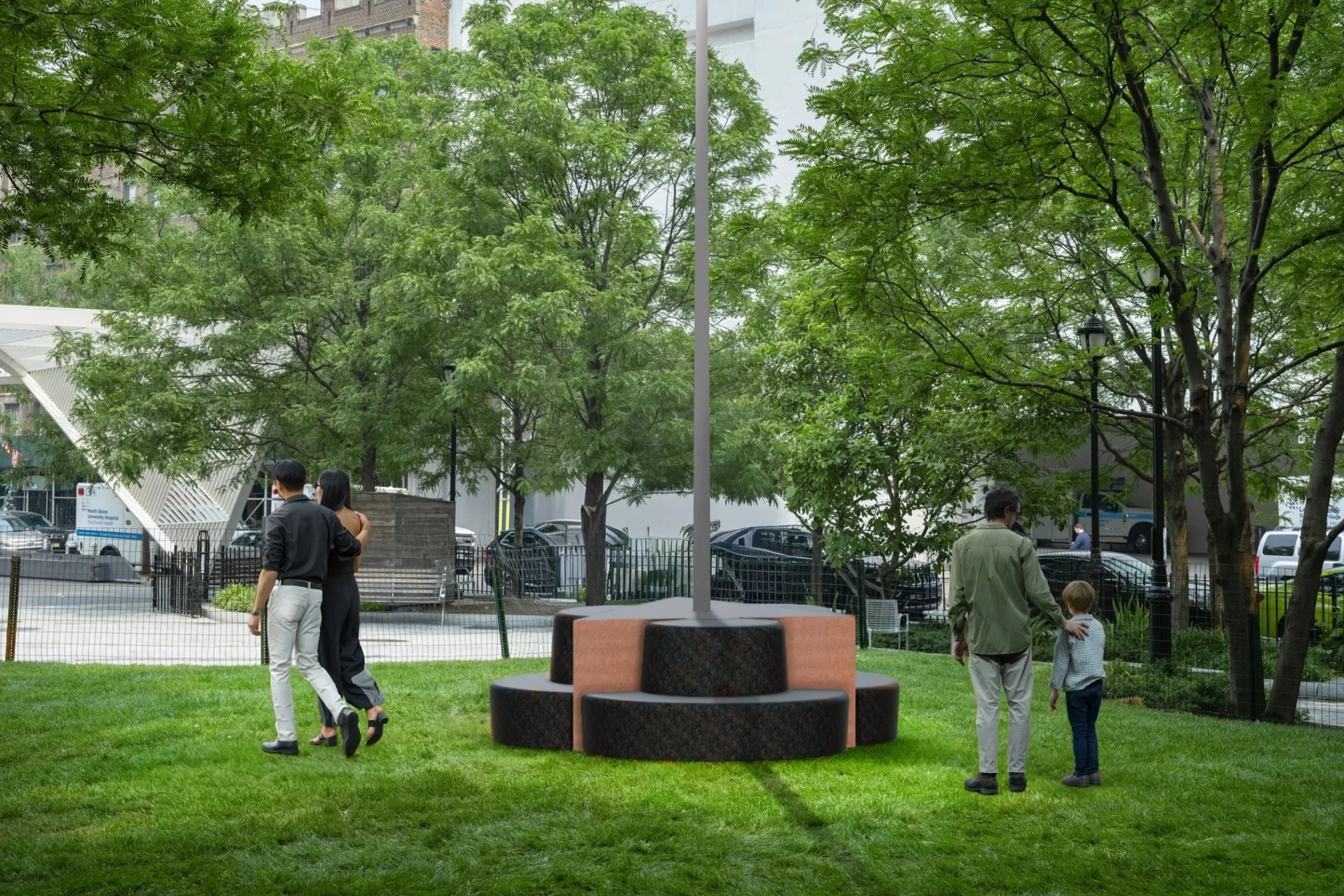
NYC AIDS Memorial Reactivates Scott Burton
Oscar Tuazon’s new memorial commission shows how institutions can preserve AIDS-era public art through transformation rather than static tribute.
Why this memorial commission matters now
The New York City AIDS Memorial is marking its tenth anniversary with a commission that understands remembrance as an act of material editing rather than pious display. According to The Art Newspaper, Oscar Tuazon’s Eternal Flame for Scott Burton will open on 20 June at St. Vincent’s Triangle and remain on view for a year. The work revisits Scott Burton’s final public commission for the Sheepshead Bay fishing piers, a project completed after Burton’s death from AIDS-related illness and later decommissioned after decades of weather damage and the destructive force of Superstorm Sandy. That backstory is the point. This is not just another anniversary sculpture. It is an argument about what it means to preserve queer art history when the original civic object can no longer survive intact.
The official memorial page for Eternal Flame for Scott Burton frames the commission as a centerpiece of its anniversary program and stresses that Burton’s salvaged materials have been recontextualized for a new generation. That phrasing matters. Cultural institutions often talk about legacy as if it were a static inheritance that needs only to be guarded. This project proposes something sharper: legacy is a public infrastructure problem. Works decay, sites change, and archives by themselves do not restore civic presence. If the AIDS crisis stripped a generation of artists from the field, then every later preservation choice carries an ethical charge. The Memorial seems to understand that history cannot remain meaningful if it is kept at the level of commemoration alone.
Scott Burton’s public art was always about use, not distance
Burton was never a sculptor of remote monumentality. His furniture-like benches, tables, and seating forms deliberately blurred the line between sculpture and public utility. That is one reason he continues to matter. As the Memorial notes, Burton’s art embedded social contact into everyday form, making public space tactile, shared, and quietly performative. The original Sheepshead Bay commission did not ask viewers to stand back reverently and decode symbolism from a distance. It asked them to sit, touch, occupy, and spend time. That is a very different theory of public art from the one that dominates so much civic sculpture, where the public is expected to admire an object without changing its own behavior.
That legacy also helps explain why Burton’s work belongs at the AIDS Memorial rather than in a sealed museum afterlife. The history of AIDS art is often narrated through protest graphics, activist photography, and devastating losses in the studio system. Burton adds another register: the redesign of common space itself. His work made sociability part of the sculpture. In the context of AIDS memory, that becomes newly charged. Touch, gathering, and bodily proximity were all politically loaded conditions during the crisis. Burton’s public idiom now reads as both formal invention and historical witness.
The Memorial’s page quotes art historian David Getsy on Burton’s model of resilience, intimacy, and contact. That is exactly the right vocabulary. Many institutions speak about inclusivity while commissioning objects that do not materially change how a public inhabits a site. Burton did the opposite. He made use a medium. Tuazon’s decision to preserve that logic instead of converting Burton into a more familiar hero-statue format is one reason this commission deserves attention beyond the memorial sector.
Oscar Tuazon chooses adaptation over nostalgia
Tuazon is well suited to this assignment because his own practice has long operated between sculpture, architecture, and social form. In the TAN report and in the Memorial’s statement, he describes his interest in Burton’s public work as something hidden in plain sight: publicly legible yet intensely private. That is a good way to understand the challenge. A memorial institution could easily have staged a retrospective tribute or installed a plaque. Instead it asked a living artist to work through Burton, not around him. Tuazon used salvaged fragments from the Sheepshead Bay installation and transformed damaged terrazzo into a new aggregate material, while retaining Burton’s commitment to functional sculpture.
That choice avoids two common institutional failures. The first is restoration theater, where an object is repaired into a false illusion of untouched original life. The second is reverent distance, where a damaged work is immobilized as evidence of loss. Tuazon threads a more demanding line. He treats damage as history, not as embarrassment, while refusing to let that damage end the work’s public future. The resulting circular bench and light-bearing pole are explicitly contemporary, but they are not opportunistic updates. They preserve the original commission’s social ambition while acknowledging that Burton’s public art now reaches us through breakage, salvage, and historical interruption.
There is also a political intelligence in using adaptation as the memorial form. AIDS remembrance cannot be convincing when it pretends institutions behaved well the first time around. Tuazon’s own statement on the memorial page is blunt: the HIV/AIDS crisis was a failure of institutions, and the answer was pride, visibility, and community. That is not decorative rhetoric. It repositions public sculpture as a communal technology rather than a donor-facing object. In a city where memorialization is often absorbed into real estate branding and civic self-congratulation, that emphasis feels unusually clear-eyed.
What the commission says about preservation culture
This project also lands in a broader moment when preservation culture is being forced to confront climate damage, underfunded maintenance, and the uneven afterlives of late twentieth-century public art. Burton’s decommissioned Sheepshead Bay work is not an isolated case. Across the United States, ambitious public commissions from the 1970s through the 1990s are entering a phase where material vulnerability can no longer be ignored. Yet institutions still tend to treat preservation as a technical matter handled by specialists offstage. Eternal Flame for Scott Burton makes preservation visible as a public and curatorial act. It says the afterlife of a civic artwork is itself a cultural event worth narrating.
That matters because the works most likely to disappear are not always the ones art history talks about best. They are often hybrid objects tied to municipal systems, modest budgets, and difficult environments. Burton’s Sheepshead Bay commission was exactly that kind of work: neither trophy sculpture nor anonymous street furniture, but something messier and more important. The Memorial’s decision to foreground the work’s decommissioning and salvage gives the public a harder, more honest story than the usual language of tribute. It reminds viewers that civic art is not immortal by default. Someone has to decide whether its social meaning is worth renewing.
The institutional coalition behind the project reinforces that point. The Memorial is working alongside New York City Department of Cultural Affairs and NYC Parks Art & Antiquities, both of which are tied to the original history of Burton’s commission. Those agencies are not incidental. They show that legacy work often depends on bureaucratic continuity as much as on curatorial vision. When that continuity fails, artists fall out of public life even when their importance remains uncontested on paper.
Memory is credible only when it changes the present
The strongest line in this story comes from Memorial director Dave Harper, who says commemoration is an active, living verb. That line could have been empty branding. Here it is backed by the structure of the project itself. The unveiling will include live performance and public gathering, and the work’s very form invites occupation rather than distant consumption. The Memorial is not merely adding an artwork to its site. It is insisting that AIDS memory should remain social, contested, and physically shareable. That is a much better use of a tenth anniversary than the safer route of self-congratulation.
There is a useful internal comparison here with our recent guide to reading public-art commissions around major civic spectacles. In that guide, the question was whether commissions could do more than decorate a host-city narrative. The Burton project clears that bar because it is not trying to sell an event. It is trying to restore historical pressure to a site of memory. The public does not encounter this commission as ambient uplift. It encounters it as a proposition about how a city should care for artists it once failed.
What comes next will determine whether the project’s ambitions hold. If the work remains legible as a place people actually use, not just photograph, the Memorial will have accomplished something rare. It will have shown that preservation can be both intimate and unsentimental, and that AIDS-era art history can return to public space without being reduced to elegy. That is a harder achievement than monumentality. It is also more alive.
There is another standard worth applying here: whether the commission can keep Burton from being absorbed into the generic language of cultural remembrance. Too many memorial projects work by smoothing the artist into a symbol of loss, at which point the actual formal intelligence of the work begins to evaporate. Burton deserves the opposite. His practice asked how sculpture could reorganize everyday encounter. If visitors leave the Memorial thinking only that Burton was an artist tragically lost to AIDS, the project will have done half its job. If they also leave understanding that his forms changed how public art could function, then the commission will have preserved more than biography.
That is why this story matters outside New York. Many institutions are sitting on fragile public-art histories tied to communities once treated as expendable. The Burton commission models one way forward: not fake restoration, not archival retreat, but a public reactivation that acknowledges damage and still insists on use. In an art world crowded with commemorative rhetoric, that is a serious editorial statement disguised as a bench and a beam of light.