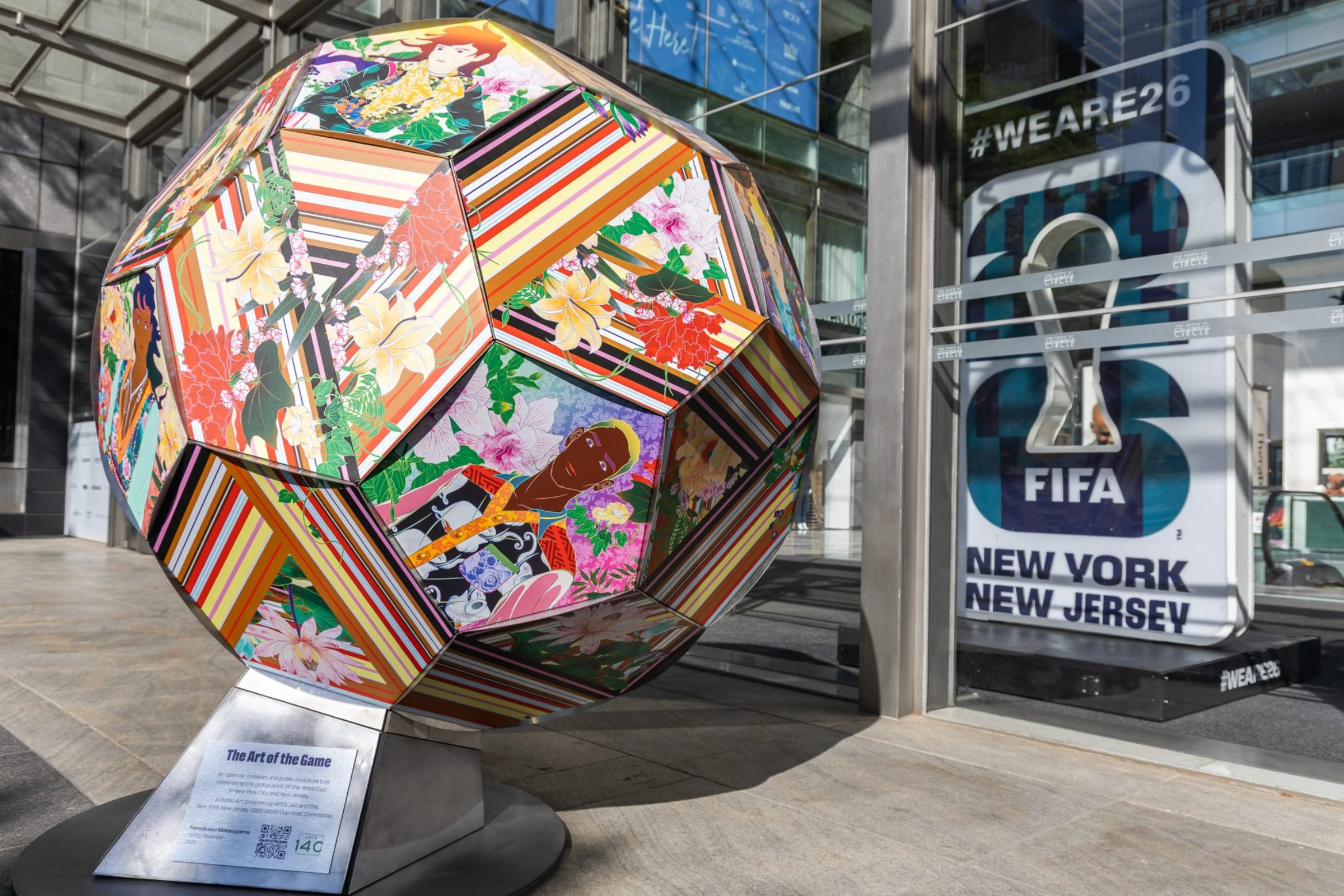
How to Read World Cup Public Art Commissions
Use the World Cup’s artist-designed soccer ball trail to read sponsorship, civic branding, site politics, and what public art is really being asked to do
Start With the Civic Machine Behind the Artwork
The World Cup public art trail now rolling across New York and New Jersey looks cheerful on first contact: twenty-three artist-designed soccer ball sculptures, spread across boroughs and host-region sites, with names like Katherine Bernhardt, Hank Willis Thomas, Bony Ramirez, and Tomokazu Matsuyama attached. According to Artforum’s report, the project was organized by ARTS 14C and the FIFA World Cup 2026 New York New Jersey Host Committee, with support from Christie’s and a roster of museum leaders who helped select artists. That already tells you how to read it. Before you ask whether any single sculpture is successful, ask what coalition produced the project and what each member of that coalition wants from it. Mega-event art is rarely just about art. It is about hospitality, tourism, reputation management, private sponsorship, and the desire to make large civic spectacles look participatory rather than purely extractive.
This is not a cynical way to look at public art. It is the necessary baseline. Host committees need stories that make event infrastructure feel cultural rather than logistical. Nonprofits need visibility and donor-facing legitimacy. Museums and museum directors often want to demonstrate civic relevance without taking on the full liability of curating in messy public space. Sponsors want association with accessibility, creativity, and regional pride. Artists may want wide public reach, new audiences, and the chance to make work outside conventional exhibition formats. All of those interests can coexist, but they are not identical, and good criticism starts by mapping the deal rather than pretending the project floated into existence through pure generosity.
Read the Form: Why a Soccer Ball Is Not a Neutral Support
The project’s modular sculpture format matters. These objects are not blank plinths. They are prefabricated soccer balls made of pentagonal and hexagonal panels, designed to receive paint, mixed media, or UV-printed imagery. In other words, the commission begins with a strong formal limit tied directly to branding. The artist is not inventing the structure. The event is. That means the work already contains a negotiation between individual authorship and a predesigned public-facing icon. When you see one of these sculptures, ask how the artist responds to that limit. Do they treat the ball as a canvas for surface-level decoration, or do they use the repetition, curve, and symbolic weight of the object to complicate what a World Cup symbol can mean?
Some of the most interesting artist-designed civic objects work because they do not pretend to escape the commission’s frame. They work from inside it, bending it just enough to expose its assumptions. In a sports mega-event context, the soccer ball is a particularly loaded format because it carries fantasies of universality and joy while often concealing unequal distributions of money, access, and power. An artist who merely beautifies the object may produce something pleasant. An artist who lets the object’s status as civic branding remain visible can produce something more durable. That is the difference between themed decoration and public art with friction.
For context, compare this project with last night’s guide to reading art fair announcements. In both cases, the language of openness and opportunity can obscure the structural terms of participation. Who chooses? Who pays? Who benefits from foot traffic? Who gets to claim community in the press release? Those questions travel well from fairs to public commissions because both formats convert cultural labor into place-making value.
Follow the Geography, Not Just the Artist List
The official story emphasizes that works are spread across all five boroughs and nearby New Jersey locations, with placements at sites like Rockefeller Plaza, Grand Central Terminal, MetLife Stadium, and the Brooklyn Museum. Geography here is not neutral distribution. It is messaging. A project that stretches across transportation hubs, tourist magnets, sports infrastructure, and established art institutions is trying to stitch together multiple publics under one event umbrella. Read that spread carefully. Which neighborhoods get symbolic inclusion and which get sustained programming? Which sites already have heavy visitor traffic and therefore maximize sponsor visibility? Which placements align the project with elite cultural institutions, and which are framed as neighborhood access points? A map of the commissions is also a map of whose presence the host region wants to make legible.
This is where local context matters. New York and New Jersey are not blank host backdrops awaiting international activation. They are regions with existing public art ecologies, transit inequities, municipal permitting systems, and competing narratives about who the city is for. A sculpture in Midtown does one thing. A sculpture near a community-facing institution in another borough does something else. When the project claims accessibility, look for the evidence in siting, signage, and programming. Is accessibility being used to describe actual public encounter, or is it functioning as a moral gloss on a brand circuit?
The ARTS 14C project page, The Art of the Game, is helpful here because it foregrounds the coalition of cultural leaders assembled around the initiative. Specific artist pages, such as the commission by Saya Woolfalk Wilson and the project entry for Derrick Adams and Jerrell Gibbs collaborator pages now live under the program, make it easier to compare how the same object format can produce very different public effects. That list is not window dressing. It shows how civic legitimacy is produced through institutional name recognition. When major directors from the Met, Brooklyn Museum, Whitney, and others are attached, the project borrows authority from the museum sector while remaining more agile and sponsor-friendly than a museum show. That borrowing can be productive, but it should not go uninterrogated.
Pay Attention to Agnes Gund’s Afterlife in the Story
Artforum notes that this was the last philanthropic endeavor conceived by Agnes Gund, whose role in convening museum leaders and arts patrons was central. That detail matters for more than sentimental reasons. Gund represents a particular model of American cultural philanthropy: networked, institutionally trusted, and able to move ideas between museums, nonprofits, and civic projects with unusual speed. When a project invokes her, it is also invoking a lineage of cultural brokerage in which elite relationships make public-facing art possible. Again, that is not automatically a problem. Many good public projects exist because someone with influence decided to spend it. But criticism has to notice how philanthropy shapes the field of what becomes feasible and what remains invisible.
In the case of World Cup commissions, philanthropic framing can soften the harder questions that come with mega-events: labor, security, public spending, displacement, and who actually experiences the city as welcoming during moments of global spectacle. Art can help produce a more generous civic atmosphere, but it can also launder the event by surrounding it with the vocabulary of creativity and inclusion. The stronger the philanthropy story, the more necessary it becomes to ask what else the story is helping the public overlook.
Judge the Work by What It Lets the Public Do
Most public art coverage stops at artist rosters and installation shots. That is lazy. A better question is what kind of behavior the project invites. Are people meant to linger, photograph, play, argue, read, learn, or simply pass through? Does the work offer interpretive material that helps non-specialists understand why these artists were chosen? Are the commissions scaled and sited so that children, commuters, tourists, and local residents encounter them differently? Public art succeeds when it produces usable public time, not just visual content. A project tied to the World Cup has an unusual opportunity here because football culture already generates ritual, gathering, and spontaneous conversation. The art can either plug into that energy or sit beside it as a branded parallel track.
Look, too, at whether the commissions permit contradiction. A good artist can make a celebratory object carry ambivalence. That matters because the host-city script for mega-events is almost always upbeat. But cities are not uniformly upbeat. They are contested. Public art that reflects only the official mood usually dates badly. Work that leaves room for irony, tension, migration, memory, or uneven belonging tends to survive the event that commissioned it.
Separate Exposure From Value
One of the easiest mistakes in reading projects like this is assuming that visibility equals significance. Yes, twenty-three artists receiving wide public exposure is meaningful, especially in a region where many people who will encounter the works do not regularly enter museums. But exposure alone is not the same as artistic or civic value. Ask whether the project is building relationships that continue after September 7, when the sculptures come down. Are there school partnerships, neighborhood programs, archives, artist talks, or acquisition plans? Or is the work meant to peak during event season and disappear once the hospitality cycle moves on?
This question is especially important because temporary public art often functions as a flexible labor solution for cities and sponsors: it gives the appearance of cultural investment without the long-term obligations of maintenance, staffing, or permanent policy change. Sometimes temporary work is the right format. Not every commission should become permanent. But readers should be alert to the difference between purposeful temporariness and disposable spectacle. The former understands its duration as part of the concept. The latter uses duration to avoid accountability.
What to Watch as the Project Develops
Over the next few months, the best way to evaluate The Art of the Game is to keep three questions in view. First, which works actually hold up once the novelty of the format wears off? Second, how evenly is the project distributed across publics rather than publicity zones? Third, does the critical conversation around the commissions remain focused on celebrity names and sponsor logos, or does it get specific about what individual artists made and why those choices matter? If the project earns serious attention, it will be because at least some of the artists managed to turn an event symbol into a more complicated public object.
The World Cup will bring enough noise on its own. That is why art tied to it has to do more than amplify enthusiasm. At its best, public art can make a mega-event legible as a civic structure with winners, losers, fantasies, and blind spots. That is the standard worth using here. Do not ask only whether the sculptures are fun. Ask what kind of city, and what kind of public, they imagine into being.