How to Read a Focused Sculpture Show
Use this guide to read tight museum sculpture shows on their own terms, from checklist logic and color decisions to curatorial framing and missing context
Start by Identifying the One Claim the Exhibition Is Actually Making
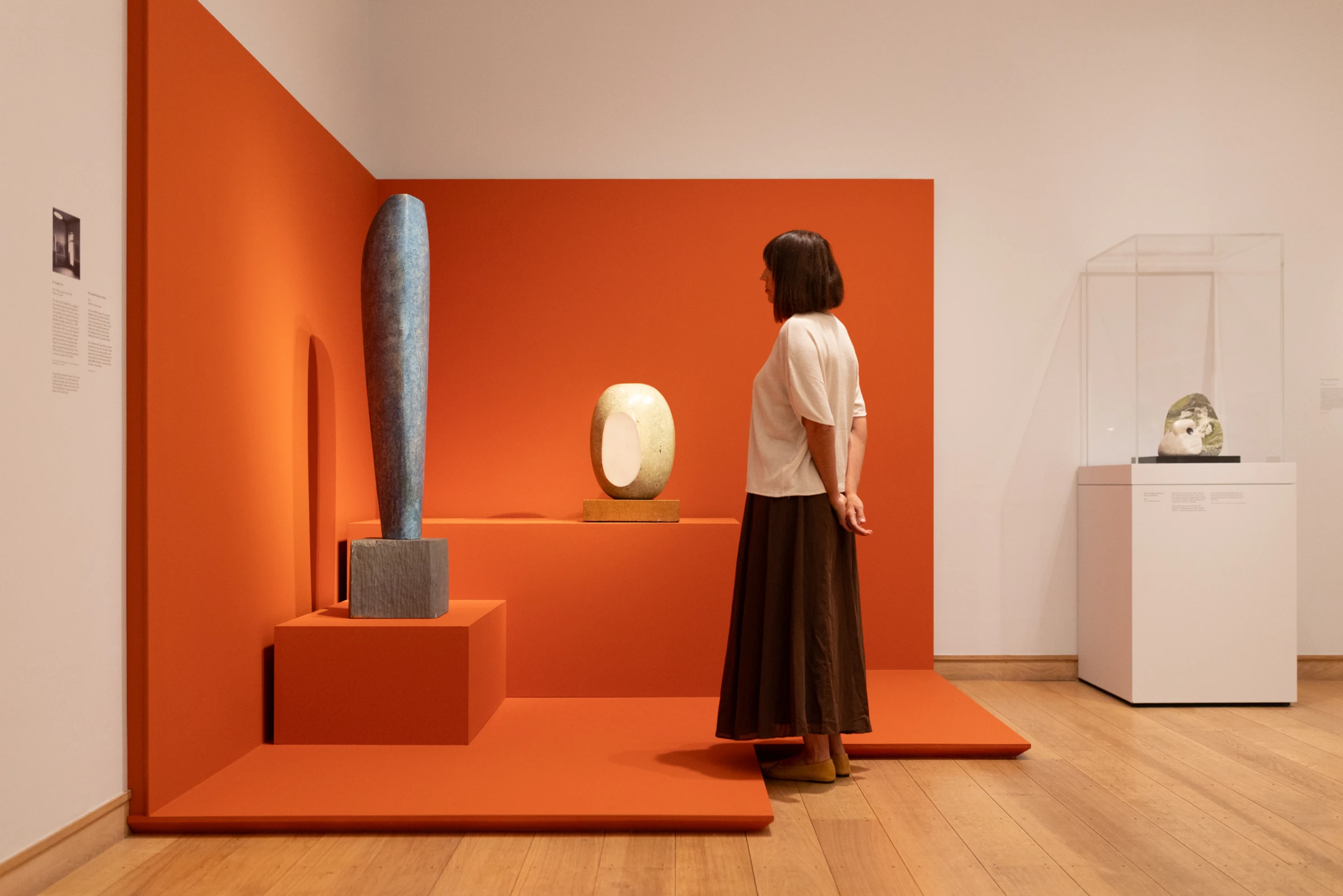
The hardest museum shows to read are often the smallest ones. A focused sculpture exhibition can feel elegantly manageable, but that neatness is deceptive. Unlike a large retrospective, which can survive on scale and familiarity, a tight show usually depends on one curatorial claim. Everything turns on whether that claim is persuasive. Before you get hypnotized by labels, installation design, or the aura of a canonical artist, ask the basic question: what is this show trying to prove. In the case of Hepworth in Colour at the Courtauld, the claim is that color is central to Barbara Hepworth’s sculptural thinking. That is concrete. It gives you something to test.
This is the first discipline of serious exhibition looking. Do not accept “rediscovery” as an argument by default. Museums love to imply that a familiar artist has suddenly become new again. Sometimes that is true. Often it means the institution has found a cleaner marketing angle. A focused show needs a stronger basis than novelty. It should identify a precise distortion in the way the artist has usually been understood, then assemble enough evidence to challenge that distortion. If you cannot state the show’s thesis in one sentence after the first room, the curators may not have one.
That habit is useful well beyond sculpture. We made a similar point in our recent guide to reading autumn art calendar signals: lists and events only become meaningful once you know what argument they are making about attention. Exhibitions work the same way. They are not neutral containers. They are propositions staged in space.
Read the Checklist as an Editorial Sequence, Not a Neutral Inventory
Once you know the thesis, stop looking at the checklist as a mere record of objects. Treat it as an editorial sequence. Which works appear first. Are there anchor pieces everyone expects, or is the exhibition deliberately withholding the obvious in order to reset your eye. Does the show move chronologically, materially, thematically, or through visual rhymes. These choices tell you how strongly the curators trust their own argument. A weak show often overexplains because the object sequence does not do enough. A strong one uses placement to produce recognition before the text arrives.
With sculpture, this matters more than most visitors realize because the medium’s meaning is distributed through adjacency, spacing, and the pace of movement. One carved form alone may look self-sufficient. Place it beside a drawing, a variant, or a later cast, and a different set of decisions becomes legible. In the Courtauld’s Hepworth materials, the concentration on painted forms, stringed interiors, and drawings is not incidental. It asks you to compare how color behaves across media. That is a checklist strategy, not just a loan list.
When the checklist feels too perfect, be suspicious in a productive way. Ask what is missing. Maybe the show excludes inconvenient works that would muddy the thesis. Maybe availability forced the issue. Maybe the curators are right to be selective. The point is not to demand completeness from a focused show. It is to register that selectivity is interpretation. The cleanest small exhibitions are often the most aggressively edited ones.
Look at Color, Surface, and Lighting Before You Read Biography
Sculpture exhibitions involving famous artists are constantly threatened by biography creep. The institution gives you a powerful life story, and before you know it every formal decision becomes an illustration of that narrative. Sometimes biography matters deeply. But it should not be your first instrument. Begin with what the object is doing. How does painted color sit on the material. Does it sink, flare, sharpen, soften, or create depth. Where does the surface feel worked against the grain. How does the lighting intensify or flatten the relation between mass and void. Those are not secondary observations. They are the route back to the work.
This is especially important in sculpture because viewers often confuse reverence with close looking. They circle the object obediently, read the label, nod at the dates, and move on. A focused show should slow that reflex down. Spend enough time with one work to notice whether the curatorial thesis holds under pressure. In a color-centered Hepworth exhibition, for example, the question is not simply “did she use color.” Of course she did. The real question is whether color changes the way the sculpture organizes tension and space. If your answer after sustained looking is yes, the show has evidence. If the color feels cosmetic, the thesis weakens.
The museum’s own editorial support materials can help here if you use them strategically. The Courtauld’s related posts, including 5 Things to Know About Barbara Hepworth and In the Studio with Barbara Hepworth and Ben Nicholson, offer useful context. Read them after you have spent time with the objects, not before. If you front-load museum interpretation, you risk borrowing its conclusions instead of forming your own.
Track the Institutional Motive Behind the Show
No exhibition is only about art history. Institutions stage focused shows for reasons that include scholarship, brand positioning, fundraising, collection care, visitor strategy, and plain scheduling logic. None of that invalidates the art. It does affect how the art is framed. When a museum emphasizes a recently acquired work, a conservation campaign, or a donor-backed rediscovery, those institutional motives become part of the show’s structure. A smart visitor does not resent that. A smart visitor reads it.
In the Hepworth case, the rescue and presentation of Sculpture with Colour (Oval Form) Pale Blue and Red matters because it links public funding and scholarship to a visible curatorial outcome. That can be productive. It can also generate a halo effect in which the significance of the acquisition gets mistaken for proof of the curatorial thesis. Separate those layers. A work may be worth saving for the nation and still need a strong argument to justify the show built around it.
This is where museum press material becomes revealing. Compare the exhibition page with the institution’s broader news framing, such as the Courtauld announcement for the show. Press language usually smooths disagreement away. It tells you what the museum wants the show to stand for publicly. Your job is to compare that ambition with what the works can actually sustain. If the rhetoric promises a revelation and the installation delivers only a tasteful restatement, say so. Museums need sharper audiences, not more grateful ones.
Use Comparison to Resist the Authority of Canonical Taste
Focused sculpture shows often revolve around artists whose reputations already feel settled. That creates a trap. Visitors can mistake inherited respect for actual persuasion. The cure is comparison. Compare one work to another in the same room. Compare the exhibition’s thesis to the artist’s established reputation. Compare the museum’s framing to other institutions’ presentations of the same figure. For Hepworth, it helps to think alongside related materials such as the Courtauld’s earlier Hepworth and Nicholson presentation, where photography and studio context structured the encounter differently.
Comparison also lets you resist the smoothing effect of “British modernism” as a cultural category. Too many canonical sculpture shows invite viewers into good taste rather than real thought. The galleries are beautifully lit, the labels are polished, and the forms are already consecrated. Without comparison, everything can begin to feel self-evidently important. But importance is exactly what a serious exhibition should keep earning from room to room. If the show only works because the artist’s name arrives pre-authorized, it is not working hard enough.
For that reason, focused shows are a good place to practice negative judgment. Which object does not carry the argument. Which room feels padded. Which interpretive leap relies more on curatorial confidence than on visual proof. These are not hostile questions. They are how you respect a museum show enough to take it seriously.
Finish by Asking What the Show Changes, Not Whether You Enjoyed It
Enjoyment matters, but it is a shallow closing question. A better one is: what has changed in the way you will look at this artist, medium, or period after leaving. A successful focused sculpture exhibition should alter your habits of attention. Maybe you now see color as structurally necessary to Hepworth rather than ornamentally interesting. Maybe you become more alert to the role of spacing and sequence in small gallery installations. Maybe you grow more skeptical of museums that market “fresh takes” without enough evidence. Those are meaningful outcomes.
The best focused shows do not give you a complete artist. They give you a sharper problem. That is enough. In fact, it is preferable to the bloated retrospective that tells you everything and changes nothing. If a museum can send you back to familiar work with less certainty and better questions, it has done its job. Your job, in return, is not to repeat the wall text but to test it against the objects until the claim either strengthens or breaks.
That is how to read sculpture seriously now. Start with the thesis. Read the checklist as editing. Look at surface before biography. Track the institution’s motive. Compare relentlessly. Then leave with a changed method of looking rather than a pocketful of approved facts. Focused shows ask for more from the visitor because they claim more precision than broader surveys. When they are good, that precision is exhilarating. When they are weak, the weakness is visible fast. Either way, if you know how to read them, you do not have to be overawed by museum authority to get something real from the room.