AI Helps Return a Cadell Interior to the Market
A thrift-store find identified with Gemini and sold at Lyon & Turnbull shows how AI is entering attribution without replacing connoisseurship
From thrift-store purchase to six-figure Scottish picture
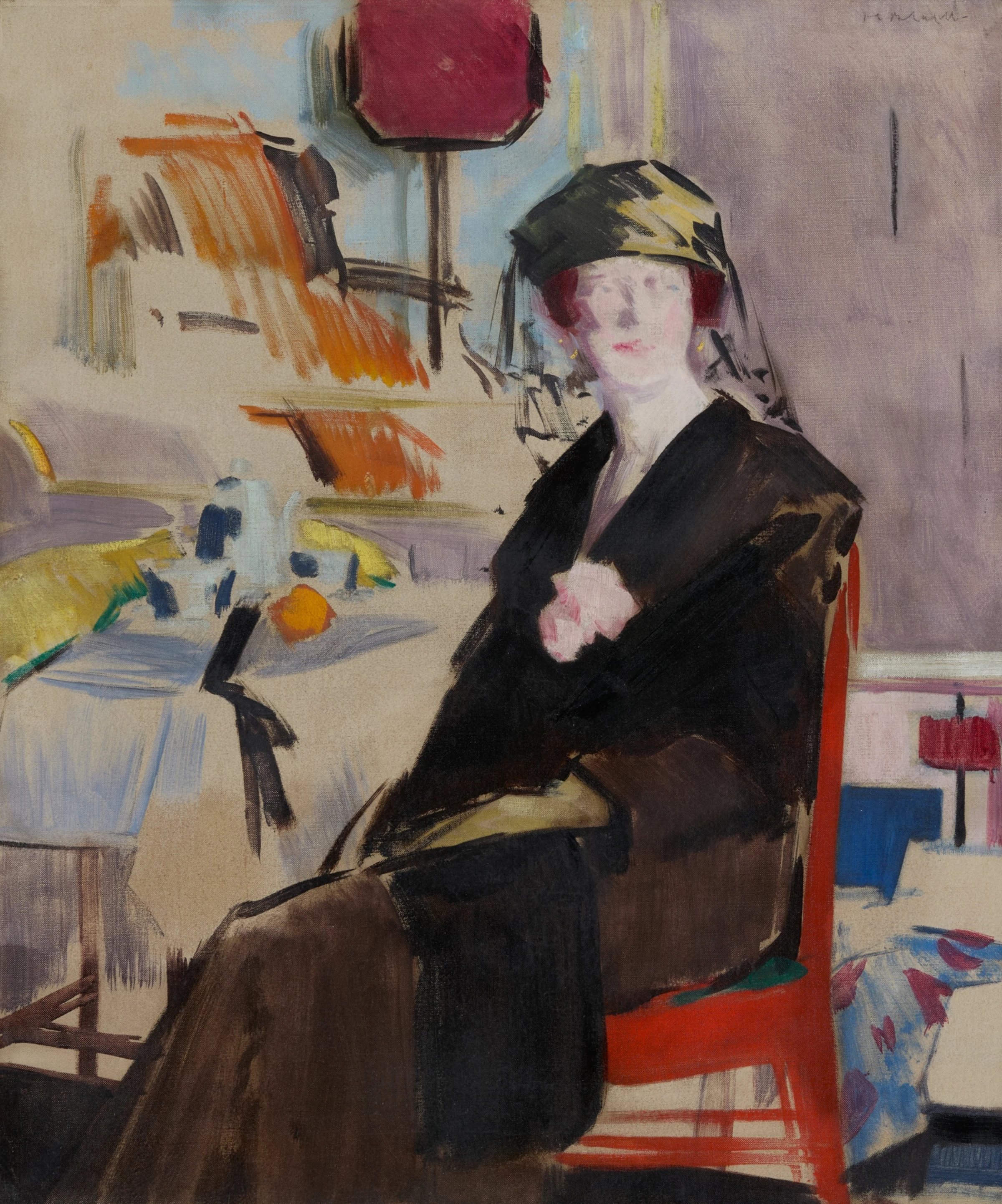
The art market loves a sleeper, but the rediscovery of F.C.B. Cadell’s Interior: The Lady in Black is notable because the story is not only about money. It is also about method. According to ARTnews, Helene Plotkin bought the painting for under $100 at a White Plains thrift store roughly sixty years ago because she liked the brushwork and color. This month, after her son turned to Google’s Gemini for help, the work was connected to the Scottish Colourist Francis Campbell Boileau Cadell and went on to sell for more than $250,000. That headline invites the usual AI amazement, but the stronger story is how digital pattern matching interacted with old-fashioned looking, provenance, and auction-house scholarship.
The sale itself gives the painting institutional footing. On the Lyon & Turnbull lot page, the work is catalogued at 62.2 by 75 centimeters and traced to a Christie’s London sale on 18 March 1966, where it was incorrectly titled Portrait of Miss Don Wauchope and sold for £21 before being acquired by the present owner in New York that same year. That chain matters because AI did not conjure a marketable masterpiece out of thin air. It helped reopen a trail that experts could then test against archival evidence, auction records, and the known grammar of Cadell’s interiors.
What the painting reveals about Cadell at his peak
Cadell’s work has always rewarded people who understand atmosphere as structure. Lyon & Turnbull’s own essay on the lot, echoed in its related story F.C.B. Cadell and the Art of the Modern Interior, describes the picture as an image of the artist’s north-facing Edinburgh studio, with lilac walls, polished black floors, mirrors, a coffee set, a ribboned fan, and the model May Easter seated at the center. These details are not decorative filler. They are the mechanism by which Cadell transformed upper-class interiority into a high-key modernist theater of surface, reflection, and self-fashioning.
The work dates from what the auction house calls the most important and successful period of Cadell’s career, after his demobilization from the First World War and during the years when his Ainslie Place home became both studio and motif. That context helps explain why the picture resonates so strongly in today’s market. The Scottish Colourists remain attractive not merely because they are scarce, but because their best works sit at a productive intersection of national identity, design history, and cosmopolitan modernism. Cadell is intensely local in his Edinburgh sensibility and broadly European in his pictorial intelligence. Interior: The Lady in Black makes that double identity immediately legible.
There is a second reason the painting landed so forcefully. It looks expensive in the way buyers understand instinctively. The black dress, the red chair, the veil, the mirror play, and the decorative precision create the sort of visual authority that does not require academic patience to admire. That may sound crude, but auction results are shaped partly by how quickly a picture can announce its seriousness in a room or on a screen. Cadell’s best interiors do that almost instantly.
Where AI fits and where it does not
The temptation is to say AI discovered the painting. That overstates the case. Plotkin discovered it decades ago by recognizing quality even without a name attached. Her family preserved it. The auction house traced provenance and wrote the scholarly case. AI seems to have served as an accelerant, not a substitute, narrowing the distance between curiosity and attribution. That still matters. Many families with inherited pictures never reach the stage of contacting specialists because the threshold for asking feels too high. A conversational tool that suggests a plausible artist, school, or comparison can bring dormant objects back into circulation.
But the risks are obvious. Attribution is not image search dressed up as expertise. Models hallucinate. They flatten nuance. They can produce confident nonsense if fed weak images or partial information. The danger is that collectors begin treating AI as an authentication device rather than an index of possibilities. In this case the system happened to point toward a real and valuable painting. In many others it will point somewhere plausible but wrong. The responsible takeaway is modest: AI can help people ask better questions sooner, but it cannot replace specialists, provenance work, condition analysis, or legal due diligence.
This is especially true in art histories where variants, studio hands, copies, and afterlives complicate any neat visual match. The more liquid the market, the more incentives there are to believe a machine when it tells you what you want to hear. Auction houses know this. So do insurers, museums, and estate managers. Expect more marketing around AI-enabled rediscoveries, but also expect the serious end of the trade to keep insisting on documentary proof.
Why this sale lands beyond one family windfall
The Cadell result speaks to a market increasingly hungry for stories that combine scholarship with spectacle. Buyers do not just want a good picture; they want a picture with a narrative strong enough to survive social circulation. A thrift-store acquisition that reenters the market through AI prompting has exactly that narrative. Yet the better lesson lies in how traditional expertise still underwrites the final price. The sale does not show a machine replacing the art world. It shows the art world turning a machine-assisted lead into a verified object of desire.
That distinction matters for smaller houses and regional categories. Scottish painting does not receive the same global chatter as blue-chip postwar art, but a story like this expands the audience for Cadell by making connoisseurship feel contemporary again. It also reminds collectors that rediscovery does not belong only to major estates and blockbuster archives. Sometimes it happens because someone trusted their eye in a thrift store, then waited long enough for the right technology and the right specialists to meet the object.
The broader implication is not that AI will flood the market with lost masterpieces. It is that attribution workflows are getting more porous. That can be healthy if it leads more owners toward proper expert review. It will be unhealthy if it trains people to see every unidentified picture as a lottery ticket. In the Cadell case, luck met discipline. That is rarer than the headline suggests, which is precisely why the story deserves attention.
There is also a useful contrast here with outright fraud narratives. Our recent report on new technology in French art-forgery investigations dealt with the opposite problem: too much false certainty wrapped in technical language. The Cadell story lands because the object itself could carry the scrutiny placed on it. That is a crucial distinction. Technology is most useful in art history when it increases the number of worthwhile leads, not when it pretends to end debate. In this case, AI widened the search while provenance and specialist judgment did the closing work. That hierarchy should stay intact.
Another reason this result resonates is that it restores attention to the middle zone of the market where scholarship still changes lives. The headlines around mega-collections and trophy consignments can make art history look inaccessible to ordinary owners, as though meaningful rediscoveries happen only inside vaults or museum basements. A painting bought on instinct in a thrift store interrupts that hierarchy. It suggests that significant works can still circulate below elite radar and that regional categories like Scottish modernism remain vulnerable to misidentification precisely because the market does not watch them with the same obsessive intensity reserved for the usual global stars. That vulnerability creates risk, but it also keeps the field intellectually alive.
The provenance trail reinforces that point. A Christie's attribution error from 1966 did not erase the painting's quality, but it helped send the work into decades of quiet private life. Once an object slips free of a widely legible title and artist name, it can become invisible to the systems that would otherwise track it. Rediscovery stories often depend on repairing those breaks in legibility. AI may help surface candidates, but what restores an object to history is still the slow work of reconnecting the picture to records, exhibitions, and the habits of close description that markets trust.
What comes after the AI rediscovery headlines
The next phase will be quieter and more consequential: collectors, auction houses, and estates will build AI into early-stage triage while guarding the high-value decisions behind human expertise. We are already in that transition. Sales like this give the trade a feel-good example to point to, but they also sharpen the need for better public language about what AI actually did. If that language stays imprecise, the market invites confusion. If it gets more honest, AI could become one more useful instrument in the long chain between looking and knowing.
For Cadell, the sale reinforces his standing as more than a regional favorite. For everyone else, it is a reminder that tools can widen access to art history without dissolving the gatekeeping functions that keep the market from descending into fantasy. That balance is fragile. It is also where the real future of machine-assisted attribution will be decided.