Nick Doyle Turns the AI Oracle into Gallery Theater
Nick Doyle's Perrotin show uses an AI psychic named Ava to fuse self-help speech, tech hype, and American myth into gallery theater
Nick Doyle's Perrotin show understands that AI is already a performance genre
Nick Doyle's Collective Hallucinations at Perrotin New York lands at exactly the right pressure point in the current AI-art conversation. The interesting thing about the exhibition is not that it uses artificial intelligence. Plenty of artists do that now, often with less to say than they think. What matters here is that Doyle treats AI as a social costume before he treats it as a technical system. As ARTnews reported, the installation centers on Ava, an AI oracle who speaks in a language that slides between therapy, influencer reassurance, mystic suggestion, and hustler confidence. That mix is not gimmickry. It is the dominant tone of platform-era persuasion rendered spatially visible.
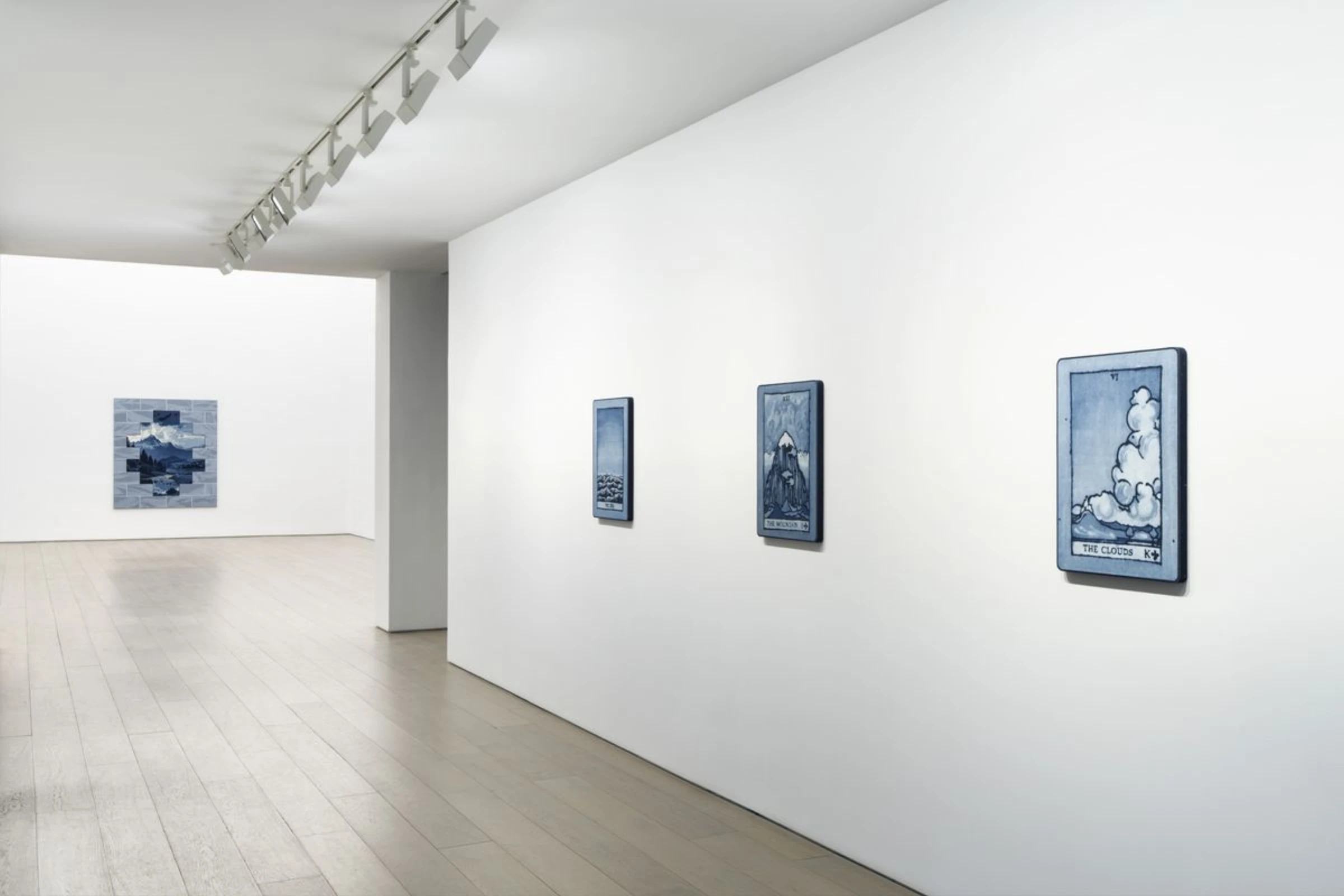
Perrotin's own exhibition page makes the structure clear. Doyle pairs wall-mounted denim collages with an immersive psychic-parlor installation he describes as his first experiment with AI. The gallery says the work mines the relationship between land and technology, progress and destruction. That phrase can sound like standard contemporary-art packaging, but in this case it points to something sharper. Doyle is linking frontier myth, Californian futurism, and self-invention culture as parts of one American belief system, not separate topics stitched together for relevance.
The show's best move is to connect psychic services, western myth, and tech sales language
The centerpiece, a denim-clad structure advertising "Psychic Readings $10 Special," is smarter than it first appears. A cheap storefront oracle and a venture-backed AI interface promise the same thing in different accents: insight without labor, revelation without politics, intimacy at scale, and a personalized route through uncertainty. That is why Ava matters. She is not simply an artwork's chatbot component. She is a condensation of cultural scripts we already know by heart, from lifestyle coaching and wellness spirituality to predictive analytics and startup optimism. Doyle is not asking whether machines can sound human. He is asking why contemporary humans already sound so much like machines trained to keep us engaged.
The western imagery deepens that reading. Perrotin's text describes collaged symbols such as aviators, bricks, car keys, cacti, and blocked or fenced reinterpretations of Ansel Adams landscapes. These are not random Americana props. They are pressure points in a mythology of freedom, property, mobility, masculinity, and westward possibility. Doyle, who grew up in Southern California, seems less interested in romanticizing that mythology than in showing how exhausted it has become. The desert dream persists, but under late capitalism it arrives fenced, monetized, burnt out, and algorithmically narrated back to us.
This is where the show becomes more than another AI-curious installation. Many artists working with machine systems focus on image generation, computational aesthetics, or the politics of data extraction in a relatively direct way. Doyle comes at the subject sideways through performance language and symbolic décor. That may prove more durable, because the most important cultural fact about AI right now is not only what the technology can do. It is the kind of person it asks us to become: coached, optimized, suggestible, always one prompt away from a better self and a worse dependency.
Denim gives the work a material intelligence that saves it from concept-only art
Doyle's continued use of denim is crucial. Without that material stubbornness, the exhibition could easily have floated off into topical cleverness. Denim is one of those fabrics that carries too much history to behave innocently. It evokes labor, fashion, masculinity, Americana, commodity circulation, and class performance all at once. By tailoring it into wall-based symbols and using it inside the installation, Doyle keeps the work tethered to manufacturing, wear, and mythic national texture. The AI oracle does not emerge from a sleek posthuman void. It emerges from the cultural fabric of the United States, literally and metaphorically.
That grounding matters because a lot of AI art still mistakes relevance for substance. The artist plugs a machine-learning element into the room and assumes the work has inherited complexity. Doyle is doing something more disciplined. The technological element is only one register inside a larger set of references that includes Ansel Adams, strip-mall architecture, pawnshop atmospherics, and the implosion of the American dream. Even readers skeptical of the exhibition's rhetorical frame should admit that it is trying to place AI inside a historical continuum rather than treating it as unprecedented magic.
There is also a formal pleasure in that decision. The collaged symbols sound almost cartoonishly legible on paper, yet they may work precisely because they flirt with cliché. American mythology is made of clichés: the road, the sun, the fence, the key, the open land that turns out not to be open at all. Doyle seems to know that if he handles those symbols too delicately, the work dies. Better to let them arrive with their full burden of recognizability and then darken them until they feel sour, overdetermined, and newly suspect.
The exhibition's weakness may be the same thing that makes it recognizable
There is still a risk that the show's tone becomes too easy to consume. The AI psychic, the self-help cadence, the denim Americana, the critique of progress mythology: all of it is legible fast, which is both a strength and a hazard. In a gallery ecosystem shaped by image circulation and conversational snippets, recognizability helps the work travel. But recognizability can also flatten the experience into something like stylish diagnosis. The strongest version of the show would keep surprising viewers after the premise is understood. The weaker version would let the premise do too much of the labor.
That is where writing and installation pacing will matter. Can Ava's speech actually destabilize the visitor, or does she mainly confirm what a skeptical urban art audience already believes about platform culture? Does the physical set create enough friction to resist becoming a photo-ready one-liner? It is easy to stage a fake psychic booth. It is harder to make it function as an instrument for reading twenty-first-century desire. Doyle may be able to do that, but the test is experiential, not conceptual.
There is a useful comparison with our coverage of Bergen Assembly's new convenors. Both cases involve institutions trying to navigate states of enchantment without giving up critical intelligence. In Bergen's case the question is curatorial atmosphere. In Doyle's case it is machinic intimacy. The common challenge is avoiding the dead zone where irony and belief cancel one another out. If viewers feel only superior to Ava, the work shrinks. If they feel uncomfortably addressed by her, it opens.
What to watch as the AI-art cycle matures
The larger importance of Collective Hallucinations is that it points toward a more socially literate phase of AI-related art. The first wave of attention went to spectacle, generation, and panic. The next useful phase may focus on interface behavior, emotional scripting, and the vernacular of machine-mediated guidance. That is where AI is becoming ordinary in daily life, and that is where artists can still catch culture thinking out loud. Doyle appears to understand that the most revealing AI image may not be a generated picture at all. It may be the sentence that sounds caring while quietly enclosing you inside a commercial logic.
Collectors and curators should also notice what the show does with temporality. It looks backward as much as forward. The psychic booth, western landscape, and denim surface all say that technological fantasy in the United States has always borrowed older forms of prophecy, extraction, and mythic self-renewal. Silicon Valley did not invent those instincts. It monetized them at scale. An exhibition that can make that continuity visible has more staying power than one that simply waves at the newest tool.
For now, Doyle's exhibition looks like one of the more interesting uses of AI in a commercial gallery because it does not pretend the machine is the whole story. The machine is a mask, a salesman, a therapist, a mystic, and a mirror held up to an exhausted national script. That is enough to take seriously. Whether it is enough to haunt the viewer after leaving the gallery is the question that will decide how far this show actually goes.
It also suggests a healthier standard for future AI-related exhibitions. Rather than asking artists to explain the technology more efficiently than journalists or engineers can, institutions should ask what new social theater the technology enables and what old myths it reactivates. Doyle's answer is that the oracle booth and the chatbot are cousins inside the same culture of guidance-for-sale. That insight is not revolutionary, but it is specific, visual, and pointed. In a field crowded with generic anxiety about artificial intelligence, specificity already feels like a real achievement.
That may be the show's quiet strength in market terms as well. Collectors and galleries are going to keep backing AI-adjacent work, but the pieces most likely to last will be the ones that embed machine culture inside older material and symbolic histories instead of chasing software novelty. Doyle has at least made that bet visible. He is wagering that viewers will recognize a national myth talking to itself through a synthetic voice. If enough of them do, the work will outlive the current prompt-cycle chatter surrounding it.