Rietberg Reframes the Colonial Photo Archive
Museum Rietberg's A Kind of Paradise asks who gets to rewrite colonial photography and what repair can mean inside the museum now
Museum Rietberg's new exhibition treats the archive as a site of struggle, not nostalgia
Museum Rietberg's A Kind of Paradise, on view in Zurich through 6 September, deserves attention because it refuses the prettifying habits that often creep into exhibitions about historical photographs. As The Art Newspaper reported, the show gathers artists from Africa, the Americas, Asia, Australia, and Oceania who work through colonial-era image archives without pretending those archives are neutral records waiting to be rediscovered. That distinction matters. Too many institutions still frame the historical photograph as an innocent vessel of memory. Rietberg instead frames it as contested material: evidence of extraction, classification, erasure, fantasy, and imposed ways of seeing that continue to shape public culture long after the shutter clicked.
The museum's own exhibition page makes the ambition plain. It describes a group show in which internationally recognized artists from diasporic and historically colonized contexts reinterpret visual material that once helped define identity and belonging on colonial terms. That language could have drifted into uplift. What saves it is the work's underlying sharpness. These artists are not merely illustrating overlooked stories. They are challenging the authority structure that made certain stories look official and others disposable in the first place.
Curator Jana Guyer has built a show around alteration, refusal, and critical fabulation
The strongest curatorial decision, judging from the reporting, is that curator Jana Guyer does not treat archival photographs as sacred originals whose aura must dominate the room. Instead, the exhibition is structured around how contemporary artists crop, obscure, annotate, restage, and fictionalize inherited images. That includes approaches tied to what Saidiya Hartman has called critical fabulation, where artists and writers work within damaged records while refusing to let official silence decide the limits of narrative. In practice, this means the archive is not restored to stability. It is pushed until its omissions become visible.
That is a better exhibition model than the familiar one in which an institution congratulates itself for finally showing difficult material while keeping the interpretive power firmly in curatorial hands. Guyer appears to understand that the real issue is not access alone. It is what happens after access. Who gets to manipulate the image? Who has permission to refuse its framing? Who can invent where the record is broken? Those are artistic questions, but they are also institutional ones, because museums still decide how much imaginative freedom decolonial rhetoric is allowed to have inside their walls.
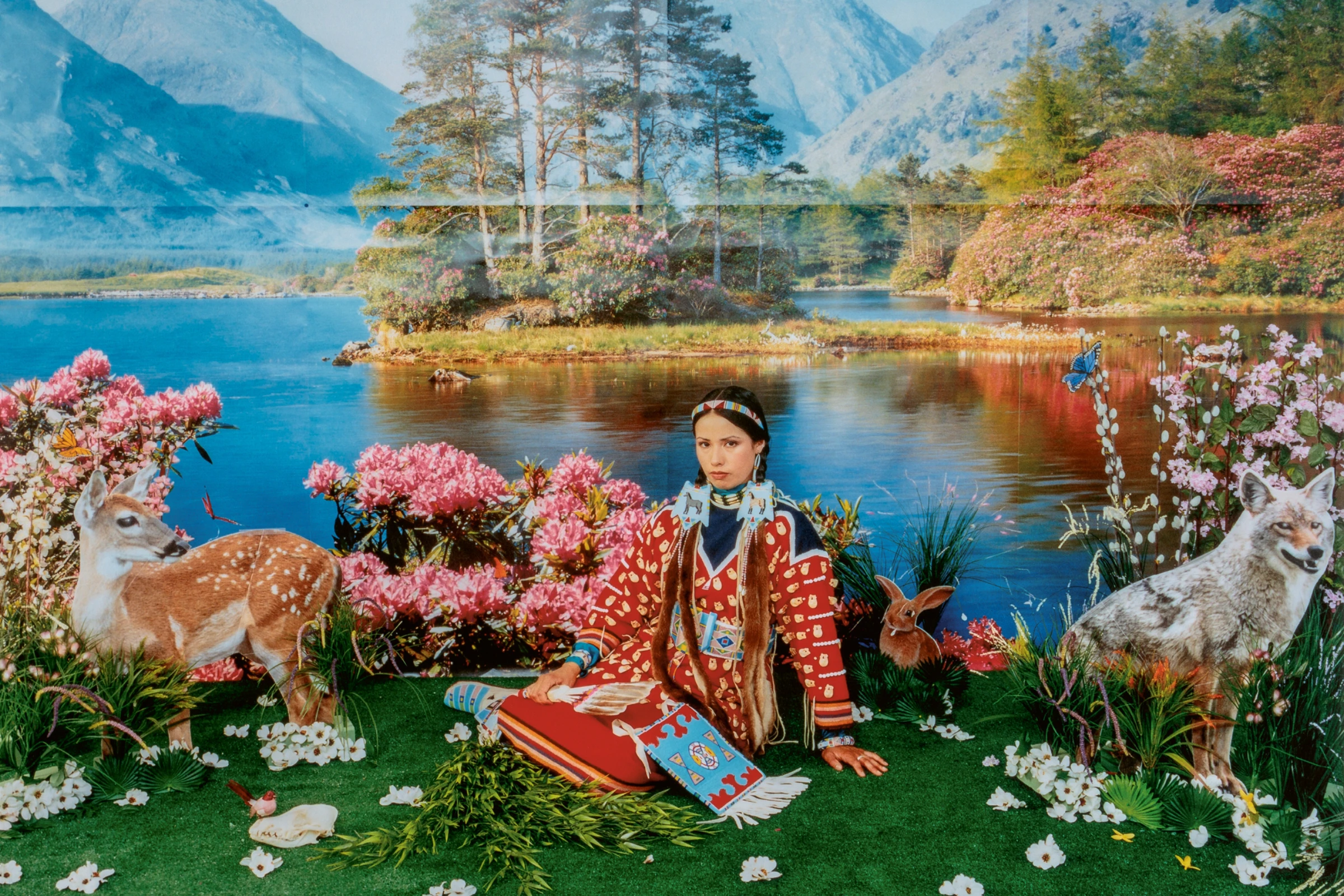
The artist list underscores the point. Museum Rietberg includes figures such as Daniel Boyd, Yuki Kihara, Frida Orupabo, Rosana Paulino, Wendy Red Star, Omar Victor Diop with Lee Shulman, and Andrea Chung. This is not a token roster built to demonstrate global range. It is a set of practices already known for scrutinizing the image economies of empire, ethnography, tourism, missionary documentation, and racial typology. By putting them in one frame, the museum is not only surveying a trend. It is admitting that some of the most urgent contemporary work right now is being done through hostile inheritances rather than clean slates.
The show matters because colonial photography still shapes how institutions imagine knowledge
There is a tendency to speak about colonial photography as though it belongs to a sealed nineteenth-century past. That is convenient and wrong. The classificatory habits embedded in those images survive in museum catalogues, schoolbooks, travel marketing, anthropological legacies, donor narratives, and the broader desire to turn other people's lives into legible visual information. A show like this matters because it insists that the archive is not dead storage. It is active infrastructure. The old image keeps working unless somebody interrupts it.
That interruption can be formal, emotional, or political. One artist may erase faces to register violence in the record. Another may reconstruct kinship where the archive recognized only specimen and type. Another may take a colonial photograph's compositional logic and turn it against itself. The point is not that all archival reuse is automatically radical. Plenty of contemporary art treats old photographs as mood boards. What gives this exhibition force is that it appears to distinguish between aesthetic recycling and real historical pressure. The artists are not mining the past for texture. They are contesting how visual authority was built.
Readers who followed our coverage of the Wellcome Jain manuscripts transfer will recognize the broader pattern. Across museums and archives, the issue is no longer whether institutions can acknowledge compromised holdings in principle. The issue is whether they will allow that acknowledgement to alter the terms of scholarship, display, and authorship. A Kind of Paradise suggests one answer: let artists treat the archive as unstable evidence rather than a stable patrimony. That is a stronger move than another wall label about difficult histories.
Rietberg also exposes a European institutional contradiction it cannot fully escape
It is worth praising the exhibition without pretending the host institution sits outside the problem. Museum Rietberg is itself a European museum shaped by collecting histories, display traditions, and audience expectations that emerged from the same imperial world the show critiques. That contradiction does not invalidate the project. It does mean the exhibition should be read as self-implication rather than benevolent correction. A museum cannot simply host decolonial work and declare the matter handled. It has to prove, over time, that such work changes collecting priorities, interpretation, staffing, partnerships, and research methods.
That is where the hardest questions begin. Does the exhibition generate new commitments to provenance research, to collaboration with source communities, to the re-description of older holdings, or to giving artists leverage over interpretation beyond the show itself? Or does it remain a temporary island of criticality inside a structure otherwise happy to continue as before? No single exhibition can answer that alone. But a serious reader should keep the question alive, because institutional appetite for radical language often exceeds its appetite for redistribution of authority.
The same tension appears in the show's emotional rhetoric. Museum copy speaks of healing power, and that may be true for some visitors. But healing is not the same as comfort. The more useful achievement here may be estrangement. Good archival art makes viewers less sure they know what a photograph is doing, whose desire it served, and what kinds of speech it suppressed. If visitors leave feeling gently enlightened rather than newly suspicious of visual inheritance, then the exhibition will have been absorbed too neatly into the liberal museum script.
What comes next is whether museums let this method travel beyond one successful exhibition
The exhibition will likely be discussed as evidence of a broader curatorial turn toward archival practice, and that is partly right. But the real test is whether other institutions learn the correct lesson. The lesson is not simply that archive-based shows are timely. It is that artists need room to disobey the archive's original terms. Museums that borrow the surface of this exhibition while neutralizing its method will miss the point entirely. The future value of A Kind of Paradise depends on whether it becomes a model for riskier interpretation, not just another reference in decolonial programming decks.
That is also why this exhibition has practical significance for artists, curators, and readers. Artists gain a visible precedent for treating historical photographs as material for reconstruction rather than reverence. Curators get a reminder that context can be sharpened through juxtaposition and refusal, not only expanded through more didactic text. Readers get a framework for looking harder at any exhibition that claims to revisit difficult archives. Ask who is granted narrative agency. Ask what gets covered, cut, or reimagined. Ask whether the institution seems willing to let uncertainty remain in the room.
If the answer to those questions stays productively unsettled, Rietberg will have done more than mount a topical group show. It will have helped move the museum field away from the fantasy that the archive becomes ethical as soon as it is displayed critically. That fantasy has lasted too long. The more bracing possibility is that archives become newly legible only when artists are allowed to wound the record back.
There is also a pedagogical consequence worth watching. Exhibitions like this can change how younger artists, students, and museum visitors understand the act of looking itself. If the show succeeds, viewers will leave more alert to cropping, captioning, sequencing, institutional custody, and the emotional weather produced by old photographs. That is not a minor outcome. It means the exhibition would be building archival literacy rather than merely showcasing archival art. In a moment when digital circulation strips images from context at industrial speed, that kind of literacy may be one of the most practical critical tools a museum can help produce.
That educational effect could turn out to be the exhibition's longest afterlife. A museum audience trained to see photographs as edited power relations rather than transparent windows becomes harder to placate with sentimental archive talk later on. That matters well beyond Zurich. Collections departments, curatorial teams, and school programs across Europe are all under pressure to show that critical history can be made visible without collapsing into jargon. If Rietberg has found a way to do that through artists rather than institutional sermonizing, other museums will study the model closely.