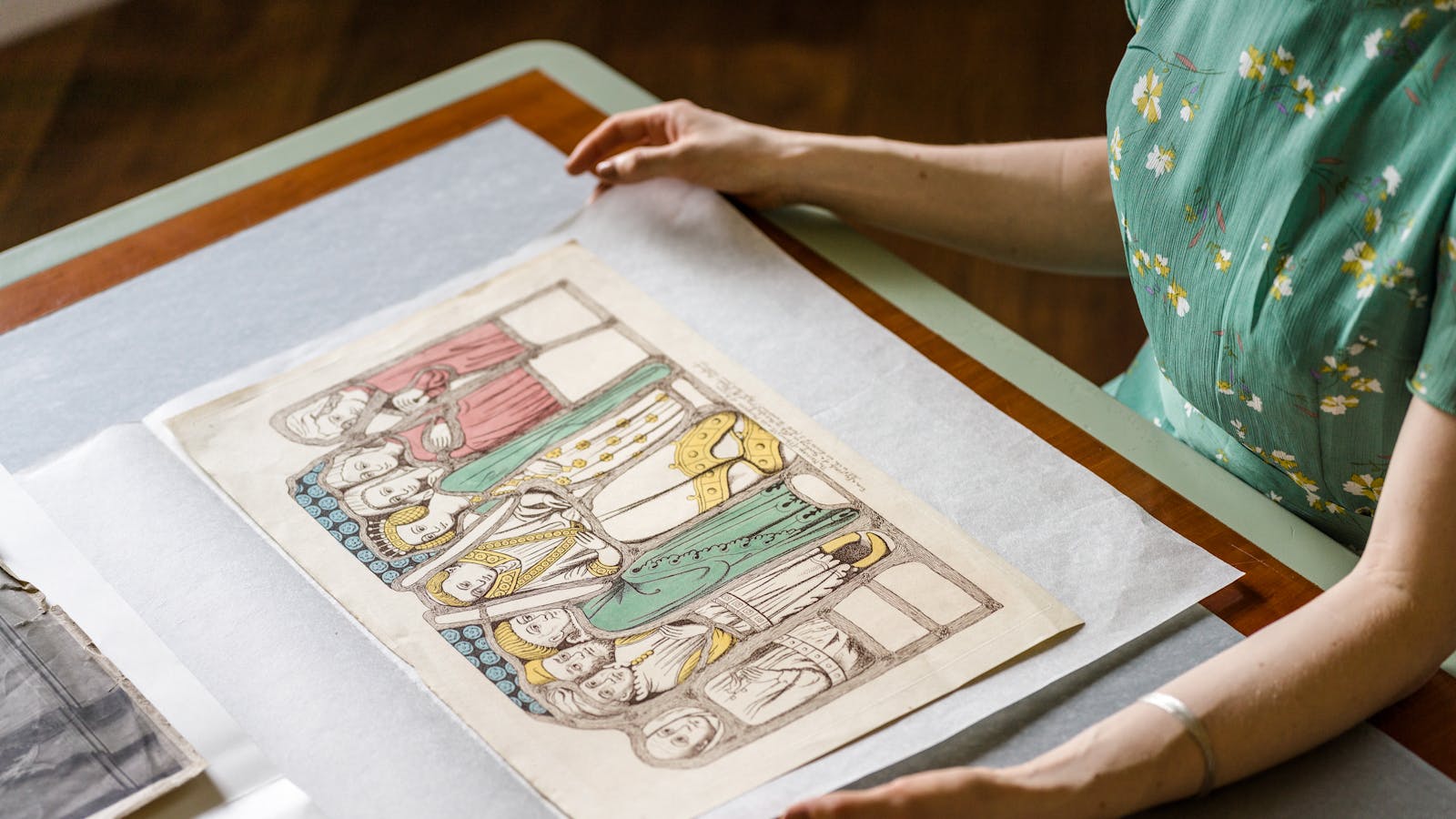
Wellcome’s Return of 2,000 Jain Manuscripts Tests a More Useful Model of Restitution
Wellcome Collection’s transfer of 2,000 Jain manuscripts suggests a restitution model built around community care, research access, and historical honesty rather than symbolism alone.
Wellcome Collection’s plan to transfer roughly 2,000 Jain manuscripts to the Birmingham Centre of Jain Studies through the Institute of Jainology is one of the most serious restitution stories in Britain this year. As The Art Newspaper reported, the manuscripts were acquired in 1919 from a Jain temple in what is now Pakistan at what Wellcome’s own collections team describes as a low price and against the best interests of the original owners. That admission alone matters. It rejects the old museum habit of treating compromised acquisition histories as unfortunate footnotes rather than grounds for action.
What makes this case more interesting is that the destination is not the nation-state most outsiders might expect. The manuscripts are not being sent to India or Pakistan. Instead, they are being transferred to a UK-based Jain institution for deposit at the University of Birmingham. In less careful hands, that arrangement could look like a dodge. In this case, it reads as an attempt to match restitution to actual custodial capacity, community access, and scholarly infrastructure rather than to a simplified geography of return.
That matters because the manuscripts sit inside the brutal historical afterlife of partition. The original Jain communities connected to these materials were scattered by the violence and displacement that accompanied the 1947 division of India and Pakistan. In that context, a restitution plan built purely around national territory could easily become symbolic rather than practical. Wellcome’s challenge was not just to recognize that the manuscripts were acquired wrongly. It was to determine where they could be responsibly cared for now, by people with a living stake in them.
The result is imperfect, but usefully so. It acknowledges that decolonial restitution is often messier than slogans allow. Objects do not always have a single obvious home after a century of dislocation, war, migration, and institutional collecting. What responsible museums owe the public is not a fantasy of purity. They owe a transparent explanation of why a particular transfer route best serves the originating community, the material itself, and future research access.
Why this restitution case is stronger than a symbolic headline
The strongest part of the Wellcome decision is its combination of moral clarity and practical planning. Adrian Plau’s acknowledgement that the manuscripts were bought cheaply and contrary to their owners’ interests is important because it names harm without hedging. Too many institutions still treat restitution as a reputational concession, framed in neutral language about provenance complexity or evolving standards. Here, the institution appears to have said what should be said: the acquisition conditions were wrong, and continued possession is therefore difficult to justify.
But moral clarity alone is not enough. A credible transfer also requires a receiving structure capable of safeguarding and activating the material. The University of Birmingham’s Jain studies infrastructure offers that. So does the involvement of the Institute of Jainology, which has long worked to build community-facing scholarship and visibility in the UK. In other words, the receiving arrangement is not just ceremonial. It is designed to produce cataloguing, conservation, teaching, research, and access.
The numbers involved raise the stakes. This is not a single icon returned for a photo opportunity. It is a large scholarly corpus, stored across many boxes, including manuscripts with relevance to medicine, religion, language history, and visual culture. A transfer of this scale requires governance, conservation planning, rights management, and long-term institutional commitment. That makes the case unusually significant for other libraries and museums holding large manuscript groupings acquired under colonial-era asymmetries.
Wellcome also benefits from the fact that it already presents itself as an institution rethinking the biases embedded in its collections history. Its own collections platform explicitly notes that the holdings were assembled within racist, sexist, and ableist systems of valuation. Statements like that can be cheap if they remain rhetorical. They become meaningful when an institution is willing to part with important material rather than simply describe the problem in wall text.
The case exposes the limits of nation-first restitution frameworks
Public debates about restitution often get trapped in a single question: which country should receive the object? That framework is understandable, but it can be too blunt for archives and manuscripts shaped by migration, religious community, and political rupture. The Jain manuscripts case shows why. Pakistan is the modern territory from which many of these materials were taken, yet the Jain communities tied to those temple worlds were largely displaced. India has a far larger Jain population, but not necessarily one obvious institution positioned to receive a vast British-held archive immediately. The transfer therefore had to be thought through on community and infrastructural terms, not only cartographic ones.
This does not mean nation-state claims are irrelevant. It means they are sometimes insufficient as the sole decision rule. Museums dealing with manuscripts, archives, and sacred or semi-sacred objects may need to build layered solutions involving community organizations, university repositories, and shared stewardship agreements. If that sounds administratively messy, it is because history is messy. Clean restitution narratives often fail precisely where material histories are most damaged.
There is a lesson here for institutions that fear restitution because they imagine it always leads to absolute loss of research access. The Birmingham arrangement suggests another route: transfer ownership or authority while preserving robust scholarly use and community engagement. That is not a loophole to keep control. It is a way of separating possessive institutional reflex from the genuine public good of study, cataloguing, and access.
The British museum sector should be paying attention. Libraries and archives hold many dispersed manuscript groups whose acquisition histories are ethically compromised but operationally complex. The Wellcome case suggests that the right question is not, “Can we find the perfect recipient?” It is, “Can we build the most just and durable custodial network from the institutions and communities that actually exist?”
What other institutions should learn from Wellcome’s move
First, museums need to document the grounds for return in plain language. If an object group was acquired under coercive, exploitative, or grossly unequal conditions, say so. Do not bury the issue in provenance jargon. Second, institutions should involve receiving communities early enough that the transfer model is shaped collaboratively rather than announced as a finished benevolent act. Third, they should budget for the afterlife of restitution: conservation support, digitisation, cataloguing help, transport, and where appropriate, ongoing partnership.
That last point is crucial. Returning 2,000 manuscripts is not like returning a painting. The value lies partly in the corpus. Scholarship depends on keeping the body legible, stable, and accessible. If museums want restitution to be more than reputation management, they need to support the conditions that let returned materials live active intellectual and community lives after transfer.
Wellcome’s decision will not settle the sector’s arguments. Some critics will say the material should have gone to South Asia. Others will argue the UK destination reflects lingering institutional control. Those tensions are real. But the measure of the decision should be whether it improves justice, care, and access relative to the status quo. On that test, the move looks more serious than most British institutional gestures in this area.
The transfer also sharpens a broader point. Restitution is not only about giving things back. It is about replacing the collector’s logic with a custodian’s logic. In 1919, the manuscripts entered Wellcome through a market mindset that treated vulnerability as opportunity. In 2026, they are leaving through a framework that at least tries to prioritize community connection and viable care. That is not a full repair of history. It is, however, a material break with the assumptions that made the acquisition possible in the first place.
Another reason the case deserves attention is that manuscripts behave differently from more familiar restitution flashpoints such as bronzes, sculptures, or paintings. They are deeply relational objects. Their value lies not only in visual singularity but in networks of script, commentary, ritual use, marginal notation, material history, and comparative study. A museum cannot claim to have addressed restitution seriously if it treats manuscript return as a single handover event rather than as the transfer of a living research ecology.
There is also a British policy angle. If the Charity Commission approval process moves forward as expected, the case may become a practical reference point for other UK bodies holding contested archives under charitable structures. That could matter well beyond Jain materials. It could shape how trustees talk about fiduciary duty when ownership history is ethically unsustainable. For readers tracking this shift, artworld.today’s earlier guide to reading a catalogue raisonné critically offers a parallel lesson: cultural stewardship gets stronger when institutions stop mistaking possession for authority.
The Wellcome transfer will still need to be judged by execution. Are the manuscripts catalogued clearly after transfer? Is access meaningful for Jain communities as well as for scholars? Are digitisation and conservation priorities funded, not simply promised? Those are the measures that will tell us whether this becomes a durable model or merely an unusually articulate announcement. But even at this stage, the institution has done something many museums still resist. It has accepted that ethical repair may require losing possession in order to gain legitimacy.