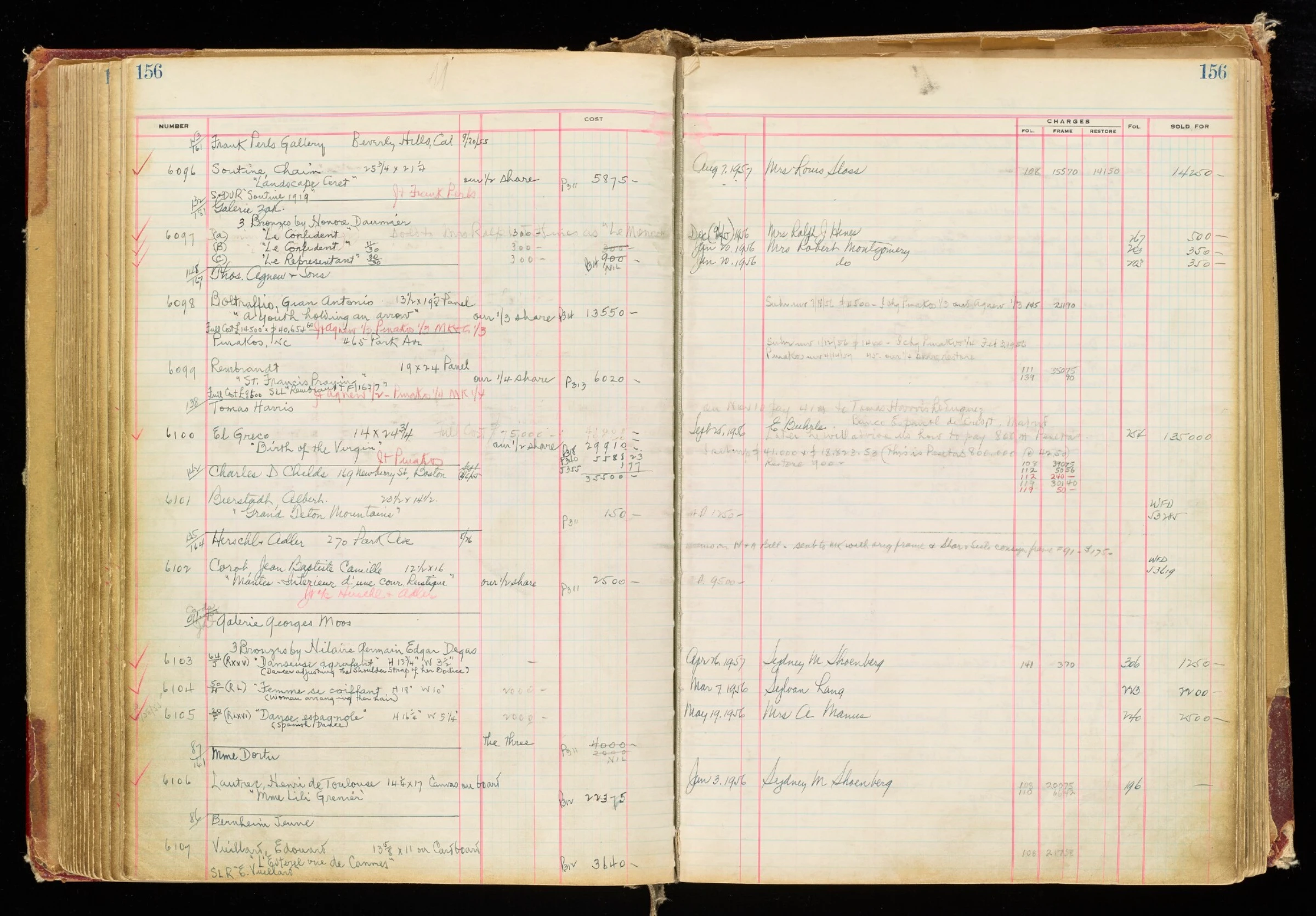
How to Read a Catalogue Raisonne
A catalogue raisonne is the most rigorous instrument available for assessing an artist's complete body of work. Knowing how to use one is essential for collectors, researchers, and anyone navigating the secondary market.
A catalogue raisonne is the most rigorous instrument available for assessing an artist's complete body of work. Compiled over years, often decades, by scholars with direct access to estate archives, correspondence, and physical objects, the catalogue raisonne attempts to document every work an artist produced, organized typically by medium, period, or both. For collectors, researchers, and anyone navigating the secondary market, knowing how to read one is an essential competency that separates informed participation from speculation.
The first thing to understand is what a catalogue raisonne actually claims. A well-constructed catalogue raisonne is not merely a list of works: it is a scholarly argument about authenticity, dating, and provenance. Each entry typically includes a catalogue number, dimensions, medium, current location or owner, exhibition history, literature references, and a provenance chain. The completeness of these entries varies significantly between catalogues, and understanding their gaps is as important as understanding what they contain.
Attribution is the most consequential question a catalogue raisonne addresses. When a work appears in a catalogue raisonne, it is understood, provisionally at minimum, to be genuine. When it does not appear, that absence is meaningful but not necessarily disqualifying: catalogues are revised, supplementary volumes are issued, and scholars sometimes disagree. The critical habit is to ask why a work is or is not included, not simply whether it appears. Organizations such as the International Foundation for Art Research (IFAR) maintain databases and advisory services that can contextualize attribution disputes when a catalogue raisonne entry is ambiguous or contested.
Provenance entries deserve particular scrutiny. In a responsible catalogue raisonne, the provenance chain traces ownership from the artist's studio or first known sale to the present, with gaps noted rather than elided. The most reliable catalogues flag ownership breaks, particularly for works that circulated through European collections between 1933 and 1945, a period of widespread displacement and coerced transfers. Institutions such as the Getty Provenance Index and the Art Loss Register provide supplementary databases that scholars cross-reference when assessing these gaps. Any provenance chain that skips this period without explanation warrants additional investigation before acquisition.
Dating can be contested. Artists did not always sign and date their works, and catalogue raisonne scholars must reconstruct chronologies from exhibition records, correspondence, photographs of studios, and stylistic analysis. When dates are given as ranges, or marked as approximate, the catalogue is being honest about uncertainty. That honesty is a sign of scholarly integrity rather than weakness. Treat works with approximate dating as requiring additional corroboration rather than as red flags in themselves.
The literature field in each entry lists publications in which the work has been reproduced or discussed. A deep literature trail generally supports attribution, though it is not proof: forged works have occasionally appeared in print. More useful is the relationship between literature references and exhibition history, because works shown repeatedly in institutional contexts over decades tend to have more robust documentation trails than works that emerge suddenly from private collections. Cross-referencing exhibition histories with institutional records is standard due diligence practice.
Print catalogues raisonnees are updated only through new editions or supplements, which can lag behind scholarly developments by years. Some catalogue raisonne projects have moved online to allow more frequent revisions. The Wildenstein Plattner Institute, which maintains digital catalogues raisonnees for artists including Monet and Gauguin, exemplifies this shift toward real-time scholarship. Before relying on a physical edition, confirm whether a digital supplement exists and whether significant attribution disputes have emerged since the print edition was issued. The field moves, and the most damaging errors in collection building come from treating an old edition as a current authority.
For collectors assessing a potential acquisition, the catalogue raisonne is a starting point, not a verdict. It is standard practice to engage the catalogue raisonne committee directly if one exists, and to commission an independent technical examination of the work, including analysis of pigments, support materials, and, where relevant, canvas or panel construction. Authentication committees for major artists often have formal submission processes, and their decisions carry significant market and legal weight. Some committees have dissolved in the face of litigation risk, leaving a vacuum in authentication infrastructure that buyers must navigate carefully.
Understanding what a catalogue raisonne cannot do is equally important. No catalogue can guarantee authenticity definitively: scholars make judgments on available evidence, and new evidence can revise those judgments. The Wildenstein Plattner Institute and other cataloguing bodies have faced litigation related to authentication disputes, illustrating how high the stakes can become when scholarly judgment intersects with market value. The Getty Research Institute and comparable centers of art-historical scholarship have published extensively on the methodological challenges of authentication, providing essential context for anyone trying to assess a catalogue raisonne entry critically.
The lesson for practitioners is to treat catalogue raisonne entries as authoritative evidence rather than irrefutable proof, and to conduct due diligence accordingly. A catalogue raisonne that is transparent about its limitations, honest about gaps, and methodologically rigorous in its entries is far more valuable than one that projects false certainty. Learning to read these signals is what separates collectors and researchers who use the instrument effectively from those who mistake its presence for a guarantee.
Collectors working with living artists or recently deceased estates should also consider that a catalogue raisonne may not yet exist, or may be in active development. In these cases, direct correspondence with the artist's studio, primary gallery, or estate foundation is the appropriate channel for authentication inquiries. Organizations such as the Appraisers Association of America maintain directories of specialists qualified to assess works in the absence of formal catalogue coverage. The absence of a catalogue raisonne does not necessarily diminish a work's value or authenticity, but it raises the due diligence standard substantially. In practice, acquiring works not documented in a catalogue raisonne requires a higher threshold of primary source verification, direct expert engagement, and technical examination before any transactional commitment is made.