New-York Historical Opens Its Tang Wing in 2026
The New-York Historical opens a $175 million wing for democracy, research, and the future LGBTQ+ Museum while betting architecture can frame a civic argument
A $175 Million Wing Opens as Democracy Itself Feels Less Stable
The New-York Historical is opening the Tang Wing for American Democracy at exactly the kind of moment when institutions love to say the word democracy and many struggle to describe what they can materially do for it. The Art Newspaper reports that the 71,000 square foot expansion cost $175 million, took three years to build, and will open on 18 June with new galleries, library storage, a conservation studio, classrooms, and a future home for the American LGBTQ+ Museum. On paper, this is a standard capital-project success story: public funding, private philanthropy, and an old museum becoming physically larger. In practice, it is an argument about what a history museum thinks architecture can do in a period of democratic strain.
The museum is being unusually explicit about the premise. Its inaugural exhibition, Democracy Matters, arrives during the United States semiquincentennial cycle and stages the building itself as civic pedagogy. There is risk in that choice. The stronger the title, the easier it becomes for viewers to ask whether the institution has built a persuasive space for public thought or simply a photogenic setting for consensus language. The Historical seems aware of that tension. The wing is not just gallery square footage. It folds together collection care, teaching space, reading-room access, and the future arrival of a partner museum whose subject is still too often treated as supplementary rather than central to national history.
What the Tang Wing Actually Adds Beyond Prestige
The reporting makes clear that the expansion is operational as well as symbolic. The new wing gives the Historical two additional exhibition halls, a dedicated conservation studio capable of handling multiple object types, expanded classrooms for its Academy for American Democracy, and an 11-floor storage tower for the Patricia D. Klingenstein Library. Those are not decorative improvements. They change what kind of institution the Historical can be on a daily basis. For a museum that already presents itself as a civic resource rather than a narrow specialist collection, this matters more than the donor headline.
Consider the educational arithmetic alone. Museum president Louise Mirrer says the academy can now host 30,000 students annually in its four-day sixth-grade course, up from 3,000. That is the sort of expansion institutions sometimes bury beneath design language, but it is where the project becomes legible as policy rather than branding. If the Historical can sustain free or low-cost access to this programming, the Tang Wing may matter less as a monument to philanthropy than as infrastructure for repeated contact between students and historical argument. That distinction is everything. A wing earns its keep when it changes institutional throughput, not when it simply adds a dinner-friendly donor narrative.
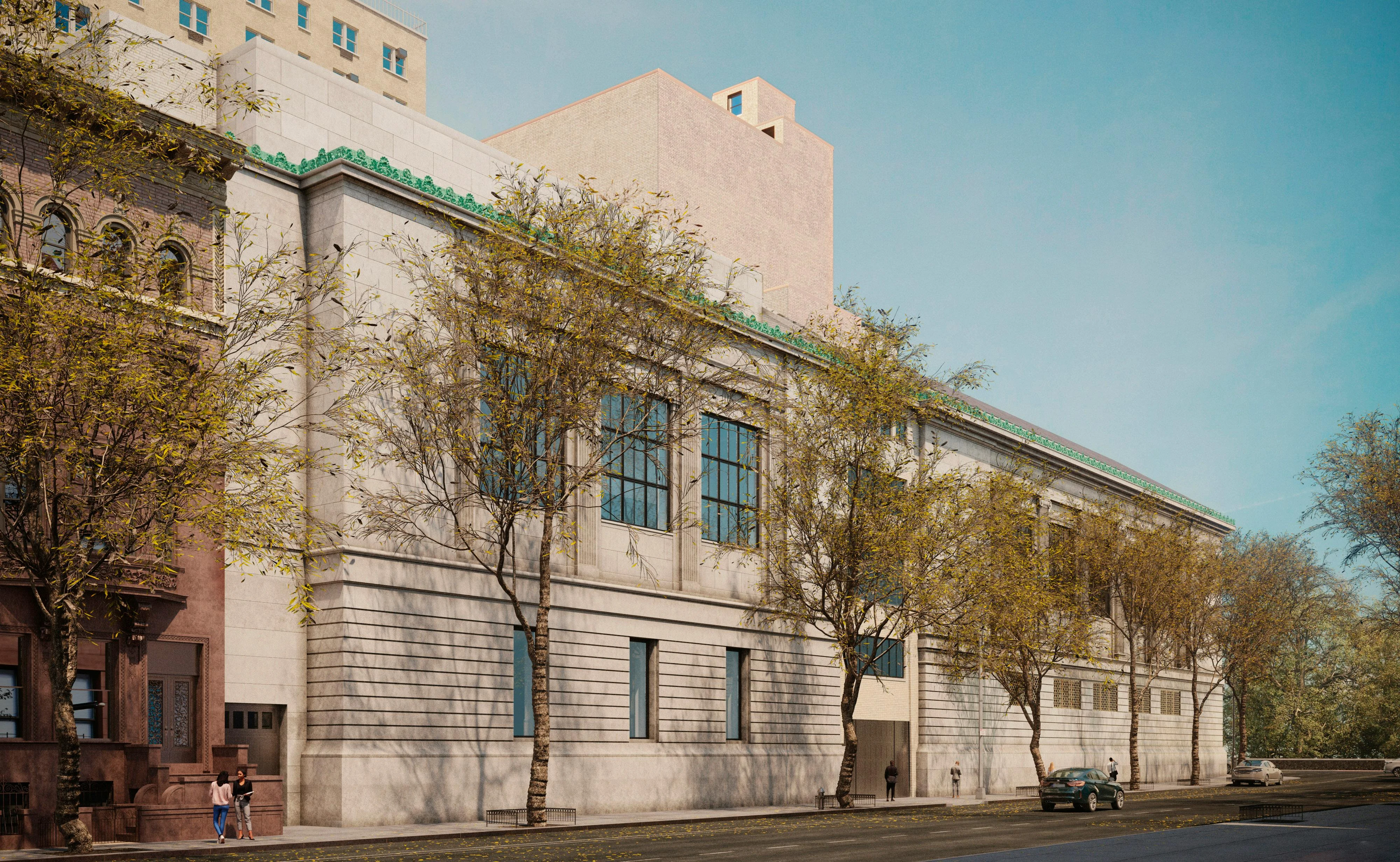
The physical design choices matter too. Robert A.M. Stern Architects did not attempt a rupture. The building extends the Historical's existing Beaux Arts language while expanding its internal machinery. That may sound conservative, but in this case continuity is part of the institutional argument. The Historical wants the wing to feel like an enlargement of a civic trust rather than a signature-architect interruption. The gamble is that aesthetic continuity will let the programming carry the polemical weight. If the exhibitions are sharp, the architecture can serve as a disciplined frame rather than a distraction.
The new conservation studio deserves special attention because it signals a different kind of seriousness than headline galleries do. Conservation space rarely produces splashy opening photos, yet it determines whether an institution can responsibly acquire, lend, interpret, and preserve complicated holdings over time. Expanding beyond paper-only conservation means the Historical is building capacity for textiles, paintings, objects, and mixed historical materials that need highly specialized treatment. That is not glamorous, but it is how museums turn aspirations into durable practice.
There is an archival politics to that expansion as well. When a museum can keep more holdings on site and give researchers better access to them, it changes who can build arguments from the material record and how quickly those arguments can circulate. For a history institution, that is not back-office housekeeping. It is a public function. More shelf space and a better reading room can sound modest next to a grand gallery, but they often produce the deeper institutional effect because they shape what historians, students, curators, and journalists are actually able to study.
The same goes for research access. By restoring and enlarging storage and reading facilities for maps, photographs, archives, books, and major collections like the Billie Jean King papers and Time Inc. archives, the Historical is betting that scholarship still belongs at the center of public history. That sounds obvious until one looks around the sector. Too many institutions now chase spectacular public-facing installations while back-end research functions remain cramped, delayed, or effectively invisible. The Tang Wing's strongest claim is that it treats conservation, archives, exhibitions, and teaching as one ecosystem rather than separate prestige silos.
The Politics of Calling a Building Democratic
Naming the addition the Tang Wing for American Democracy invites scrutiny on several fronts. One is philosophical: can architecture really host democratic thinking, or does it often aestheticize it? Another is financial: what does it mean when democracy is advanced through a project underwritten by large gifts and tied to elite board leadership? The Historical is hardly alone in facing that contradiction. Nearly every major American museum now speaks the language of access, pluralism, and civic value while relying on fundraising models that concentrate decision-making power among a small number of wealthy actors. The wing does not solve that contradiction. It stages it in stone, bronze, terrazzo, and Tennessee marble.
Still, there is substance here. The museum is not using the wing only to celebrate the Founders in a sanitized mood. The reporting describes an opening show that includes both fragments of a toppled George III statue and a recent work by Kent Monkman, an artist whose practice has repeatedly forced historical institutions to confront colonial mythologies. That juxtaposition matters. It suggests the Historical is at least attempting to make democracy visible as a contested process rather than a completed inheritance. That is a higher standard than the default patriotic exhibition model, which often substitutes reverence for analysis.
There is also the future presence of the American LGBTQ+ Museum, set to open on the fourth floor in 2027. That move does not simply diversify the tenant list. It reorders what counts as foundational history inside a major New York institution. Readers who want to understand the strategic significance of this kind of move should look at artworld.today's recent guide on how to read museum expansion announcements. The lesson there holds here too: additions are never only about space. They reveal what narratives a museum wants more room to authorize.
Why This Project Could Reshape the Historical More Than It Reshapes the City
It would be easy to overstate the Tang Wing as a citywide political intervention. Buildings do not repair democratic culture on their own, and even the best museum programming reaches only a fraction of the public sphere. The sharper claim is narrower and more believable. The wing could materially reshape the New-York Historical itself by integrating collection care, pedagogy, and public interpretation at a larger scale than before. That kind of internal restructuring often matters more than the grandest external rhetoric.
The museum also benefits from timing. As schools, universities, archives, and public agencies face ideological pressure, a history museum that expands classroom and research capacity can credibly present itself as protective infrastructure. Whether it deserves that trust will depend on programming choices, not renderings. The institution will have to prove that difficult histories stay difficult once the opening-week glow fades. It will have to show that the rhetoric of democracy does not stop where donor comfort begins.
There is a city-politics dimension as well. New York's cultural institutions are increasingly expected to justify themselves through education metrics, tourism impact, civic identity, and neighborhood value all at once. The Tang Wing gives the Historical more evidence on all four fronts, but it also increases expectations. Once an institution says democracy is its organizing frame, every choice about access, interpretation, staffing, and partnership becomes more legible as a political choice. The wing will be judged not just by architecture critics but by teachers, researchers, students, and communities asked to see their own histories reflected in it.
The strongest museum buildings create pressure as well as possibility. They force institutions to live up to the claims embedded in their floor plans. That may be the best reason to take this project seriously. The Historical has built a structure that promises more classes, more archives, more conservation, more difficult national narratives, and a larger role for LGBTQ+ history. Those are concrete promises. If the museum fulfills them, the Tang Wing will matter long after the opening speeches disappear.
For now, the Tang Wing looks like one of the more serious museum capital projects of the year because it combines symbolic ambition with practical capacity. New galleries alone would not have been enough. New stacks alone would not have been enough either. The power of the project lies in the fact that exhibitions, archives, conservation, classrooms, and future partnership space all reinforce one another. In a museum field full of expansion talk, that is a more convincing use of $175 million than most institutions manage.