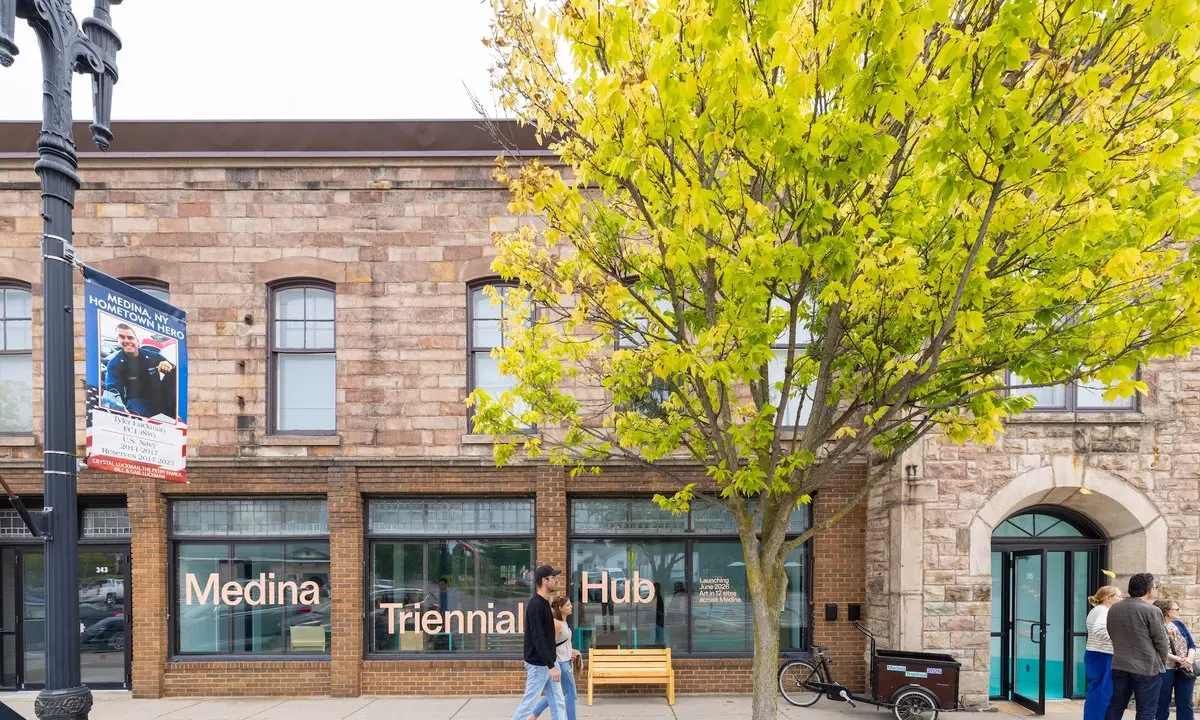
Medina Triennial Makes a Small Town a Big Art Test
The new Medina Triennial uses canal-corridor funding, local labor, and 39 artists to test whether a rural art event can become durable civic infrastructure.
Medina is asking whether a triennial can behave less like a spectacle and more like public infrastructure
The inaugural Medina Triennial opens this weekend with a scale and seriousness that would be notable in any city. In a village of roughly 6,000 people along the Erie Canal, it is something else: a direct challenge to the assumption that ambitious contemporary art must either attach itself to a major metropolis or shrink into a locally charming side event. According to The Art Newspaper, the exhibition brings together 39 artists and collectives across ten sites from 6 June through 7 September. The title of the first edition, All That Sustains Us, makes the proposition unusually clear. This is not a triennial about parachuting art into a picturesque place. It is about maintenance, labor, ecology, and the social systems that allow a town to keep functioning.
The comparison with failed or paused American triennials is useful here. Cleveland’s Front International and the paused seventh edition of Prospect New Orleans showed how difficult it has become to sustain event-driven platforms once philanthropic novelty fades. Medina is starting from a position of smaller ambition, but perhaps greater honesty. It is not pretending to be a global mega-event. It is asking whether a regional art project can earn permanence by fitting the grain of a place rather than overpowering it.
That framing matters because the American exhibition circuit has spent the past several years learning how fragile the large-format art event has become. International triennials sound glamorous until the bills arrive, donors drift, and the host city begins asking what exactly it bought. Medina is entering that landscape with a budget under $2 million, support from regional foundations and overseas funders, and an initial push from the Medina Triennial organization and the New York State Canal Corporation. In other words, it is trying a smaller, harder model: less headline theater, more civic embedding. That is why this opening deserves attention beyond western New York. The experiment is not merely curatorial. It is structural.
The point is easy to miss if one reads the story as another feel-good account of art revitalizing a forgotten town. Medina is not being used as a blank canvas for urbanist fantasy. The exhibition grows from the village’s canal history, its sandstone legacy, and its institutions that still carry community life day to day. That makes the triennial more interesting and more vulnerable. If the work does not connect, there is nowhere to hide behind cosmopolitan buzz. The town will know.
Public money, canal history, and a walkable footprint define the project more than market scale does
One of the sharpest details in the reporting is the source of the original momentum. The New York State Canal Corporation, a subsidiary of the New York Power Authority, backed the initiative as part of a broader $300 million effort to strengthen tourism and recreation along the Erie Canal corridor. That is an unusual chain of support, and it is precisely why the project feels important. American public agencies routinely finance roads, waterfront improvements, lighting, and parks while treating contemporary art as an optional luxury to be considered only after the “real” infrastructure is done. Medina flips that logic. Here culture is being treated as part of the infrastructure question itself.
There is also an economic realism to the curatorial frame. A budget below $2 million would be an afterthought for some city biennials, but in Medina it forces sharper choices. Fewer artists, fewer sites, and more local integration may prove not to be compromises at all, but the reason the project feels believable. Scale is often the enemy of memory. A walkable triennial that residents can explain may do more lasting work than a prestigious one nobody can narrate back to you a month later.
Curators Kari Conte and Karin Laansoo have built the exhibition around a compact geography rather than sprawling ambition. The sites sit within about half a mile of one another, which makes the event walkable in a way many large-scale exhibitions only pretend to be. The official sites program spreads work across parks, a church, a YMCA, a former high school, the railroad museum, and the triennial hub. That choice is not only logistical. It refuses the neutral white-box fantasy that art arrives untethered from local use. Visitors encounter art in spaces that already matter to Medina residents.
The exhibition’s historical grounding is equally deliberate. Medina’s canal and sandstone histories are not decorative backstory; they shape what kinds of works make sense there. Lina Lapelytė’s performance at the railroad museum and Mary Mattingly’s Floating Garden project speak to transport, labor, and environmental interdependence rather than abstract placemaking jargon. The triennial is also borrowing a lesson from events like the Echigo-Tsumari Art Triennale: if a rural exhibition is going to justify itself, it must offer residents something more durable than opening-weekend prestige.
What Medina gets right is the uneasy relationship between participation and seriousness
Community-based exhibition language can turn mushy fast. Every organizer now claims to value listening, participation, and local voices. What usually follows is a set of token workshops that leave the actual power structure untouched. Medina appears to be aiming for something more demanding. The Art Newspaper describes artists working with students, residents, business owners, maple farmers, church groups, and local tradespeople during the run-up to the opening. That sounds less like decorative outreach and more like a production method. The distinction matters. A town does not feel ownership because a curator says it should. It feels ownership when the work would look different without local knowledge and labor.
That tension between usefulness and artistic ambition will decide how seriously the wider field takes Medina. If critics dismiss it as civic programming with contemporary-art branding, the model weakens. If artists feel reduced to service providers, the model weakens. The triennial needs to show that rigorous art can emerge from place-specific collaboration without becoming municipal illustration. That is a narrow path, but it is precisely the path worth attempting right now.
There is also a curatorial intelligence in using Mierle Laderman Ukeles as a conceptual touchstone. Ukeles’s maintenance art remains one of the most rigorous frameworks available for thinking about care, exhaustion, public systems, and the labor hidden behind cultural polish. By invoking that lineage, Medina gives itself a vocabulary tougher than the usual revitalization script. The village is not being represented as rescued by art. It is being examined as a place sustained by forms of upkeep that art institutions often romanticize without understanding.
That still leaves open a harder question: can a triennial built around participation avoid flattening aesthetic difference? Serious exhibition making requires friction. Some works should challenge local expectations, not simply mirror them back. Conte hints at that tension when she says this is not a show of abstract paintings hung at a distance from civic life. Fair enough. But a successful triennial also needs room for opacity, difficulty, and forms that are not instantly legible. The strongest community-based exhibitions are not simplified. They are translated carefully enough that complexity survives.
The real stakes are what happens after the opening weekend optimism burns off
Medina’s promise lies in its modesty, but modesty alone is not a strategy. Rural and small-city cultural projects often launch with intense goodwill, volunteer energy, and a burst of national attention, only to discover that maintenance is harder than inauguration. The curators have already done some of the necessary groundwork: school talks, church conversations, municipal approvals, and constant negotiation with site owners. The challenge now is whether the exhibition can leave behind durable habits rather than memories of a remarkable summer.
A final reason to take Medina seriously is that it rejects the exhausted binary between cosmopolitan relevance and local accountability. Too many American art projects still assume they must choose one or the other. Medina is trying to prove that a place can be deeply itself and still enter an international conversation, provided the conversation is anchored in actual material conditions rather than branding.
That means thinking beyond attendance. Did local institutions gain new partners? Did artists build relationships that survive the closing date? Did the triennial create a repeatable template for state agencies that do not usually imagine culture as part of their remit? Those are the metrics worth watching. They are less glamorous than visitor selfies, but more decisive. We have seen versions of this question elsewhere in the art world, including our recent guide to Rome’s event-driven art ecology, where visibility can surge faster than infrastructure. Medina is trying to reverse that order by starting with infrastructure itself.
If the model holds, other regions will copy it quickly. Not because it is cheap, but because it is legible. A power authority, a canal corridor, a nonprofit, a walkable town center, a curatorial frame tied to labor and ecology: that package can be explained to funders and residents without resorting to art-world mystification. If it fails, the failure will still be instructive. Either way, Medina is more than a charming provincial story. It is a test of whether American exhibition culture can become smaller in footprint, thicker in civic relationship, and sharper in purpose at the same time.