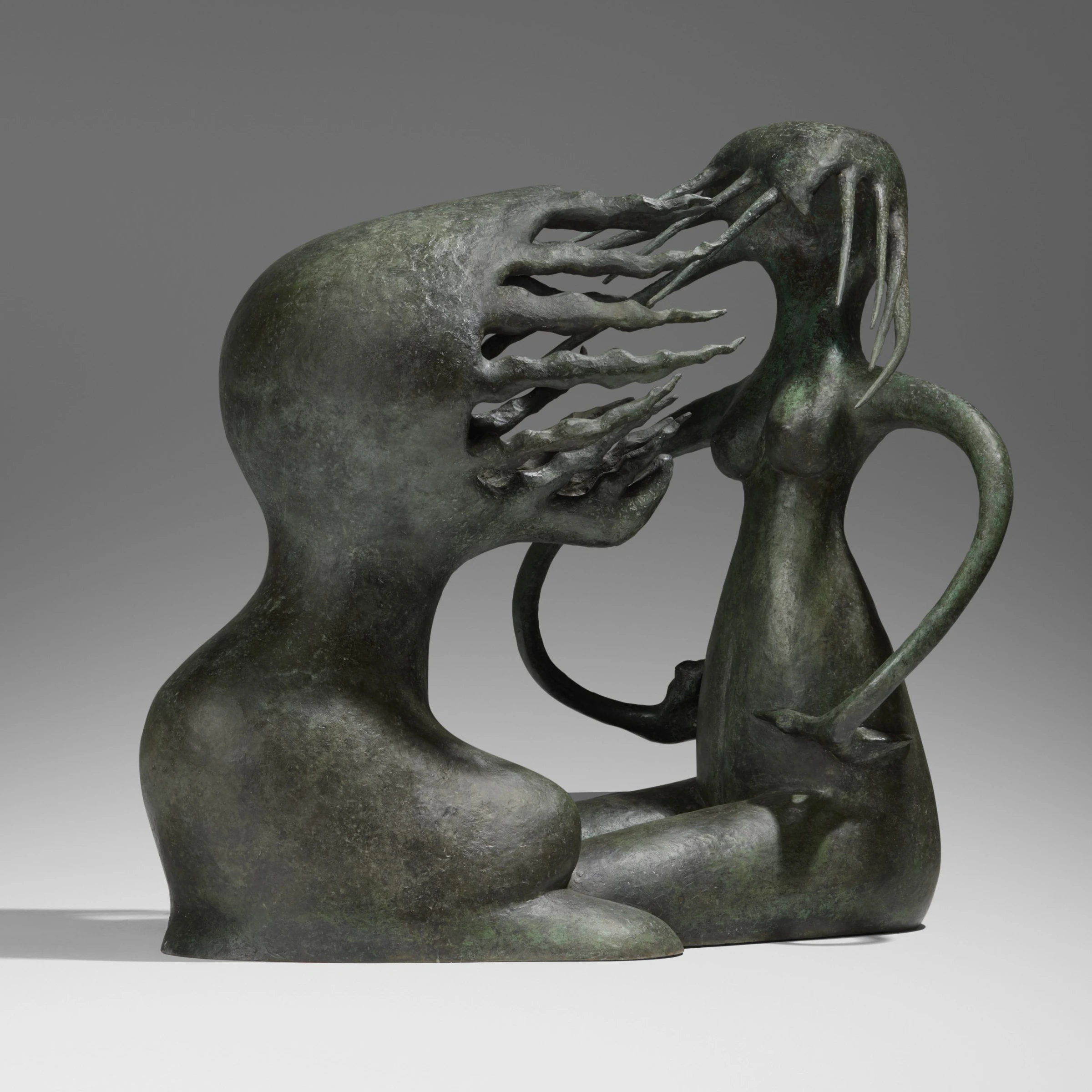
Maria Martins’s Market Finally Catches Up
Maria Martins’s $3.17 million Impossible sale finally prices the Brazilian Surrealist as a major sculptor, not a footnote to Marcel Duchamp
A $3.17 Million Result Changes the Terms of the Conversation
Maria Martins has spent decades in the market occupying a strange position: widely respected by specialists, frequently cited in museum contexts, and still priced as if she were a secondary figure orbiting more famous men. That contradiction cracked open in May when Rago Wright sold her 1946 bronze Impossible for $3.17 million with fees, according to Artnet News. The result obliterated the Brazilian Surrealist’s previous auction high and did more than set a record. It announced that the market is finally beginning to price Martins as a major sculptor in her own right. For years, curators and historians have treated her as essential to any serious understanding of transnational Surrealism, modern Latin American sculpture, and mid-century New York’s expatriate networks. Buyers, however, were slower. The spread between institutional esteem and auction value had become too wide to sustain.
The sale matters because it did not come from speculative hype around a newly fashionable name. It came from a work that many scholars already regard as one of Martins’s defining sculptures. In other words, the market was not discovering a random sleeper. It was catching up to a hierarchy that art history had established long ago. That distinction is important. When a record comes from scholarship finally forcing its way into the pricing mechanism, it tends to have more durability than a quick run driven by trend-chasing and scarcity talk.
Why Impossible Matters Inside Martins’s Career
Impossible belongs to the period in which Martins developed the sinuous, unsettling sculptural language that makes her impossible to dismiss. Born in Brazil, trained across Rio, Paris, and Kyoto, she moved through multiple artistic geographies before arriving in New York in 1939, when her husband was appointed Brazil’s ambassador to the United States. That move placed her inside a dense intellectual and artistic circuit, but Martins did not merely absorb those surroundings. She twisted them. Her sculpture fused biomorphic Surrealist energies with a bodily aggression and erotic strangeness that remain distinct even within a movement crowded with strong personalities.
Artnet notes that only three editions of Impossible are known, with one at the Museum of Modern Art in Rio de Janeiro and another at New York’s MoMA. The auctioned example is thought to be the earliest. That museum presence matters because it confirms the work’s canonical status independent of the sale result. Collectors were not bidding on a pretty secondary object with a romantic story attached. They were bidding on a work already secured inside institutional art history. That helps explain why the contest drew a dozen phone bidders, nine absentee bidders, and three online bidders. Scarcity played a role, but scarcity alone does not produce that depth of competition. Confidence does.
Confidence in Martins has also been strengthened by a wider correction in how the twentieth-century canon is being written. Women who were once reduced to muses, lovers, or scene-makers are increasingly being restored as primary agents. Martins is a classic example. Her affair with Marcel Duchamp has been repeated so often that it sometimes functions like a market crutch, a shorthand that introduces her through someone else’s prestige. But her work never needed that shortcut. If anything, the sale exposes how much that framing held her back.
The institutional case for Martins has been visible for years. The Museum of Modern Art in New York holds an example of Impossible at MoMA, while another edition belongs to the Museum of Modern Art in Rio de Janeiro. Those placements are not decorative credentials. They show that her sculpture already occupies durable museum space on both sides of the equator. The market had access to that evidence and still moved slowly. That is why the new record feels less like sudden discovery than institutional pressure finally becoming impossible for buyers to ignore.
The Market Lag Was Real, and It Was Intellectual as Much as Financial
Before this sale, Martins’s auction record stood at just $329,000, set in 2014. That gap between $329,000 and $3.17 million is not a normal incremental market climb. It is a rupture. Artnet reports that only 22 of her works have appeared at auction since 2003, and more than half of those were sold in 2025 alone. Thin supply always complicates pricing, but low volume can also disguise under-recognition. When not many works trade publicly, the market can postpone a real valuation argument for years. The record at Rago Wright forced that argument into the open.
This matters beyond Martins. Auction markets often claim to reward quality neutrally, but they are shaped by narrative convenience. Works circulate more easily when buyers have a ready-made story that places them in a familiar hierarchy. Martins’s problem was never lack of quality. It was that the market found it easier to position her as adjacent to canonical men than to rebuild the canon around her own achievements. That is why her breakthrough resembles other delayed corrections in modern and postwar art, where scholarly consensus arrives years before pricing catches up. We have seen related dynamics in restitution-driven sales and reputation resets, including the recent Georg Kolbe record after restitution, where the sale became inseparable from a larger historical reframing.
The danger now is simplification in the opposite direction. Once a market wakes up, it likes to pretend it always knew. Expect a wave of dealer copy and fair-booth conversation insisting that Martins was “undervalued” as if that were a natural weather pattern rather than the result of market choices. The better reading is harsher. She was mispriced because the market preferred a flatter, more convenient art history than the one her work demanded.
Another reason this result matters is that Martins is unusually well positioned to scramble lazy distinctions between “Latin American modernism” and the supposedly central story of Euro-American Surrealism. Her career does not sit neatly in either box. That is precisely what makes it useful now. As museums keep revising twentieth-century narratives, artists like Martins expose how provincial the old center-periphery model really was. A stronger market for her work could encourage more ambitious loans, catalogues, and institutional pairings that place Brazilian sculpture inside the mainline history rather than in a separate corrective annex.
What the Record Means for Museums, Collectors, and Brazilian Modernism
The most immediate effect will be on supply. A record of this scale tends to bring dormant works out of private hands, whether through strategic consignments, inheritance planning, or lenders reassessing insurance values. More public examples will sharpen the pricing picture, but they will also test whether buyers can distinguish between major Martins sculptures and merely market-adjacent works. The best scenario is a deeper conversation about quality within her oeuvre. The worst is a reflexive scramble in which every object becomes “museum level” because one indisputably great sculpture reset the ceiling.
Museums should treat the sale as a signal to intensify, not outsource, their scholarship. When a market catches up to an artist of Martins’s stature, institutions often lose acquisition agility just when validation is strongest. That means curators may need to pursue loans, partnerships, and research projects more aggressively if purchases become difficult. The result also strengthens the case for exhibitions that place Brazilian modernism and transatlantic Surrealism in more reciprocal relation, rather than using Europe and the United States as the only coordinates that matter.
There is also a practical market effect worth watching. Once a single object redraws an artist’s ceiling so dramatically, specialists begin regrading everything around it: edition quality, surface condition, casting chronology, exhibition history, and relation to the artist’s peak years. That process can be healthy if it sharpens judgment, and destructive if it turns into a rush for anything with the right name attached. Martins deserves the first response. She does not need the second.
Collectors, meanwhile, need to decide whether they are buying an overdue correction or a fresh speculative story. The answer will depend on the work. But the central lesson of this result is not that Martins suddenly became important in 2026. It is that the market could no longer avoid pricing a fact the museums already knew. For once, the auction room did not invent significance. It admitted it.
The broader implication is that scholarship is gaining leverage over pricing in a more visible way. When collectors see museum holdings, stronger criticism, and a persuasive transnational narrative lining up behind an artist, market hesitation starts to look less like prudence and more like lag. Martins now offers a case study in how that lag can end abruptly. The next few seasons will show whether the correction deepens through thoughtful placement and curatorial work, or whether the trade tries to flatten her again into a quick list of “important women artists to buy now.”
That distinction will shape how durable the correction becomes. If museums, scholars, and collectors keep insisting on the specificity of Martins’s best work, the record can anchor a longer historical reset. If the market turns her into a generic rediscovery narrative, the depth of her practice will get thinned out again. The healthier path is obvious: treat the sale as an opening for harder looking, sharper comparison, and better institutional framing.