Carrington's Villa Pilar Reappears in London
A newly surfaced Leonora Carrington painting from her 1940 confinement will join the Freud Museum show, deepening its account of trauma and invention
Villa Pilar turns a strong Freud Museum exhibition into a sharper one
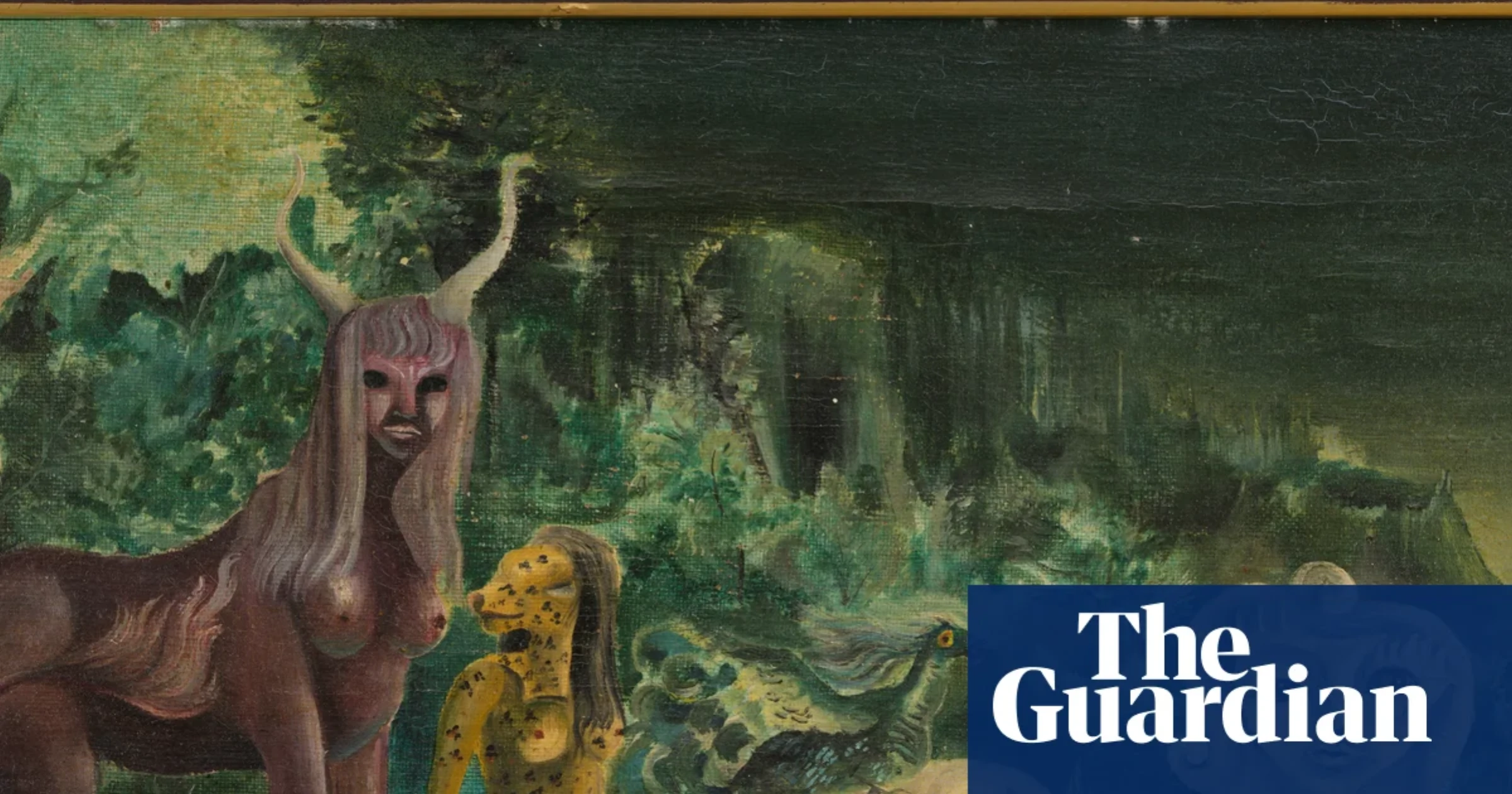
Leonora Carrington's wartime years are so often summarized as biographical catastrophe followed by artistic survival that the work itself can get flattened into illustration. The newly resurfaced painting Villa Pilar, made in 1940 during Carrington's confinement at Sanatorium Morales in Santander, resists that simplification. The painting will go on public view in London for the first time this summer when it joins the Freud Museum's exhibition Leonora Carrington: The Symptomatic Surreal, which has been extended through 10 August before traveling to Faro Santander. The news is not merely that a lost work has emerged. It is that the exhibition now gains an object capable of showing, with unusual force, how Carrington turned psychic emergency into one of the defining visual languages of twentieth-century Surrealism.
According to the reporting behind the discovery, the painting remained in the family of Dr Luis Morales, the psychiatrist who treated Carrington after her breakdown in Spain. That provenance matters because it anchors the work inside the intimate and compromised history of her hospitalization. Carrington later described the ordeal in Down Below, the extraordinary memoir that remains one of the century's harshest accounts of psychiatric violence. Yet even within that brutal setting she sketched daily and produced paintings that did not simply document suffering. They reconfigured it. Villa Pilar and Down Below depict the hospital as a charged symbolic zone populated by metamorphic forms, unstable identities, and a landscape that looks less therapeutic than mythic. The green sky alone sounds like a refusal of realism severe enough to become its own truth.
The Freud Museum show is about more than rediscovery theater
The Freud Museum exhibition was already notable because it focused on Carrington's Santander sketchbooks and letters from 1938 to 1941 rather than lazily recycling her celebrity as Surrealism's wild daughter. That curatorial decision matters. It shifts attention from persona to process, from anecdote to form, and from generalized talk about the subconscious to the specific historical crisis that sharpened Carrington's imagery. The museum describes the exhibition as the first institutional show dedicated to the drawings from those sketchbooks, and that claim explains why Villa Pilar lands with such force. It plugs an actual gap in the record. This is not a bonus work stapled onto a marketing cycle. It changes the density of the argument the exhibition can make.
Carrington's relationship to psychoanalysis has often been treated too tidily, especially in institutions eager to pair her with Freud as if symbolic overlap were enough. The better reading is messier. Carrington was interested in dreams, mythology, occult systems, and psychic transformation, but she was also someone who survived institutional control and refused to let that experience be translated into passive victimhood. In that sense, the Freud Museum is a risky venue and a productive one. It invites viewers to consider not just the unconscious as a theme, but the collision between psychoanalytic interpretation and the lived violence of psychiatric treatment. The exhibition's strongest promise is that it can hold those tensions open rather than smoothing them into inspirational recovery narrative.
That is also why the extension matters. Museums often extend shows because ticket demand is high or programming slots are flexible. Here the extra time allows the institution to incorporate a newly available work that deepens the show's conceptual center. The public programme around the exhibition, including tours and talks listed by the museum, should now read differently. Once Villa Pilar enters the room, the show becomes less about scattered archival recovery and more about a coherent body of wartime invention assembled against the grain of dispersal. Carrington's sketchbooks were sold from Julien Levy's collection in 2004 and scattered into private hands. Bringing related material back into conversation is not just scholarship. It is an act of repair.
Carrington's market rise is real, but it is not the point
Whenever a rediscovered Carrington surfaces, the market arrives quickly. The recent auction record for her work - £22.5 million in 2024 - will inevitably shadow discussion of Villa Pilar. But the more interesting issue is how the market has lagged behind the complexity of the art. Carrington is no longer treated as a marginal surrealist eccentric, yet institutions still sometimes package her through the familiar shortcuts of mysticism, feminism, rebellion, and biography without staying long enough with the formal intelligence of the work itself. Villa Pilar offers a corrective because it belongs to the moment when so many of her later motifs were under pressure, not polished into signature style.
The painting's imagery of hybrid beings, verdant but uneasy space, and psychological transformation shows how Carrington built her language from instability rather than decorative fantasy. That matters historically. Surrealism often gets flattened into a set of dreamlike effects available for endless merchandising. Carrington's best work is harder than that. It treats metamorphosis as a condition of survival, not as whimsy. Readers who followed our recent piece on archival images and historical reframing at Museum Rietberg will recognize the larger editorial issue: once institutions recover difficult material, the next question is whether they contextualize it rigorously or merely celebrate possession.
The answer in London will depend on installation and interpretation. The Freud Museum has a real chance to show how Carrington's wartime practice emerged from exile, coercion, and self-reinvention without reducing the work to case history. If it succeeds, Villa Pilar will not function as a trophy of rediscovery. It will function as a visual argument about what art can do when the artist has been pushed to the edge of social and psychic legibility.
What the London display will test
There is a practical test ahead. Can a relatively small museum use a single newly available work to change how a major artist is read in public? The Freud Museum does not have the scale of a national retrospective machine, but smaller institutions sometimes make better arguments because they cannot rely on quantity or spectacle. They must be precise. By connecting Villa Pilar to letters, drawings, Down Below, and Freud's own collection of antiquities, the museum can stage a show about displacement, symbolic language, and the politics of care that feels pointed rather than diffuse.
It is worth remembering how unusual Carrington's position was within the Surrealist orbit she inherited and resisted. She was close enough to the movement to absorb its fascination with dream logic and transformation, but skeptical enough to refuse being reduced to somebody else's muse, patient, or symbolic object. The Santander works matter because they show a young artist producing images under conditions that would have broken many people, then refusing to let those conditions dictate the terms of interpretation. That refusal is visible not just in biography but in composition. The world of Villa Pilar is not documentary space. It is a space reorganized by inner pressure until psychiatric authority, personal memory, and myth all become unstable at once. That is a harder and more durable achievement than therapeutic self-expression.
The exhibition also throws useful light on transnational Carrington scholarship. Her life connected Britain, France, Spain, Portugal, the United States, and Mexico, and museums still tend to claim portions of that itinerary according to their own institutional needs. London can stage Carrington as a Surrealist and psychoanalytic interlocutor. Santander can stress local memory and historical return. Mexican institutions have long understood her as a central figure in modern art rather than an eccentric visitor. A strong public conversation around Villa Pilar should move across those frames rather than settle into one. The art is richer than any single national story, which is precisely why institutions such as the Freud Museum's exhibition programme and Faro Santander now matter so much.
That is why the painting's first public display in London matters beyond the thrill of recovery. It gives viewers a chance to look at a work produced inside a life-threatening historical interval without being asked to separate form from circumstance. Carrington's achievement was not that she transcended history into pure imagination. It was that she used imagination to metabolize history without surrendering to it. Museums often speak of resilience when they really mean marketable adversity. Villa Pilar offers something harsher and more honest: a record of artistic intelligence operating in conditions that never should have existed.
There is another reason the discovery resonates now. Museums have become more comfortable mounting exhibitions about women surrealists, but they often do so through a language of overdue recognition that risks becoming automatic. Carrington deserves better than that template. What is compelling here is not just that a woman artist was overlooked and is now being restored, though that history matters. It is that a specific work from a specific crisis moment can still unsettle the categories institutions bring to it - madness, cure, exile, symbolism, market recovery, feminist canonization - and force a more exact reading of what the artist actually made.
When the exhibition travels to Santander in September, another layer will come into view. London can frame Carrington's work through psychoanalytic discourse and Surrealist history. Santander can return the material to the geography where the trauma occurred. That transfer should be watched closely. A good exhibition itinerary does not merely maximize visibility. It changes the terms of interpretation from city to city. Carrington's rediscovered painting deserves exactly that kind of restless framing. It is not a relic of breakdown. It is evidence of how fiercely art can think under duress.