Getty Center Renovation Turns Visitor Flow Into the Main Event
Getty is spending up to $800m to remake arrival, circulation, and welcome spaces, treating visitor infrastructure as a core curatorial and civic issue.
Getty is spending heavily on arrival because arrival has become part of the museum's programme
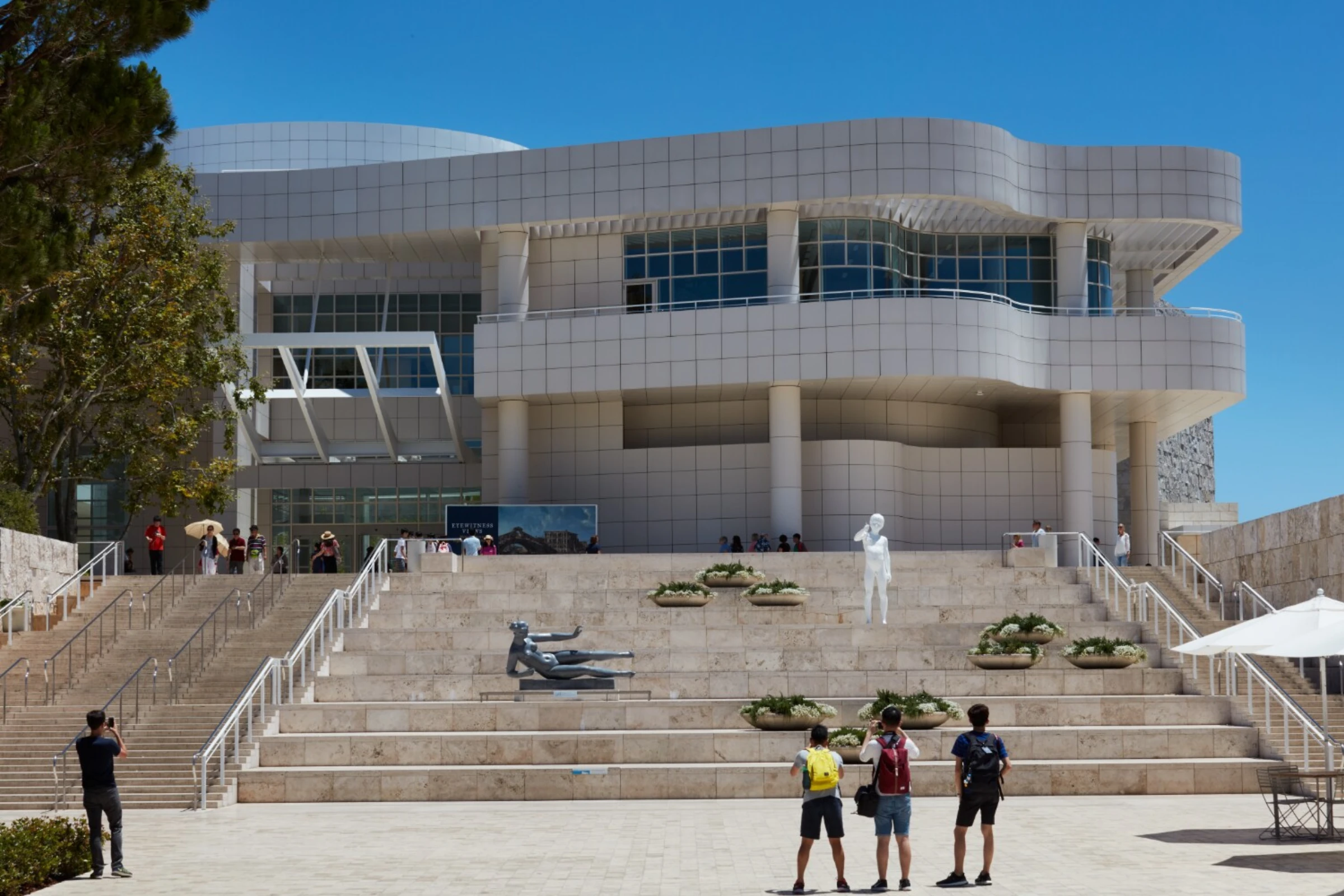
The Getty Center has finally made explicit something major museums often prefer to treat as background: the visitor journey begins long before anyone reaches a gallery wall. According to The Art Newspaper's report on the newly released renderings, the Los Angeles campus will undergo a sweeping overhaul focused on parking, the lower tram station, the tram itself, and a new welcome hall at the top of the hill. The price tag is significant, between $600 million and $800 million, and so is the message. Getty is not spending that kind of money to make a queue look prettier. It is acknowledging that circulation, access, orientation, and comfort now shape institutional legitimacy almost as much as acquisitions or blockbuster shows do.
The project comes with a deadline that sharpens its importance. The Getty Center will close to the public on 15 March 2027 for roughly a year, with reopening timed for the 2028 Summer Olympics in Los Angeles. That alone makes this more than a facilities story. A closure of that scale is a wager on the future public life of one of the country's most recognizable museum campuses. Getty is effectively saying that if it wants to remain a serious civic destination in the next decade, it cannot rely on the aura of Richard Meier's architecture and mountain-top views alone. It has to make the act of getting in, moving through, and feeling oriented on the site less frictional than it has been for decades.
The real subject is not design glamour but operational infrastructure
There is an easy way to read this story, and it is the wrong one. You can treat the Gehry Partners intervention at the lower station and the Why Architecture welcome hall as another parade of famous names orbiting a famous institution. But the sharper reading is operational. Getty has identified the lower tram stop as a weak point in the campus experience and is redesigning it around green space, shelter, and a less punitive waiting environment. That sounds mundane until you remember how museums actually work. Most visitors encounter an institution first as a series of logistics: parking, heat, shade, stairs, lines, bottlenecks, signage, and the small psychic stress of not knowing where to stand. If those systems fail, the museum begins the day by exhausting the audience it claims to welcome.
The tram replacement matters for the same reason. The original system has been part of the Getty Center's identity since 1997, but iconic infrastructure is still infrastructure. A museum that treats nostalgia as a substitute for maintenance eventually turns symbolism into inconvenience. Getty's decision to replace the tram with a system designed by Doppelmayr suggests that the institution is willing to modernize even the most recognizable parts of the visitor ritual if they no longer fit contemporary capacity, accessibility, or comfort demands. Readers of our guide to reading museum expansion announcements will recognize the pattern: when institutions emphasize circulation rather than galleries, they are usually responding to pressure points that have become impossible to ignore internally.
The upper-campus welcome hall is equally telling. Why Architecture's new structure will include an expanded bookstore and café, which some will read as standard revenue infrastructure. It is that, but it is also an argument about what museums think visitors now need on arrival. The older model assumed that architecture itself could do most of the public-facing work. The newer model assumes visitors need orientation, amenities, and flexible social space before they are ready to engage the collection. That is not a trivial shift. It reflects a broader museum-world understanding that audience development is inseparable from the quality of the threshold experience.
Getty is using a capital project to rehearse its Olympic identity
The 2028 Olympics sit behind this entire plan like an invisible co-curator. Los Angeles institutions know that the games will bring extraordinary attention, unpredictable crowd patterns, and intense scrutiny of infrastructure. Getty's timing makes clear that it wants the renovated campus to function as a polished civic gateway when the city is placed on an international stage. That ambition is sensible, but it also reveals how museums increasingly justify large capital spending: not simply through collection care or architecture, but through urban positioning. Getty is not only updating a museum. It is preparing a flagship cultural asset for a moment when Los Angeles will be judged on how well its public institutions can receive the world.
That civic framing matters because museum capital campaigns are often sold as timeless necessities when they are actually responses to quite specific political and urban conditions. The Getty Center sits above Brentwood in a city defined by car dependency, heat, distance, and event congestion. Improving shaded waiting space and circulation routes is not decorative in that context. It is a practical response to how bodies move through Los Angeles. What makes the Getty case interesting is that the institution is converting that practical response into a high-profile narrative about sustainability and accessibility. Those are real goals, but they are also contemporary legitimacy terms. Museums know donors, boards, and public agencies want to hear them.
That does not make the language empty. It does mean readers should ask what is being promised concretely. Sustainability can mean lower operational costs, smarter transport systems, more resilient materials, or simply cleaner branding. Accessibility can mean compliance, but it can also mean rethinking the basic dignity of arrival. Getty's statement points toward the broader version of both ideas. The test will be whether the finished project measurably reduces friction for families, older visitors, disabled visitors, and first-timers rather than merely producing elegant renderings and a more photogenic entry sequence.
Closing for a year is a governance test as much as a construction one
The closure window will put pressure on Getty's broader ecosystem. The institution says it will continue working with partners in Los Angeles and beyond, while expanding programming at the Getty Villa. That is the correct public line, but it also points to a real challenge. A year without public access to the Center will change attendance habits, staff workflows, tourist itineraries, and local expectations. Museums tend to describe closures as technical intervals between two normal states. In reality, they are periods when an institution has to renegotiate its relationship to its audience. Some visitors will migrate easily to the Villa or to partner venues. Others will simply disappear from the Getty habit.
This is why closure management deserves as much scrutiny as construction design. How will the Getty maintain educational visibility during the dark year? How aggressively will it program off-site? What will happen to front-of-house labor patterns when the Center is shut? How much of the project budget is being spent on public continuity rather than bricks, systems, and architects? These are not peripheral questions. They reveal whether the institution understands itself as a campus to be repaired or as a public that must be actively carried through a disruption. Museums that handle closures badly often learn too late that audiences do not automatically return just because the doors reopen.
The Getty's advantage is scale. It has brand recognition, a globally known collection, and the capacity to distribute activity across multiple sites and platforms. But scale can also produce complacency. The danger in a project of this size is assuming that prestige itself will bridge the gap. It will not. If Getty wants the renovation to read as public investment rather than elite inconvenience, it has to show that the closure year is being programmed with the same seriousness as the new welcome hall.
What this project signals for the museum field
The deeper lesson is that museums have entered a period in which back-end systems and front-end hospitality can no longer be separated cleanly from mission. Getty is not building a new curatorial wing or announcing a once-in-a-generation acquisition. It is spending hundreds of millions on thresholds, transport, and visitor support because those are now core parts of cultural competition. Audiences expect more comfort, more clarity, more dignity, and less friction than the monumental museum model once delivered. Institutions that fail to adapt risk looking architecturally impressive but behaviorally outdated.
There is also a financial-philosophy question embedded in the project. Large museums have become adept at raising money for visible architecture while describing maintenance as an unglamorous necessity. Getty's plan blurs that distinction. A sheltered stairway, a redesigned tram platform, and a more legible welcome sequence are not glamorous in the old Bilbao sense, but they are public-facing enough to attract philanthropic and civic justification. That is important because the sector is learning that neglected infrastructure eventually becomes a reputational problem. Visitors do not experience deferred maintenance as an accounting category. They experience it as confusion, delay, heat, exhaustion, and the subtle feeling that an institution values its image more than their time.
That is why the Getty renovation matters beyond Los Angeles. It shows a leading museum acknowledging that infrastructure is editorial. The way an institution receives people tells you what kind of public it imagines. A hilltop campus that once projected grandeur through distance is now being recalibrated around approachability, orientation, and flow. That shift will be familiar to anyone watching the sector. Museums are still building statements, but increasingly those statements are made through access systems, circulation logic, and the politics of comfort. Getty is betting that the museum of the late 2020s will be judged not only by what hangs on the wall, but by how intelligently the building handles the people who come to see it.