Ken Griffin's Constitution Loan Becomes a New York Museum Event
Ken Griffin has lent a second rare Constitution printing to South Street Seaport Museum, turning a trophy acquisition into a civic display.
Ken Griffin is turning constitutional scarcity into a museum event
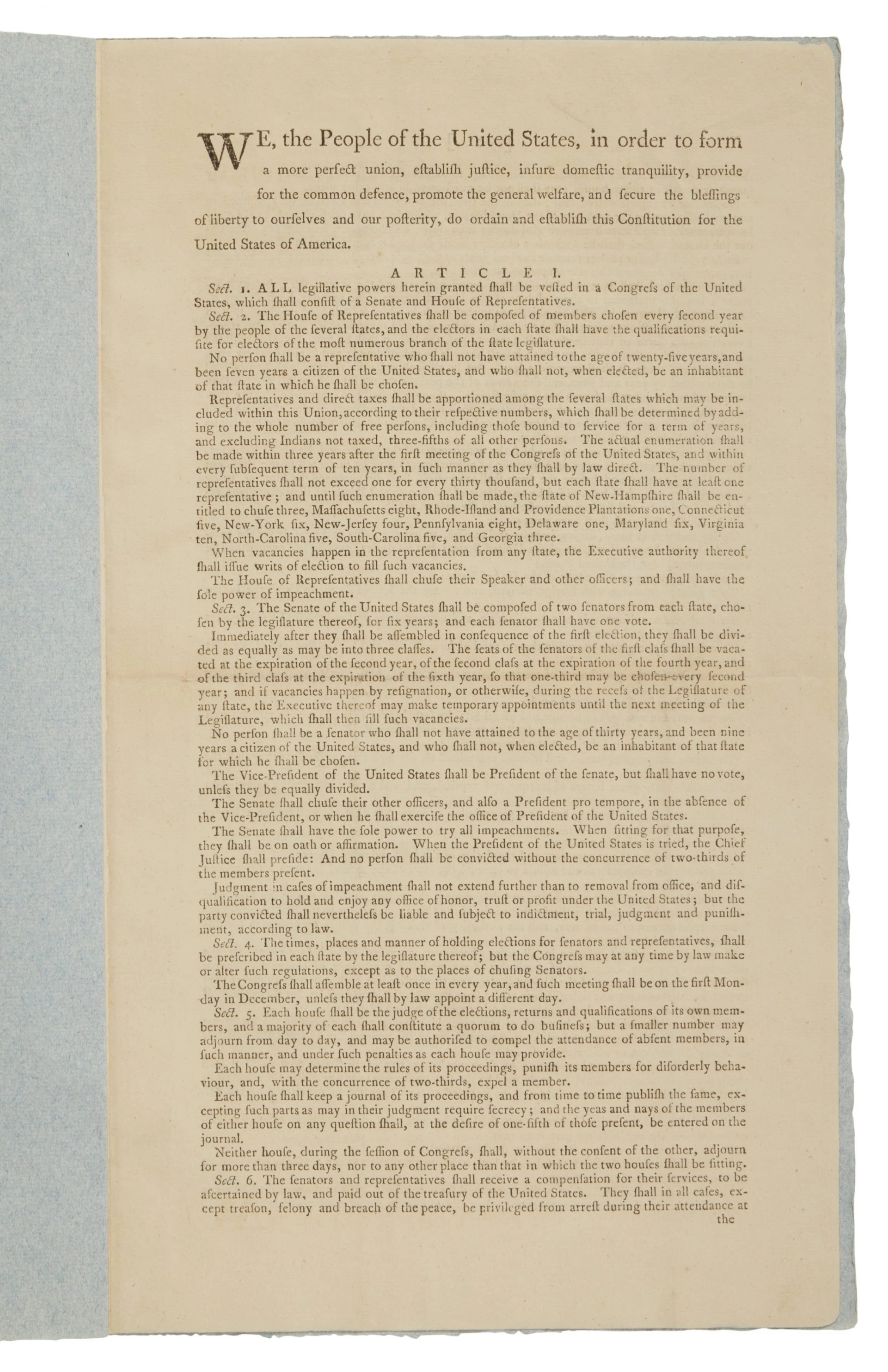
One of only two privately held first printings of the United States Constitution is now on view at the South Street Seaport Museum, and the exhibition does more than satisfy antiquarian curiosity. As Artnet reported, billionaire collector Ken Griffin has lent the so called Adrian Van Sinderen copy to the museum's exhibition "The Promise of Liberty: Words That Shaped a Nation" as the United States moves toward its 250th anniversary. The lending decision extends a pattern that has followed Griffin's purchases of American founding documents since 2021: acquire at the level of spectacle, then reframe the acquisition as public stewardship. That does not make the gesture cynical, but it does make it legible. In contemporary collecting, the line between private ownership and public virtue is rarely left uninterpreted.
The document itself carries enormous scarcity value. Roughly 500 official Constitution copies were printed for delegates to the Constitutional Convention in September 1787, and only 14 survive. Twelve are held by institutions such as the National Archives and the Library of Congress. The remaining two are owned by Griffin. That concentration of custody is what makes the museum display significant. A public does not merely get to see a rare founding document. It gets to see how wealth can consolidate symbolic national property while presenting the arrangement as access.
The museum show folds constitutional display into New York's anniversary politics
South Street Seaport Museum has smartly situated Griffin's loan inside a broader narrative about liberty, print culture, and New York's role as a port city and communication hub. According to the exhibition framing, the Constitution is shown alongside a Salem printing of the Declaration of Independence, an early printing of the Bill of Rights, material tied to Abraham Lincoln, Martin Luther King Jr., and the struggle for women's suffrage. That curatorial spread matters because it stops the exhibition from collapsing into a victory lap for one donor's collecting power. It places the Griffin loan inside a chain of documents that record both national ideals and the uneven history of who actually got to claim them.
The timing is equally pointed. America's semiquincentennial is already becoming a contest over who gets to narrate the nation's founding and for whom. Museums know this, and document exhibitions are ideal stages for that contest because they appear sober while carrying immense ideological charge. The South Street Seaport Museum can treat the Constitution as a physical object, a civic relic, and a prompt for historical self examination all at once. That is a stronger curatorial strategy than simple reverence. It also helps explain why Griffin's loans have moved through institutions such as Crystal Bridges Museum of American Art and the National Constitution Center. The documents work best when staged as public pedagogy, not only as market victories.
Still, the market story remains impossible to separate from the civic one. Griffin paid $43.2 million for another Constitution copy at Sotheby's in 2021 after outbidding the crypto collective ConstitutionDAO. He later bought record setting copies of the Emancipation Proclamation and the Thirteenth Amendment. These are not neutral acquisitions. They are acts of historical positioning. A collector assembling foundational American texts in this way is not just buying rarity. He is buying symbolic adjacency to the republic itself.
What looks like generosity is also a new model of reputation management
Collectors have always used museum lending to convert ownership into prestige, but the Griffin case feels especially contemporary because the terms of public legitimacy have shifted. In an era suspicious of trophy collecting, public display is no longer just an enhancement to private possession. It is part of the justification for it. Griffin's quoted statement about broadening access to the Constitution for the next generation reads as a civic argument, and it is one museums are happy to amplify because it aligns donor philanthropy with educational mission. But the statement also performs a subtle inversion. The public is invited to feel grateful for access to an object that, in a different ownership landscape, might plausibly live in institutional hands full time.
That inversion does not invalidate the exhibition. The South Street Seaport Museum is doing real work by contextualizing these documents and making them available to viewers in Lower Manhattan. Yet serious readers should be honest about the transaction. The collector gains reputational gravity. The museum gains audience and relevance during a politically charged anniversary cycle. The public gains temporary access to material that the market has rendered almost unreachable. Everyone benefits, but they do not benefit equally or for the same reasons.
There is also a cautionary lesson here for the art and manuscript markets. Once historical documents reach stratospheric prices, museum access often depends on the tastes and generosity of the ultra wealthy. That is not a stable democratic model for cultural stewardship. It produces moments of visibility, but it also normalizes the idea that the civic commons can be reassembled on loan from private balance sheets.
Why this exhibition matters beyond the collector headline
The strongest aspect of the Seaport presentation is that it uses the headline object to pull viewers into a longer story about liberty as an unfinished project. The Constitution does not appear alone in a halo. It is surrounded by documents that expose how national promises had to be argued over, amended, and extended across centuries. That framing is crucial in 2026, when commemorative culture can easily slide into sentimentality. A museum that only celebrates the object would miss the point. A museum that stages the object amid abolition, civil rights, and suffrage material gives it friction.
The show also says something useful about the role of smaller New York institutions. South Street Seaport Museum is not the Morgan, the Met, or the New York Historical. Precisely for that reason, hosting a major founding document allows it to claim a sharper civic role within the city's anniversary landscape. This is how exhibitions can redistribute attention. A smaller museum can become nationally relevant by framing a loaned object with local intelligence and historical texture.
What comes next is predictable but still worth watching. Expect more collectors to seek public facing pathways for high value historical material as the 250th anniversary approaches. Expect museums to compete for those loans. And expect the rhetoric of access to grow louder as the prices of foundational documents continue to climb. The key question is whether institutions can turn those loans into genuine public interpretation rather than donor theater. South Street Seaport Museum has at least given itself a chance to do that by refusing to let the Constitution sit alone as a trophy. The exhibition uses scarcity to draw people in, then asks them to think about liberty as a contested archive rather than a settled myth. That is a better use of wealth than pure possession. It is still not the same thing as a commons.
There is another reason this loan matters now. The Constitution is entering a commemorative marketplace in which museums, collectors, auction houses, and political actors all want a piece of the anniversary narrative. That marketplace rewards objects that are simultaneously scarce, photogenic, and ideologically dense. A first printing of the Constitution is all three. It can be sold as patrimony, displayed as pedagogy, and circulated in headlines as proof of patriotic seriousness. The danger is that such objects begin to function as moral shortcuts. Their presence can imply civic depth even when the surrounding interpretation remains thin. South Street Seaport Museum has to work actively against that drift if the exhibition is to become more than a prestige relay between collector and institution.
The museum has some advantages on that front. Located in a district shaped by shipping, trade, print circulation, immigration, and commerce, it can frame constitutional history not as abstract principle but as something embedded in the material life of a city. New York is an apt place to tell a story about liberty through paper, ports, and public argument. The same city that can host a billionaire's founding document can also remind viewers that law has always moved through property, class, and access. If the exhibition sharpens that contradiction rather than smoothing it away, the loan becomes genuinely useful. It turns a privately held relic into a prompt for thinking about who gets to own history and under what terms that ownership becomes public.
That may be the defining museum question of the next few years. As prices for manuscripts and founding documents continue to escalate, institutions will increasingly rely on collectors for visibility while insisting that the public interest remains central. Some of those partnerships will be productive. Others will amount to reputational laundering for concentrated wealth. The Griffin loan sits right on that fault line. It is both a real act of public access and a reminder that access now often arrives after ownership has been captured elsewhere. Museums should accept the loan if it serves interpretation, but they should never let the generosity story become so tidy that viewers forget the power arrangement that made the generosity necessary in the first place.