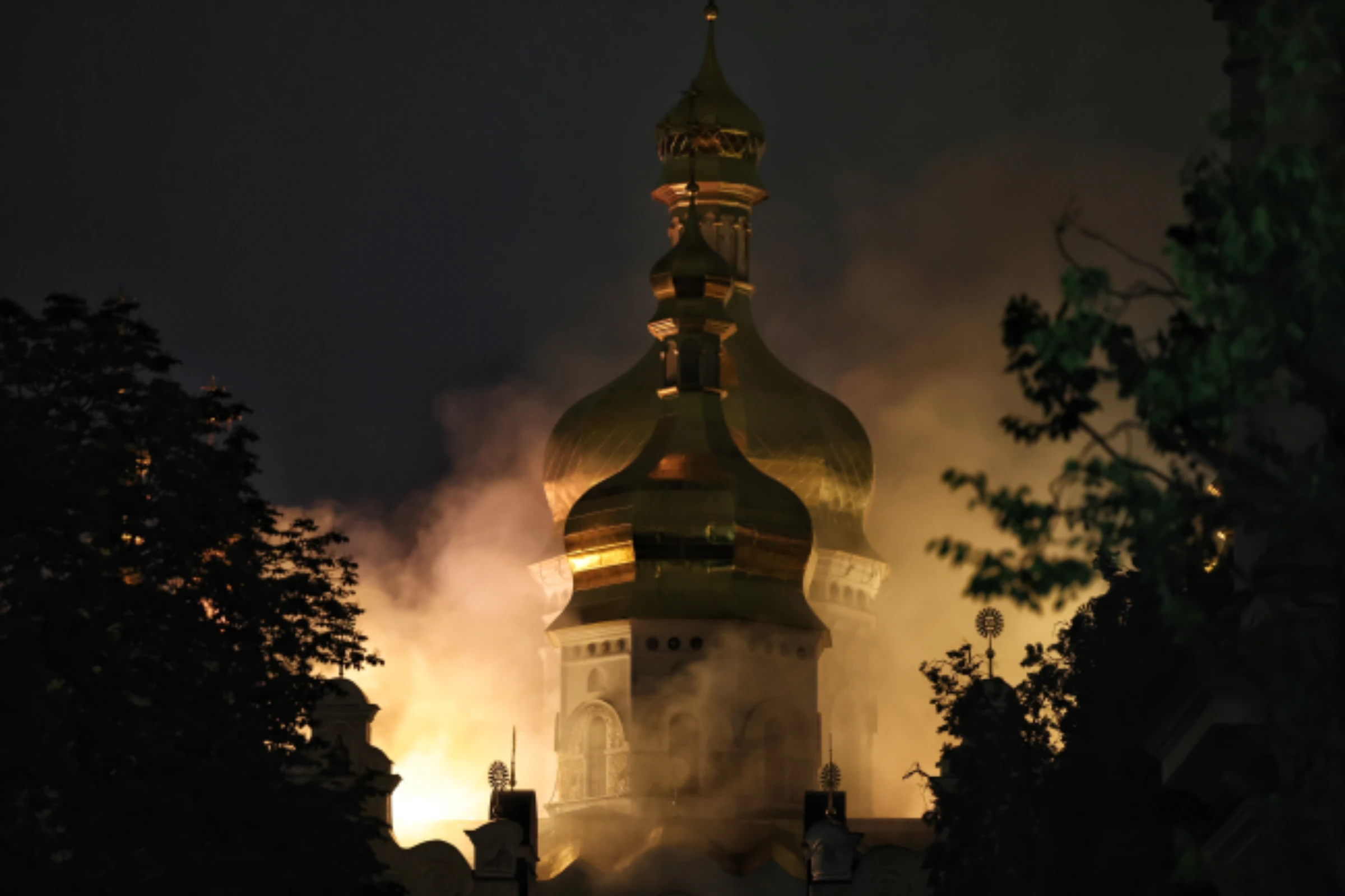
Kyiv Strike Damages Lavra Cathedral and Cultural Sites
A Russian drone strike damaged the Kyiv-Pechersk Lavra and other cultural sites, underscoring how heritage remains central to the war’s pressure campaign
A Strike on the Lavra Was Also a Strike on National Memory
Russia’s latest drone assault on Kyiv did not only target infrastructure or residential life. It struck one of the most charged cultural and spiritual sites in Ukraine: the Dormition Cathedral at the Kyiv-Pechersk Lavra, part of the UNESCO-listed monastery complex known as the Monastery of the Caves. According to Artforum’s report, the fire spread across a large section of the cathedral roof before firefighters extinguished it. Monks and rescue workers reportedly formed human chains to move treasures out of danger. The scene is by now grimly familiar in Ukraine, where safeguarding cultural heritage has become inseparable from emergency response.
The Lavra is not an ordinary monument. On the UNESCO World Heritage listing, the site is described as a core monument of Eastern Orthodox civilization and a major node in the historical development of Kyivan Rus. That status is not ceremonial. It means damage to the complex registers at multiple levels at once: religious, historical, diplomatic, and symbolic. A hit on the Lavra communicates vulnerability not just to Kyiv residents but to the broader idea of Ukrainian continuity. In wartime, attackers understand that some buildings carry more than bricks and roofs. They carry legitimacy, endurance, and the right to narrate a nation’s past.
The same attack reportedly damaged other cultural institutions, including the Dovzhenko National Film Studios, the Art Arsenal exhibition space, and sites in Dnipro and Kharkiv. That wider pattern matters. Cultural loss in Ukraine is not collateral in the casual sense often implied by wartime language. It forms part of the environment of attrition in which archives, museums, monuments, and sacred spaces are repeatedly exposed to blast pressure, fire, looting risk, and disruption. The result is cumulative. Even when structures survive, conservation systems weaken, staff disperse, and the conditions for public culture grow harsher.
Why the Kyiv-Pechersk Lavra Matters Beyond Architecture
The Lavra’s importance rests partly in age and architectural prestige, but that is only the surface. The monastery is entangled with questions of sovereignty, church authority, imperial inheritance, and national belonging. For years, disputes around the site have reflected the larger contest over whether Ukrainian religious and cultural institutions should remain embedded in Russian spheres of influence or stand decisively apart from them. That background makes every strike on the complex politically louder than damage to an ordinary landmark. The building is not only historic. It is an active participant in a living struggle over whose history Ukraine is allowed to inhabit.
International bodies have spent years documenting the vulnerability of Ukrainian heritage. UNESCO’s war damage tracking for culture in Ukraine has tried to convert anecdotal devastation into a public record that diplomats, conservators, and funders can use. Ukrainian institutions themselves have been even more direct, arguing that cultural protection cannot be postponed until after military victory because by then the archives, churches, collections, and museum buildings may already be gone or irrevocably compromised. The Lavra strike illustrates that problem brutally. Emergency response saved objects in the moment, but emergency response is not a cultural policy. It is triage.
There is also a moral hazard in the way global audiences sometimes consume these stories. Spectacular photographs of domes, smoke, and damaged frescoed interiors can flatten heritage destruction into a genre of wartime imagery. What gets lost is the everyday infrastructure required to keep such places alive: conservators, electricians, carpenters, storage plans, insurance arrangements, evacuation routes, and curatorial teams who know what must move first. When those systems are strained for years, the line between survival and irreversible loss narrows. The heroism of human chains inside a burning cathedral is real. So is the institutional exhaustion that makes such scenes recur.
There is a useful recent comparison inside our own archive. Yesterday’s coverage of damage to Ukrainian museums under Russian attack made clear that the emergency is not confined to one spectacular monument. Smaller regional institutions, municipal collections, and archives face the same exposure with fewer resources and less international visibility. The Lavra receives headlines because the symbolism is global. The underlying conservation crisis is much broader, and that is precisely why single-site outrage is not enough.
The Attack Fits a Broader Pattern of Cultural Pressure
Since the full-scale invasion, Ukrainian museums and heritage agencies have had to become logistics centers. Collections have been packed, dispersed, hidden, digitized, or transferred. Temporary exhibitions are planned around security constraints. Buildings that once hosted audiences are evaluated as potential targets. Reports from organizations such as the Mystetskyi Arsenal network and allied cultural groups have repeatedly stressed that attacks on cultural sites are not just losses for specialists. They affect civic morale, education, tourism futures, and the postwar capacity to rebuild local identity.
The strike on the Lavra also arrived on a day when Ukraine was making another move toward European integration. That juxtaposition is politically loaded. On one side sits the long, bureaucratic work of accession, reform, and alliance-building. On the other sits the immediate vulnerability of monuments that embody the deep history the state is trying to defend. Heritage therefore becomes a front line in two senses. It is physically exposed to attack, and it is rhetorically central to the case Ukraine makes about its place in Europe. The idea that culture can be separated from geopolitics never survives contact with events like this.
For the art world, there is an uncomfortable question about attention cycles. Major attacks briefly refocus international concern, prompting statements, emergency grants, and social media solidarity. Then the rhythm of fairs, biennials, and auctions resumes. Ukrainian institutions have been asking for something more durable: sustained funding, conservation partnerships, storage assistance, legal support, and long-term visibility for damaged sites. The challenge is not only to condemn spectacular attacks but to support the slower work of stabilizing what remains.
Another reason this matters is that heritage attacks alter future scholarship long before they destroy a building outright. Researchers lose access to archives. Conservators postpone treatment cycles. Exhibition loans become impossible. Local audiences stop encountering works in situ and instead meet them through emergency documentation or exile displays. Over time that changes what can be studied, taught, and remembered. A damaged cathedral therefore radiates pressure far beyond liturgical life or tourism. It constrains the cultural future of a city by forcing institutions to redirect labor from interpretation toward survival. That shift is measurable even when the structure remains standing.
That support has to include boring things the cultural sector often underrates. Fire suppression, packing materials, off-site storage, digital backups, building envelope repairs, and specialist training do not generate glamorous fundraising campaigns, but they determine whether collections survive the next strike. The same is true for legal documentation and provenance systems that help track displaced objects if theft or forced transfer follows physical damage. War compresses timelines. Institutions that once planned around years suddenly plan around hours. International partners who care about heritage need to fund for that tempo, not just for memorial statements after the fact.
What Comes Next for Ukrainian Cultural Protection
In immediate terms, the cathedral roof, interior conditions, and displaced objects will require careful assessment. Fire and water can be as destructive as blast fragments once the first emergency has passed. Documentation will matter, both for conservation and for future accountability. UNESCO, Ukrainian authorities, church representatives, and heritage specialists are likely to continue assessing the site through the frameworks already developed since 2022. Those frameworks are imperfect, but they are better than the older habit of treating cultural loss as an unfortunate footnote to military reporting.
There is also a strategic communications question for international institutions. If support is framed only as heritage rescue, Ukraine can be reduced to a recipient of pity rather than a producer of culture with agency, expertise, and its own priorities. Better partnerships start by listening to Ukrainian conservators, curators, clergy, and municipal authorities who already know which sites matter most and what kinds of intervention are realistic. The goal is not symbolic adoption from abroad. It is reinforcement of local capacity under intolerable conditions. That distinction sounds technical, but it determines whether outside help strengthens institutions or simply performs concern around them.
For curators and museum directors outside Ukraine, the immediate obligation is not to circulate another generalized statement about defending culture. It is to ask what concrete support can be moved fast: conservation supplies, temporary storage partnerships, translation help for grant applications, digitization assistance, staff exchanges, and direct institutional funding that does not disappear after the headline fades. Ukraine has already produced an extraordinary amount of expertise under fire. The more useful international posture is to back that expertise materially and durably, instead of treating each attack as a fresh discovery that heritage is at risk.
The broader lesson is harder and more urgent. If cultural heritage remains exposed year after year, then protection cannot depend only on crisis response or symbolic outrage. It has to be resourced as infrastructure. That means international partners treating culture as part of civil defense, not a decorative concern to revisit after reconstruction begins. The Lavra’s damage is tragic in itself. It is also clarifying. It shows, again, that in this war the destruction of culture is not an accidental side effect. It is one of the clearest ways pressure is applied to the idea of Ukraine itself.