Kohei Nawa Makes His Los Angeles Debut at Pace
Kohei Nawa's Los Angeles debut at Pace turns taxidermy, optics, and drift into a sharp test of how sculpture behaves in an image-saturated city
Kohei Nawa's Los Angeles debut arrives as more than a market milestone
Kohei Nawa has finally landed in Los Angeles with a solo exhibition that makes sense only if you read the city as both dream factory and logistics hub. His exhibition Photon Camp at Pace Gallery Los Angeles brings together Nawa's long-running PixCell and Prism bodies of work in his first solo presentation in the city. That headline fact matters, but not because Los Angeles needs another globally mobile blue-chip sculptor on its roster. It matters because Nawa's art has always been about the instability of seeing in an era shaped by screens, shipping networks, and mediated desire. Los Angeles, with its entertainment machinery, image industries, and appetite for atmosphere, is exactly the kind of place where those questions stop sounding theoretical and start feeling local.
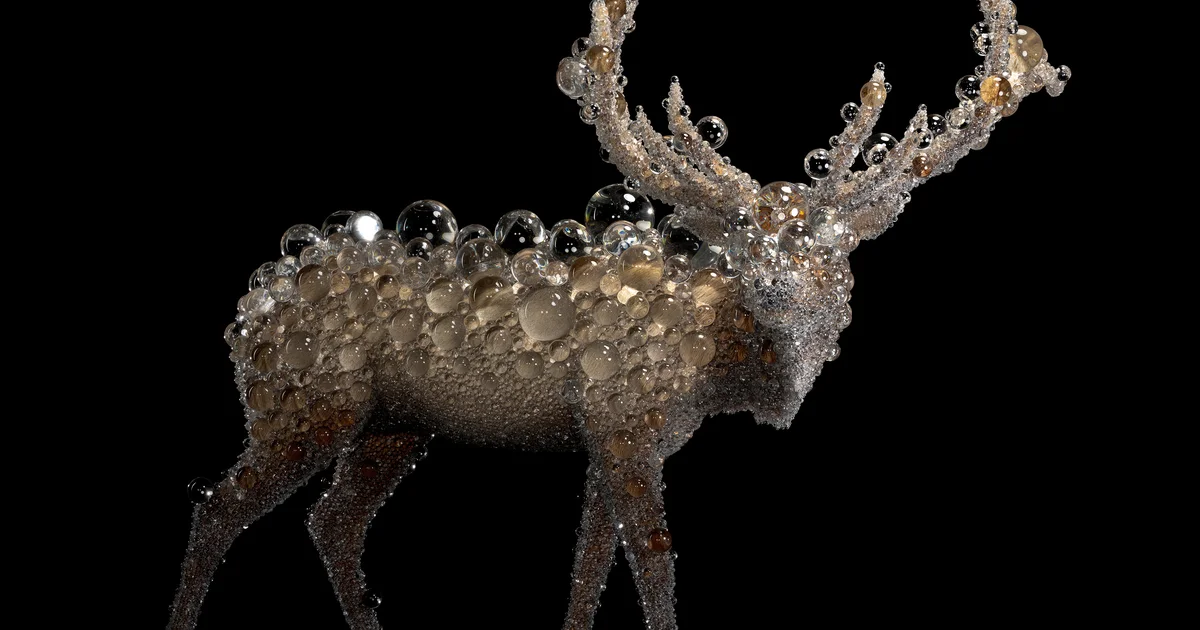
Nawa's best-known works encase taxidermied animals and found objects beneath transparent spheres, creating surfaces that magnify, distort, and splinter what lies beneath. The exhibition's anchor is PixCell-Elk #3, a confronting animal form positioned so that viewers meet its gaze before they have time to settle into passive looking. That staging is not decorative. It turns the encounter into a test. Are you looking at a sculpture, a specimen, an image field, a relic of extraction, or a proposition about how twenty-first-century perception now works? Nawa's answer, wisely, is all of the above. His Los Angeles debut succeeds because it refuses the tidy single reading that so much market-ready installation art now supplies on demand.
Pace's installation turns drift, optics, and commodity culture into one argument
One of the sharper ideas in recent reporting around the show is Nawa's insistence on the Japanese concept of drifting objects: foreign matter washing ashore, entering culture from outside, then being absorbed and transformed. It would be easy to reduce that idea to poetic branding. Nawa does not. He links it to online acquisition, global circulation, antique objects, and the afterlives of things that have fallen out of ordinary use. His broader Pace artist page makes clear that these concerns run across sculpture, installation, and collaborative projects rather than sitting inside one isolated exhibition. The animals, antique furniture, anatomical motifs, and candles are not just symbols. They are evidence of a world in which objects arrive already freighted with prior lives, logistical histories, and distorted meanings.
Los Angeles intensifies that reading. This is a city where surfaces are commercial infrastructure, where styling often stands in for ontology, and where imported things are constantly re-authored by context. By pairing PixCell works with Prism sculptures, Nawa is not simply revisiting signature series for a new market. He is building an environment in which reflection, refraction, preservation, and decay operate at once. The installation asks what happens when sculpture starts acting like a screen while stubbornly remaining physical matter. That is more urgent than it sounds. Much contemporary art about digital life still illustrates the internet instead of metabolizing its perceptual logic. Nawa, by contrast, uses material density to make mediated seeing feel unstable from within.
The Pace presentation also benefits from restraint. Rather than drowning the viewer in explanatory rhetoric, the exhibition allows motifs to collide: a taxidermied elk, a candle, anatomy, furniture, optical skins. Nawa has described wanting the boundary between artwork and non-artwork to blur. At his best, that blur does not flatten the world into immersive mood. It reintroduces hierarchy and uncertainty. Some objects feel sacred, some ridiculous, some elegiac, some grotesquely collectible. That tonal instability keeps the show from becoming a luxury showroom for post-digital wonder.
The earthquake history behind the work keeps it from becoming empty spectacle
Nawa's account of the 1995 Hanshin-Awaji earthquake and the 2011 Great East Japan Earthquake is where the project stops being merely atmospheric and becomes historically grounded. His major 2011 exhibition Kohei Nawa - Synthesis at the Museum of Contemporary Art Tokyo already showed how disaster altered his sense of matter, rubble, and circulation. Civilization, in this telling, is not a stable platform for aesthetic play. It is a repeating cycle of destruction, reconfiguration, and material drift. That perspective matters because it explains why his work, despite its polish, never fully settles into technological seduction. The distortions are not there just to make viewers marvel at surface. They are there because the world itself has become historically unstable, environmentally compromised, and visually difficult to trust.
This is the difference between Nawa and a long line of artists who have used reflective material or taxidermy as shorthand for contemporary unease. For Nawa, catastrophe is not a mood board. It is a structural pressure on form. The elk in Photon Camp is not simply uncanny because it has been optically scrambled. It is uncanny because it reads like a preserved being sent forward through a damaged civilization, a message in a bottle from one regime of life to another. That reading gives the work scale beyond the collector's wall and places it in a larger argument about memory, extinction, and the fragility of systems.
There is also a quiet refusal of digital triumphalism here. Nawa is deeply interested in how analog images became networked and globalized in the 2000s, but he does not narrate that transition as progress. He treats it as complication. The more connected images become, the more layered, unstable, and contingent perception becomes. In that sense, his Los Angeles debut speaks less to the city's appetite for novelty than to its long education in image management. Nawa's sculpture says that viewers already live inside distortion. The question is whether art can make that condition newly legible.
What this debut means for Los Angeles and for sculpture right now
Pace's decision to stage this as Nawa's Los Angeles debut says something about the city's current sculptural conversation. Much of the most visible sculpture shown in commercial galleries over the past decade has split between oversized theatrical installation and object-based refinement designed for rapid circulation between fairs, museums, and high-end collections. Nawa occupies an interesting middle ground. His work is highly legible in the market, but it remains stubbornly conceptual in ways that resist easy decorative absorption. That matters for Los Angeles, which can reward atmosphere so heavily that critical resistance gets mistaken for bad installation design. Photon Camp argues for sculpture that is immersive without being soft, seductive without being compliant.
It also sharpens a broader question about where contemporary sculpture is heading. The strongest current work in the field is not trying to compete with cinema or gaming on their own terms. It is asking what physical presence can still do once vision has been thoroughly platformed. Nawa's answer is to make objects that cannot be apprehended in one glance and cannot be reduced to one ideological function. They are ecological, metaphysical, technological, and art-historical all at once. That layered condition feels more durable than the current wave of spectacular but thin experiential art.
There is a useful internal comparison here with our recent piece on Agostino Bonalumi's spatial pressure at Art Basel Unlimited. Bonalumi pushed painting into literal space; Nawa pushes sculpture into a more unstable relation with image and environment. The mediums differ, but the question is similar: how do you keep form from becoming merely illustrative when the market loves instantly legible signatures? Nawa answers by making signature itself feel estranged.
There is another reason the show lands now. The international gallery system has become very good at packaging cross-regional artists as frictionless global brands, especially when their work can be photographed cleanly and installed with museum-grade finish. Nawa's exhibition resists that reduction because it insists on cultural translation rather than erasing it. The language of drifting objects, the memory of Japanese disasters, the use of taxidermy and antique forms, and the unstable relation between image and matter all arrive in Los Angeles without being flattened into universally legible luxury effects. That is harder to do than it sounds. Too much internationally circulated art either exoticizes local reference or neutralizes it for easy consumption. Nawa manages, at least here, to keep the references active enough that viewers have to meet the work halfway.
That should interest institutions beyond the commercial gallery sphere. If museums in Southern California are serious about presenting transnational contemporary sculpture without reducing it to spectacle or token diversity, this is the kind of show they should be studying closely. It demonstrates that ambitious installation can remain intellectually sharp, historically burdened, and emotionally strange while still drawing the eye. In the current art economy, where so much work is optimized for recognition before reflection, that is no small feat.
What comes next is less about whether Nawa can hold Los Angeles attention than whether institutions here will meet the work at its actual stakes. The exhibition offers enough beauty to attract broad audiences, but beauty is not its endpoint. The real achievement is that Nawa turns beauty into a trapdoor beneath certainty. In a city devoted to the management of appearances, that is a serious contribution. His debut does not merely place a successful international artist into the Los Angeles calendar. It gives the city a mirror that refuses to return a stable image.