JR Turns the Pont Neuf Into a Cave and Reopens the Question of Public Spectacle
JR's June Pont Neuf project borrows Christo's public scale but redirects it toward augmented reality, sponsorship and a sharper argument about civic attention
JR is not decorating the Pont Neuf. He is staging a public argument about how attention works in Paris now.
JR's La Caverne du Pont Neuf, due to open on 6 June and run through 28 June, arrives with the scale of a blockbuster and the timing of a civic test. As Artnet reported, the artist will sheath Paris's oldest bridge in an inflatable cave-like environment stretching roughly 120 metres long and 20 metres wide. According to JR's own official project page, the work is free, open around the clock and framed as a tribute to Christo and Jeanne-Claude's The Pont Neuf Wrapped. That lineage matters, but the more revealing question is not whether JR can quote one of the great public-art precedents of the late twentieth century. It is whether a 2026 public artwork can still surprise a city that already expects culture to perform as tourist infrastructure, brand theatre and social-media backdrop all at once.
JR is savvy enough to know the answer cannot be nostalgia. The project is explicitly contemporary in its machinery. It is financed without government funding, according to the artist's site, and supported by a mix of private backers that includes Snap Inc., Bloomberg Philanthropies, Paris Aéroport and Salesforce. It also folds augmented reality directly into the encounter through Snap's Spectacles and mobile layers. That makes La Caverne du Pont Neuf less a revival of the old public-art spectacular than a rewrite of it for an era in which experience is constantly mediated, reserved, shared and measured. The bridge becomes not just a site to behold but a platform through which multiple institutions get to demonstrate their idea of public culture.
The Christo comparison is useful, but mostly because it shows how different the public-art contract has become
Every large-scale temporary intervention in Paris now has to negotiate the shadow of Christo and Jeanne-Claude, and JR embraces that burden rather than dodging it. The project page openly frames the work as a tribute to The Pont Neuf Wrapped, the 1985 installation that transformed the bridge into a temporary monument to concealment, fabric and sheer urban astonishment. Yet JR is not wrapping the bridge in the old sense. He is simulating a grotto, a geological fiction that returns the stone crossing to a fantasy of pre-urban nature. That shift sounds poetic, but it also alters the politics of the gesture. Christo's work produced estrangement through subtraction. JR's produces it through immersive addition.
That distinction matters because the older project belonged to a public sphere still capable of being halted by an artwork's improbability alone. In 2026 improbability is cheap. Cities are full of projection, branding, event architecture and temporary spectacle. For a work like this to matter, it has to do more than scale up. It has to make viewers re-evaluate what kind of public attention has become normal. JR's answer is to collapse monument, promenade, image machine and interactive technology into one event. The result could be exhilarating. It could also risk proving how completely public art has been absorbed into a wider economy of managed experience.
The support structure tells the story. On the official page, JR emphasises Air Toiles Concept's engineering role, the use of organic ink, Thomas Bangalter's sound design and the augmented reality partnership with Snap. Each element adds another layer of production expertise and sponsor visibility. None of that is disqualifying. Public art at this scale has always required money and technical coordination. But it does mean the bridge is also a stage for contemporary cultural patronage, where philanthropy, tech and airport branding can all present themselves as custodians of civic imagination. Readers who want to understand the piece should not separate the spectacle from the coalition underwriting it.
The strongest part of the project may be JR's insistence that public art should still provoke disagreement
JR's own statement on the project page is unusually clear about what he wants from the work. He says that the debate a project in public space can provoke has value equal to its artistic realisation. That is one of the smarter things an artist working at civic scale can say in 2026. Too much public art is sold as consensual uplift. Cities commission works that are large enough to photograph yet careful enough not to disturb the tourism script. JR, at least rhetorically, is after something rougher. The cave image suggests regression and revelation at once, with explicit references on the project page to Plato, isolation, lucidity and the social damage of recent years.
Whether the installation can actually sustain that charge is another matter. Large crowds, timed AR interactions and the sheer novelty of a stone bridge becoming an inflatable cavern will generate plenty of excitement on their own. Excitement is not the same thing as argument. The work will need to hold up after the first flood of images, when people start asking whether the project changes their relationship to the bridge or merely reroutes attention through it. Public artworks fail when they confuse circulation with depth. They succeed when the surface thrill becomes the entry point to a more durable shift in perception.
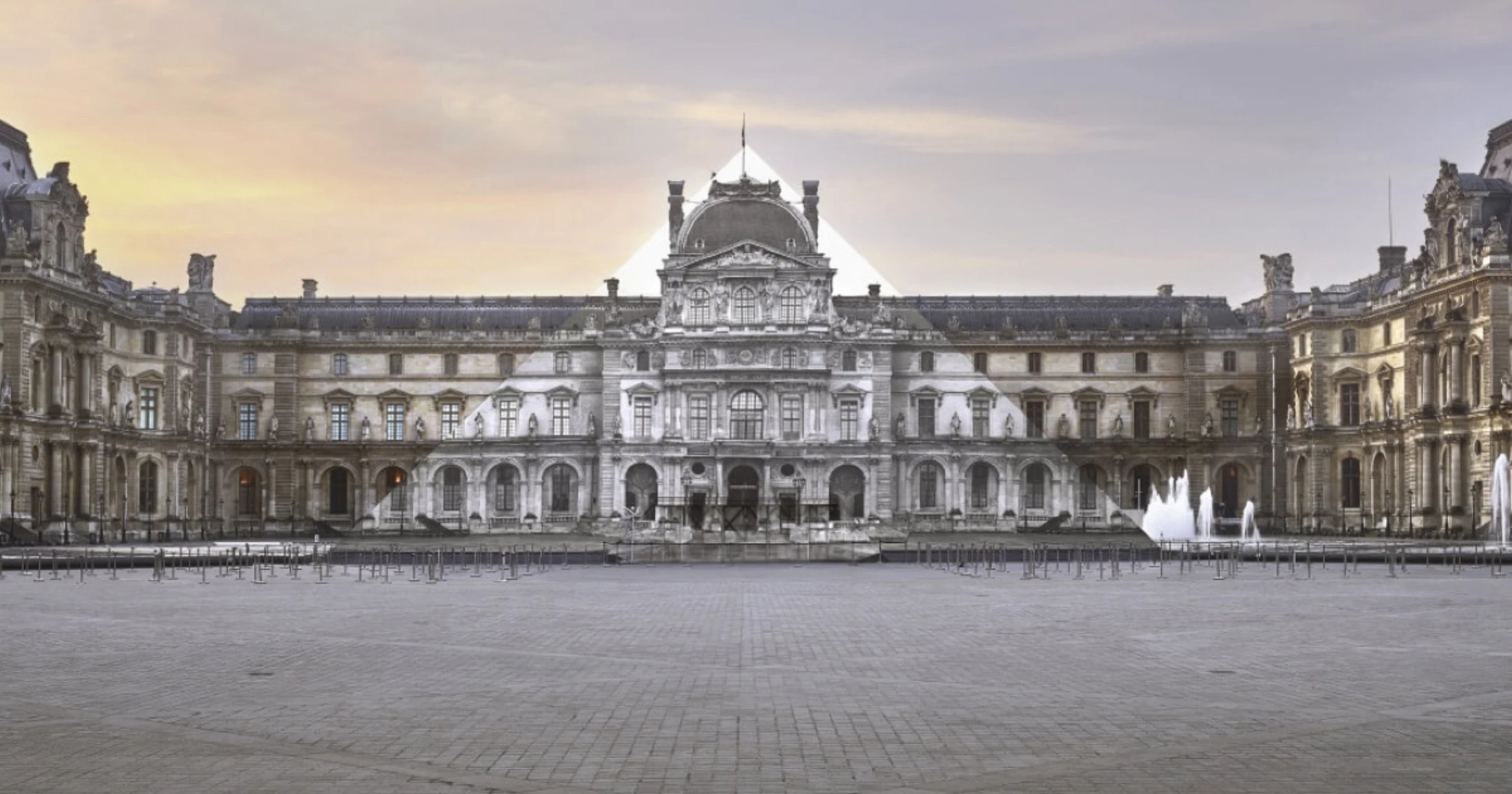
This is where JR's recent practice is relevant. As both Artnet and the artist's site note, La Caverne du Pont Neuf closes a run of trompe l'oeil interventions stretching from Florence and Rome to Milan and the Paris Opera. The method is familiar: make architecture appear ruptured, opened or transformed, then use that visual fiction to suggest another way of seeing the city. The risk of repetition is obvious. What once looked like a sharp artistic tactic can harden into a recognisable brand. The Pont Neuf commission matters because it tests whether JR can push that method past familiarity and into a genuinely collective urban encounter.
Free access does not make a public artwork innocent. It makes the distribution question more interesting.
The project will be free to visit, and that matters. So does the fact that AR access is split between ordinary mobile use and limited Spectacles sessions. That structure creates tiers inside the supposedly open event. Everyone can cross the bridge, but not everyone will experience the work in the same way or with the same technological enhancement. Public art in the platform era increasingly works like this: open in principle, stratified in practice. There is the general public, the photographed public, the reserved public and the sponsored public. The artwork becomes a common scene with unequal modes of access embedded inside it.
That is not unique to JR. It is now a standard feature of high-visibility cultural production. But the Pont Neuf is such a symbolically loaded site that the contradiction becomes especially legible. This is the oldest bridge in Paris, a piece of urban commons and historical myth. Turning it into a free immersive event sounds democratising. It also turns a public crossing into a limited-run cultural destination shaped by corporate interfaces, booking logic and brand-supported mediation. Smart viewers should hold both truths at once.
Readers who followed our recent analysis of Roberto Lugo's Madison Square Park commission will recognise the larger pattern. Institutions and artists increasingly want public work that feels accessible, photogenic and socially meaningful at the same time. The difference is that JR is working at a scale where the production apparatus becomes part of the message whether he wants it to or not. The installation is not just about a bridge and a cave. It is about the coalition required to manufacture public amazement now.
What happens in June will say a lot about the future of urban spectacle
If La Caverne du Pont Neuf works, it will not be because it produced pretty pictures of Paris with a new wrinkle. It will be because it briefly scrambled the city's habits of movement, looking and gathering, making a familiar site feel unstable enough to think with again. If it fails, it will fail in a recognisably contemporary way: as a perfectly engineered cultural event whose sponsorship architecture, image logic and pre-scripted experience leave too little room for unpredictability. Either outcome would be instructive.
For now the project deserves attention because it takes the public-art question seriously enough to risk excess. Paris does not need another tasteful commission that politely decorates civic space. It also does not need spectacle for spectacle's sake. JR is trying to occupy the unstable middle, where a temporary urban intervention can be generous, technically ambitious and commercially entangled without collapsing into pure branding. That is a difficult line to hold. It is also the line that increasingly defines ambitious public art in major cities.
The public should pay closest attention after the opening-week rush. When the influencers, press photographers and curiosity seekers have done their work, does the piece keep generating thought, friction and civic conversation? Or does it settle into a piece of content-efficient urban fantasy? The answer will tell us whether large-scale public art still has the power to shift collective perception, or whether it has become just another premium layer in the experience economy. JR has built the conditions for that question to become visible. Now Paris gets to answer it.