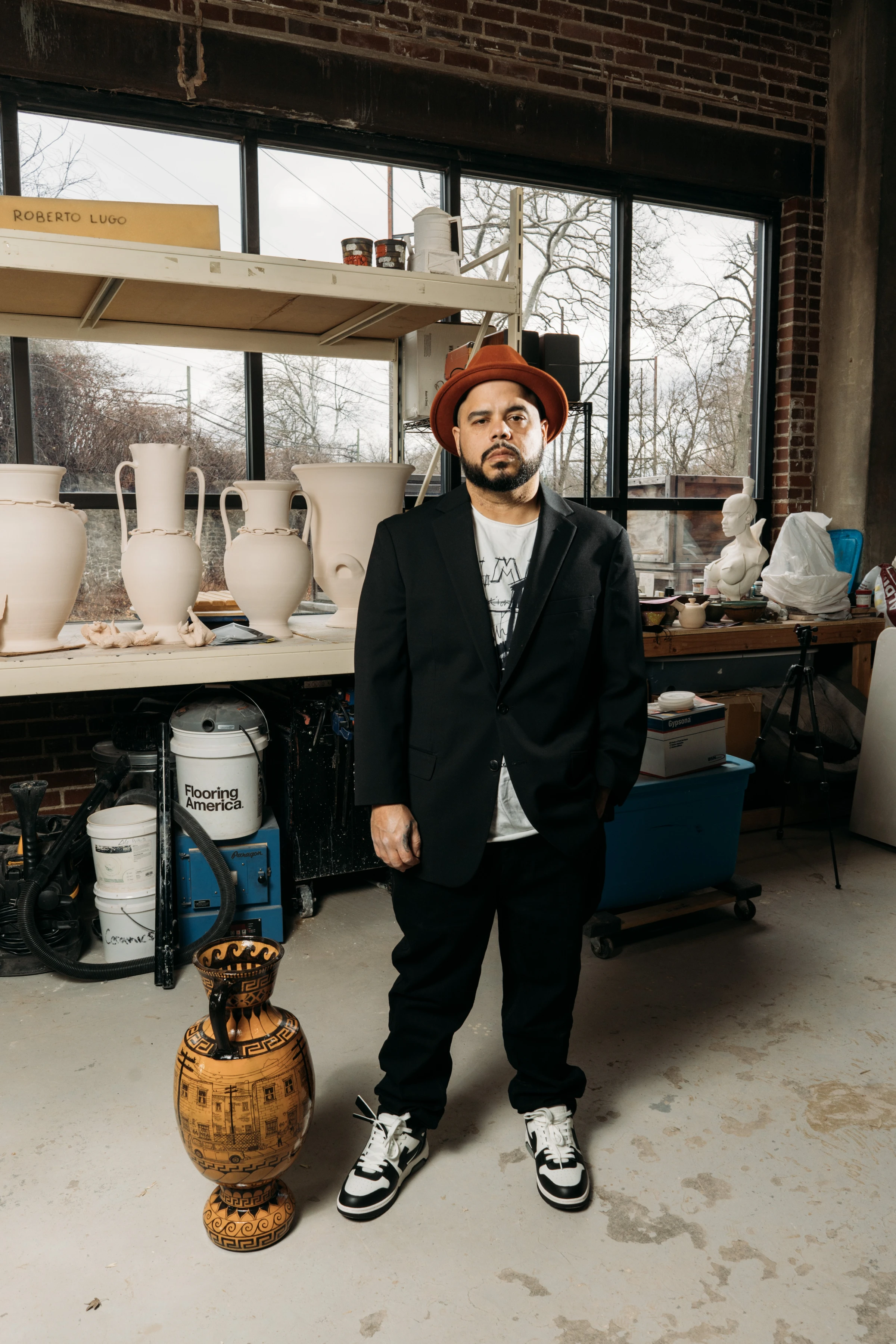
Roberto Lugo Turns Madison Square Park Into a Puerto Rican Monument
Roberto Lugo's new Madison Square Park commission scales his ceramic language into public sculpture and makes Puerto Rican visibility the work's central argument
Roberto Lugo's Madison Square Park commission makes public space carry Puerto Rican memory
Madison Square Park's latest commission does not hide behind the polite language of civic beautification. Roberto Lugo has installed a twenty-foot urn and a fifteen-foot fire hydrant in the middle of Manhattan, using the park's annual public-art platform to insist that Puerto Rican culture belongs at monumental scale. As The Art Newspaper reported, the exhibition Alfarero del Barrio opened on 20 May and runs through 6 December. The main sculpture, Capicú de Cariño (I Heard It Both Ways), turns the urn form that has driven Lugo's studio practice into a walk-through monument populated with portraits of Bad Bunny, Sonia Sotomayor, Lin-Manuel Miranda, Roberto Clemente and the artist's parents. The work is not simply representational. It argues that a park usually read as neutral public terrain is already political, and that who appears there at heroic scale still matters.
That matters because public art commissions are often asked to do two incompatible jobs at once. They are supposed to feel accessible and festive while also proving that an institution has some critical intelligence left. Lugo's project gets closer than most because it refuses to separate delight from historical pressure. The giant urn is bright, legible and inviting. It is also built out of a tradition that Lugo has spent years weaponising against the old hierarchy between decorative art and high art. In a city where monuments still tend to commemorate power that was already recognised by the state, this commission works from the opposite direction. It grants monumentality to diasporic family, neighborhood memory and cultural figures who already live in the public imagination but not always in civic form.
Madison Square Park's exhibition page shows how carefully the project was engineered
The Madison Square Park Conservancy exhibition page makes clear that this was never conceived as a single sculptural object dropped into a lawn. The park describes two hand-painted milled-foam sculptures, a series of tire planters holding native Puerto Rican plants and domino tables developed with Lugo's father for public use. That spread of elements matters. Lugo is not just installing something to be looked at. He is staging a social environment in which visitors move through an archway, sit down, play and circulate around a set of references that tie the work to barrio life instead of detached plaza formalism.
The fabrication story is equally important. According to both the park and the article, the new works were developed with The Johnson Atelier in Hamilton, New Jersey, where Lugo has been expanding his scale since 2022. That is where the piece becomes more than a feel-good commission. Public sculpture is usually discussed as a final object, but the real question is who gets access to the technical infrastructure that makes ambitious public work possible. Lugo has turned a studio language rooted in ceramics into something large enough to confront the city without losing its intimacy. That transformation required fabrication expertise, money and institutional confidence. When a public commission works, it is often because those resources amplify an artist's existing argument instead of flattening it.
Lugo has already tested that scale in projects such as The Village Potter at Grounds For Sculpture and We Here at Mural Arts Philadelphia. The Madison Square Park version feels sharper because it puts that monumentality in a site where office workers, tourists and neighborhood regulars all have to negotiate it. The work cannot be contained by a ticket line or framed as a destination for insiders. It has to survive casual encounter. That is a tougher test than gallery applause, and it is one reason this commission feels consequential.
The work rewrites the monument form without pretending monuments are innocent
The urn's iconography is direct, almost defiantly so. Bad Bunny, Sotomayor, Miranda and Clemente are not obscure references demanding curatorial mediation. Lugo knows exactly how monument culture usually works: prestige is often secured by distance, by making sure the public must rise to the level of the object instead of the other way around. He flips that logic. The figures on the urn arrive from mass culture, jurisprudence, sport and family memory. They form a social pantheon rather than a state-sanctioned one. In that sense the project belongs to a broader conversation about who gets pictured in public and how communities build esteem outside the old bronze-and-marble script.
The fire hydrant, Para Los Días Caliente (This Is For The Hot Ones), pushes that conversation further. A hydrant is not a neutral symbol in urban neighborhoods. It carries childhood, heat relief, municipal neglect, play and survival. Lugo's account of his father holding the only wrench on the block turns the sculpture into a story about informal social infrastructure. That is smarter than simply monumentalising an icon. The object suggests that neighborhoods build their own systems of care and release long before institutions arrive to commemorate them. When members of the public started tagging the piece almost immediately, the response made sense. The work practically invites a negotiation over authorship, respect and use.
There is risk in that openness. Public art institutions like interaction when it looks curated, less so when it looks messy. Lugo appears to understand that contradiction and lean into it. The phrase "se vende" on the hydrant reads like a dare as much as a joke. It points at the market conditions hanging over any successful artist who enters a high-visibility commission cycle. Public work can raise an artist's stature while absorbing the roughness that made the work urgent in the first place. Lugo's best move here is refusing to make the piece too tidy for that reality.
What the commission says about institutional appetite in 2026
Madison Square Park Conservancy deserves some credit for backing a project that is legible without being generic. Still, the institution also benefits from the charge Lugo brings. Public-art programs need artists who can make their annual commission feel socially necessary rather than merely photogenic. Lugo supplies that. His practice lets the park look plugged into debates about race, migration, class and monumentality while still delivering work that visitors will photograph. That is not a criticism of the artist. It is a reminder that institutions choose criticality when they believe it can coexist with broad public appeal.
The timing is useful too. As the United States barrels toward the 250th anniversary that Lugo himself invoked at the opening, questions of national self-image are becoming more explicit in cultural programming. Institutions are trying to decide whether to stage consensus, conflict or some manageable mixture of both. Lugo's answer is subtler than a didactic history lesson but harder than decorative pluralism. His monument says the nation is made out of diasporic memory, neighborhood improvisation and families who carried culture without waiting for official blessing. That is a better use of public art than another vague tribute to diversity.
Readers should also notice how this story connects to other access fights in the field, including our recent report on Native Neon. In both cases the visible artwork is only part of the story. The deeper issue is who gets the fabrication support, public platform and institutional confidence required to scale an idea into civic form. Lugo has won that access and used it well. The harder question for the field is how often artists from comparable backgrounds get the same opportunity before their practices are already validated elsewhere.
What comes next after the opening spectacle fades
The exhibition runs through early December, which means the real test has barely started. A public commission can look potent in opening-week coverage and then settle into decorative background noise. Whether Alfarero del Barrio avoids that fate will depend on how people actually use the site over time and whether the Conservancy frames the project as more than a summer attraction. The domino tables and planters give the work a better chance than most. They extend the exhibition into everyday behavior, which is where public art either earns its keep or gets ignored.
For Lugo, the project could mark a decisive stage in his movement from celebrated ceramic artist to major public sculptor. That transition is not automatically good. Bigger budgets and more visible commissions can dull a practice if institutions start commissioning the brand of an artist rather than the conflict in the work. Here the signs are encouraging. The monument still feels argumentative. It honors specific people, but it is really about scale, permission and who gets to picture Puerto Rican life as foundational rather than supplemental.
The strongest thing about this commission is that it refuses the false choice between celebration and critique. It is affectionate toward community memory and unsentimental about how rare that memory still is at monumental scale. In a city full of expensive public gestures that say almost nothing, Lugo has made an artwork that can host pleasure, photography, play and serious political meaning without turning any of them into an alibi for the others. That is exactly what a public commission should do, and far too few of them manage it.