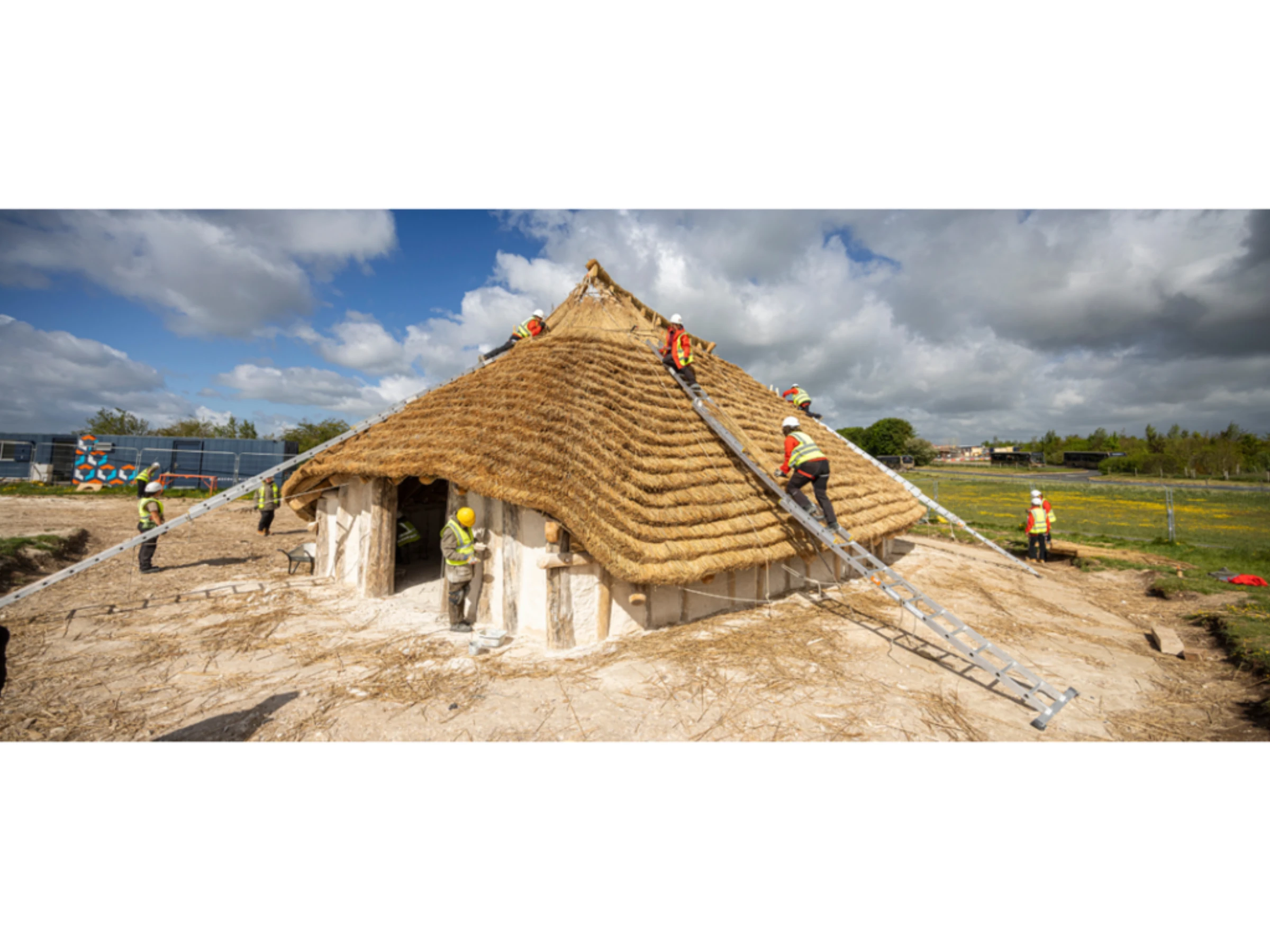
Stonehenge Gets a Full-Scale Neolithic Hall Replica
English Heritage's Kusuma Neolithic Hall turns Stonehenge into a richer public-history experience while testing how responsibly institutions stage prehistory
English Heritage is using reconstruction to change how visitors imagine Stonehenge
Stonehenge has always suffered from the same problem that haunts many world-famous sites: the monument is so iconic that it can become strangely abstract. Visitors know the silhouette before they know anything about the people who built it. English Heritage's new Kusuma Neolithic Hall is an attempt to fix that imbalance by adding a full-scale building reconstructed with historically accurate methods and materials near the site. According to ARTnews, the hall cost about $1.34 million, rises twenty-three feet high and is scheduled to open this summer. At face value, that sounds like a visitor-experience upgrade. In practice it is a curatorial wager about how much interpretation should move from text panel to lived spatial encounter.
That wager matters because Stonehenge can be overlearned and underimagined at the same time. Everyone has heard of it. Far fewer people have a concrete sense of the settlements, technologies, labor systems and collective decision-making that made the monument possible. A building you can walk around, inspect and compare to contemporary domestic scale may do more to rehumanise prehistory than another round of spectacular drone footage. The risk, of course, is that reconstruction can oversell certainty. The stronger the replica looks, the easier it is for visitors to mistake a best scholarly estimate for settled fact.
The replica works because Stonehenge was always bigger than the stone circle alone
The English Heritage history pages emphasise a point that still gets lost in popular discussion: Stonehenge is not a lone object but the center of a larger prehistoric landscape. Work began roughly 5,000 years ago, the stone circle dates to about 2500 BC and the surrounding area contains burial mounds, processional routes and traces of settlement that make the site legible as a social world rather than an isolated engineering marvel. A reconstructed hall therefore makes curatorial sense. It tries to pull attention back toward the human environment from which the stones emerged.
The building also puts pressure on the tired idea that prehistory should be encountered only as sublime ruin. There is a long museum habit of making the deep past feel remote, pristine and slightly inaccessible, as though scholarship becomes more serious when the ordinary textures of life disappear. But Stonehenge was created by people who ate, gathered materials, built in stages and solved technical problems with astonishing ingenuity. English Heritage's own overview of how Stonehenge was built stresses the woodworking-style joints used in the monument and the complexity of its construction. A hall made with historically grounded techniques helps viewers grasp that intelligence in architectural terms.
That interpretive move also belongs to a larger change in how heritage organisations talk to the public. Static grandeur is no longer enough. Sites have to explain process, labor and lived environment if they want visitors to leave with more than a postcard image. We have seen a comparable logic elsewhere in the field, including our guide to museum venue takeovers, where architecture itself becomes part of the institution's argument about value. At Stonehenge, the new hall performs that role in historical rather than managerial terms. It says the monument should be read not as a freestanding wonder but as the product of a built world, a workforce and a shared technical culture. That is a healthier story for the site to tell, because it lowers the temperature of pseudo-mysticism without reducing the achievement to dry data.
That shift is valuable because reconstructions can do something labels cannot. They restore proportion. A twenty-three-foot communal structure built with ancient tools gives visitors a physical benchmark for what Neolithic engineering and collective effort might have felt like. It also complicates the lazy fantasy that prehistoric life was crude until the stones suddenly appeared as a miracle. The monument becomes part of a continuum of making rather than an exception to it.
Immersive heritage is useful only when it stays honest about uncertainty
None of that means reconstruction is innocent. Heritage institutions love immersion because it converts scholarship into an experience economy. Visitors linger longer, families feel they got more for the ticket and photo opportunities multiply. Those are not trivial gains, especially when maintaining major sites is expensive. But immersive interpretation can slide into theatrical confidence. A replica with the authority of design, craft and cost can imply that debates are over when they are not. English Heritage needs to keep telling visitors where evidence ends and inference begins.
That is especially important at Stonehenge, where purpose remains contested even as many structural facts are well established. English Heritage's section on understanding Stonehenge acknowledges how much remains open to interpretation, from ritual use to the monument's relation to celestial alignment and landscape movement. A reconstructed hall should deepen that conversation, not close it. The best possible outcome is that visitors leave with a richer sense of prehistoric plausibility and a sharper awareness of how archaeology builds arguments from incomplete evidence.
The project also lands in a broader climate where heritage sites are competing for public attention against endless digital distraction. There is pressure to make interpretation immediate, photogenic and educational in the quickest possible way. A hall visitors can inspect from structural detail to roofline is a smart answer to that pressure because it channels spectacle back into material knowledge. Still, the institution will need to resist turning the replica into a prop detached from the actual historical questions it was built to illuminate.
The money is not just about tourism. It is about narrative control.
A $1.34 million reconstruction at a site as scrutinised as Stonehenge is a funding decision about narrative control as much as public access. Heritage organisations choose what kind of knowledge deserves architectural embodiment. In this case English Heritage is saying that understanding prehistoric builders as social actors is worth major investment. That is a better choice than pumping money only into infrastructure that moves crowds faster while leaving interpretation thin.
It also nudges the site away from pure monument worship and toward contextual literacy. For years, cultural tourism around Stonehenge has oscillated between reverence and pseudo-mysticism. One camp treats the stones as untouchable national heritage, another as a screen for spiritual projection. Both can crowd out the harder, more interesting story of labor, planning and technological sophistication. A hall grounded in experimental archaeology gives English Heritage a chance to recenter that story. If it succeeds, the site becomes less about marveling at isolated stones and more about understanding the society capable of raising them.
The hall may also help visitors understand just how much prehistoric architecture depended on communities capable of coordinating skill across time. Stonehenge was not one burst of genius. It was a staged project that required repeated acts of planning, material transport and social cooperation. When a reconstruction embodies even part of that complexity, it changes the tone of the visit from passive awe to analytical curiosity. That is the best educational outcome a high-profile heritage site can hope for. It lets wonder survive, but forces wonder to share the room with craft, logistics and human effort.
That repositioning fits the wider international trend toward reconstructions, replicas and immersive archaeology. Some efforts cheapen the past by turning it into entertainment architecture. Others sharpen public understanding by testing scholarship at full scale. The Kusuma hall will be judged by whether it does the latter. Because Stonehenge is a UNESCO World Heritage Site, the standard should be high. A site of that stature cannot afford sloppy theater dressed up as education.
What this replica could change for the field
If the hall works, it may influence how other heritage organisations interpret prehistoric and ancient sites that are rich in evidence but poor in everyday legibility. Too many visitors confront archaeology through fragments with no embodied sense of use, weight or proportion. Full-scale reconstructions can repair that gap when they are candid about method and disciplined about evidence. Stonehenge gives English Heritage a high-profile laboratory in which to prove the point.
There is also a subtler lesson for the art world. Reconstruction is never just educational. It is an aesthetic choice about how the past should feel in the present. The hall will affect mood, pacing and imagination long before a visitor reads the interpretive text. That is why institutions must treat these projects with the same seriousness they bring to exhibition design. Atmosphere is argument. Architecture is argument. At a site where myth rushes in the minute scholarship leaves a gap, those arguments matter.
The strongest case for the new hall is straightforward. It puts human making back into a place often reduced to monumental mystique. The weakest version would be a crowd-pleasing backdrop that makes prehistory feel settled and cinematic. English Heritage now has to prove which version it has built. If it keeps the reconstruction tied to evidence, uncertainty and the larger Stonehenge landscape, the project could become a model for how to stage ancient history without flattening it. If not, it will just be another expensive way of letting visitors think they understood more than they actually did.