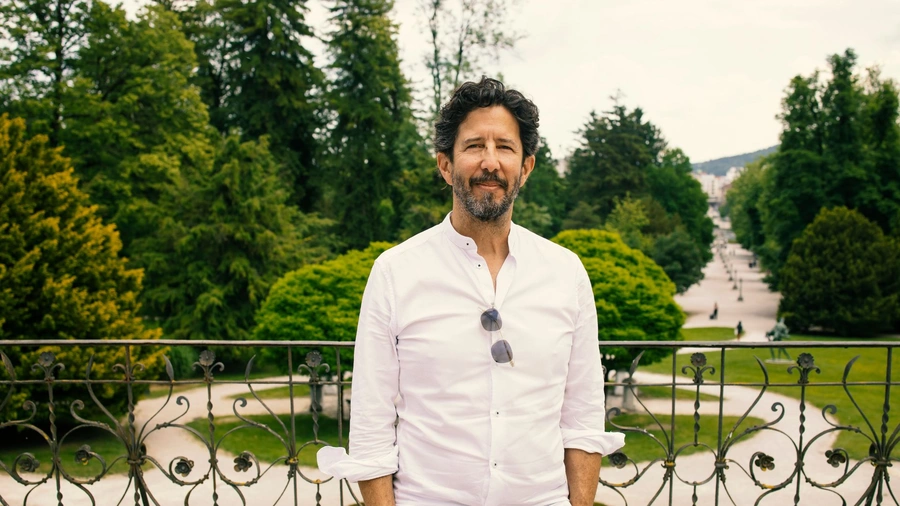
José Roca Will Curate the 2027 Ljubljana Biennale
MGLC named José Roca curator of the 37th Ljubljana Biennale of Graphic Arts, betting on a broad edition about imprint, transmission, and historical trace
Ljubljana Picked a Curator Who Thinks in Systems, Not Simply in Themes
The 37th Ljubljana Biennale of Graphic Arts will be curated by José Roca, the Colombian curator whose recent roles have ranged from the Biennale of Sydney to the Hirshhorn Museum and the independent Bogotá space FLORA ars+natura. The appointment was reported by Artforum and confirmed in MGLC's own official announcement. On paper, the choice makes immediate sense. Roca has spent two decades moving between large-scale exhibition making, Latin American institutional work, and conversations about ecology, material culture, and non-human agency. What is more interesting is the conceptual direction sketched in the first statement. Rather than treating print as a narrow technical category, Roca wants to approach it as a condition of contact, transfer, inscription, and trace. That is a serious proposition for one of the oldest biennials in the world.
Established in 1955, the Ljubljana Biennale has the burden and benefit of longevity. A biennial devoted historically to graphic arts can either be trapped by medium nostalgia or use that legacy as a lever to reopen basic questions about circulation, reproduction, and public address. Roca appears to be choosing the second route. His central question, as quoted by both Artforum and MGLC, asks what kinds of traces we leave in the world and how those traces are recorded, transmitted, or transformed over time. That is broad enough to include printmaking, design, scientific artifacts, landscape, infrastructure, and the politics of memory without dissolving into curatorial fog. It gives the biennial a real chance to rethink graphic art as a social process rather than a specialist silo.
MGLC Is Reframing Graphic Arts Through Imprint and Afterlife
MGLC's statement is worth reading closely because it reveals what the institution thinks it is commissioning from Roca. Artistic director and CEO Nevenka Šivavec said the museum first encountered him through his idea that graphic art functions as the unconscious of contemporary art, leaving an imprint, multiplying messages, and democratizing information. That is not routine praise. It suggests the institution wants this edition to leverage graphic arts as an analytic lens on contemporary conditions rather than to defend the medium as a heritage category. The biennial's history gives it credibility; the new framing is meant to keep it intellectually alive.
That strategy feels right for 2027. Print today cannot be understood solely through paper, press, or edition. Its logic runs through digital replication, memes, bureaucratic forms, protest graphics, extraction maps, scientific imaging, and the marks infrastructure leaves on bodies and terrain. If Roca follows the line he has announced, Ljubljana could become a site where those threads are held together without reducing everything to metaphor. The challenge will be discipline. Curators who expand a medium's ontology too far sometimes end up with exhibitions that say everything is connected and therefore very little matters. Roca's best work has usually been stronger than that, grounded in material relationships and spatial thinking rather than theme inflation.
The local dimension will matter just as much as the theory. MGLC is not a blank shell waiting for international relevance to arrive. It has a print workshop, residency activity, collections, and a biennial history entangled with the politics of postwar Europe and non-aligned cultural exchange. A strong edition would use those conditions as working material rather than background décor. If Roca's emphasis on imprint is serious, it should register in how the biennial thinks about local archives, languages, urban textures, and the institution's own memory as much as in the selection of contemporary artists.
Roca's Track Record Makes This More Than a Safe International Name
It would be easy to describe Roca as another well-traveled biennial curator, but that would undersell what makes him useful here. His practice has repeatedly returned to the agency of landscapes, bodies of water, and forms of knowledge that sit outside the conventional art object. At FLORA and elsewhere, he has shown a willingness to work across disciplines without giving up curatorial structure. That matters in Ljubljana because the biennial cannot rely only on brand-name contemporary art if it wants its historical mandate to feel necessary. It needs someone who can move between art, material culture, and systems of inscription while still producing a readable exhibition.
There is also a political dimension to the appointment. Roca's grounding in Latin American art and institution-building broadens the geographic assumptions that often shadow European biennials, even when they claim global scope. He is not being asked merely to diversify the guest list. He is bringing an intellectual formation shaped by questions of colonial history, territory, extraction, and public transmission. That does not automatically make the biennial radical, but it increases the chances that the exhibition will treat printing and imprint as matters of power, not just formal invention.
That broader frame could be especially productive for a biennial in Slovenia, where questions of border, translation, region, and cultural circulation are never entirely abstract. The most compelling editions of recurring international exhibitions are the ones that let their location pressure the concept instead of merely hosting it. If Roca can allow the city and institution to complicate his argument, the biennial may gain a density that large global exhibitions often lack. If the project stays at the altitude of a traveling curatorial thesis, it will feel elegant but overly portable.
Appointments like this can easily become prestige theater, where institutions hire a respected figure and mistake the résumé for the program. The statement from MGLC avoids some of that trap because it already points toward process. Roca says he envisions the biennial as a collaborative undertaking with local co-curators and that it will involve new commissions through the institution's residency program and print workshop. That is promising because Ljubljana's value lies partly in its own infrastructure. A biennial devoted to imprint should leave marks on its host institution, not just borrow its walls.
That process claim deserves attention because collaborative language can mean very different things in practice. At best, it indicates that the biennial will use local knowledge to complicate imported curatorial habits and to produce work that could not simply tour elsewhere unchanged. At worst, it is a soft public-relations phrase used to neutralize concerns about parachute curating. The eventual measure will be whether commissions, research, and interpretation show genuine dialogue with the institution's history and the city's own cultural rhythms.
What the Appointment Says About the Current Biennial Moment
The appointment arrives in a season full of art-world resets, from fair awards to study-program leadership changes. artworld.today has been following that pattern in our coverage of Soyoung Yoon at the Whitney ISP, where an institution also used a personnel announcement to signal intellectual recalibration after turbulence. These announcements are rarely just about people. They are compressed declarations about method, audience, and the scale of risk an institution is willing to assume.
In Ljubljana's case, the signal is that historical continuity alone is not enough. A biennial of graphic arts must explain why its founding premise still bites in an age dominated by digital images, logistical systems, and politicized media circulation. Roca's language about transfer, registration, and transformation suggests he understands that the medium question now lives inside broader questions of evidence, messaging, and environmental consequence. If he can turn that understanding into a crisp exhibition form, the biennial could speak well beyond specialists in print.
The appointment also speaks to a wider hunger for exhibitions that can reconnect formal questions to social infrastructures without collapsing into slogan. That is exactly the terrain where a biennial about graphic arts still has room to be genuinely useful. Printing has always been bound up with publics, with repetition, with authority, with circulation, and with the contested afterlife of images. If Ljubljana can foreground those conditions instead of simply expanding the guest list, it may recover a sharper reason for existing than many legacy biennials currently possess.
The Real Test Will Be Whether the Biennial Produces Friction, Not Just Elegance
For now, the appointment looks smart. It pairs an institution with deep history to a curator capable of rearticulating that history without genuflecting to it. But the eventual exhibition will need more than elegant statements about trace and transmission. It will need works that show how imprints operate politically: on land, on archives, on state memory, on protest, on labor, on technologies of reproduction. It will need to prove that expanding the meaning of print does not simply dilute the term into cultural mood music.
That is the burden of every major biennial appointment now. Institutions want curators who can offer a strong enough idea to justify the event's continued existence, but not so blunt a framework that the exhibition feels doctrinaire before it opens. Roca has the experience to walk that line. If the 2027 Ljubljana Biennale succeeds, it will not be because he is an internationally credible name. It will be because he turns one of the oldest biennials in Europe into a place where the mechanics of imprint, circulation, and historical residue become newly legible. That would give the event real urgency again, which is more than many appointment announcements can honestly promise.