Israel Museum Magritte Damage Tests Open Display Ethics
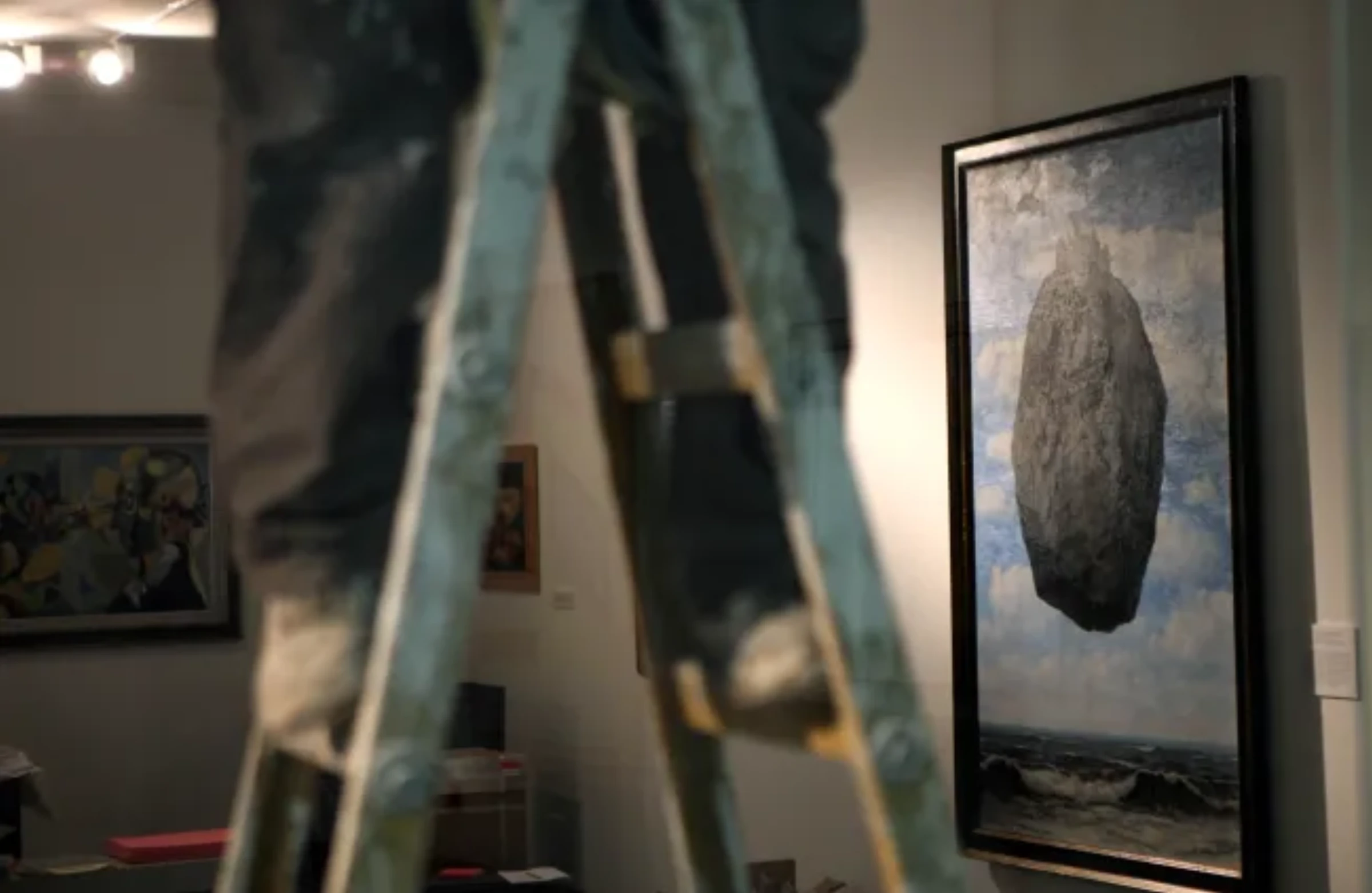
A child’s damage to Magritte’s The Castle of the Pyrenees has reopened the hard question museums hate: how much vulnerability should public access require?
A small puncture exposes a big museum argument
A six-year-old visitor reportedly pierced René Magritte’s Le château des Pyrénées with a pine cone at the Israel Museum, sending one of the twentieth century’s most recognizable paintings into conservation. The incident is easy to summarize as a freak mishap involving a child, a loose object from the sculpture garden, and a few weeks of repair. That summary is true and still incomplete. The more consequential issue is the museum’s longstanding decision not to place the work behind glass or wire it with an alarm because it wanted viewers to encounter the picture with minimal mediation. Once damage occurs, that choice stops looking like a refined curatorial preference and starts reading like a public ethics problem.
Museums have spent years defending proximity as part of the authenticity of aesthetic experience. A masterpiece seen without reflective barriers, aggressive stanchions, or obvious electronic warning systems is said to remain alive to the eye. There is merit in that argument. Paintings were not made to resemble forensic evidence sealed behind protective material. But the Magritte case makes plain what the argument costs. If public intimacy with a painting includes the possibility that a child holding a pine cone can puncture it, then museums need to say more honestly why that level of vulnerability is acceptable and who bears the consequence when the wager fails.
The Israel Museum occupies a special place in this discussion because the painting is not incidental to the institution. The work, donated in 1985 in honor of the museum’s twentieth anniversary, has become one of the site’s emblematic modern holdings. Its place within the museum’s public identity makes the incident more than a routine conservation matter. When a signature picture is damaged under normal visitor conditions, the museum has to defend not only its response but the philosophy that structured the display in the first place.
Open display is a choice, not a natural law
One of the more revealing details in the Artforum report is that the museum had consciously resisted glazing or alarming the painting in order to preserve an unrestricted viewing experience. That sentence matters because it shifts the event out of the realm of bad luck and into the realm of institutional judgment. The painting was not left vulnerable by oversight alone. It was left vulnerable as part of a museum decision about what kind of encounter should define the work.
That choice deserves scrutiny because museums often describe unmediated display as though it were the neutral or ideal condition of looking. It is not. It is a risk calculation that privileges one set of values over another. The values may be admirable: trust in visitors, fidelity to visual experience, resistance to fortress aesthetics. Still, they remain values, not inevitabilities. Once an incident happens, the institution has to account for the fact that it placed symbolic and educational weight on openness while accepting preventable exposure to physical damage.
Readers who have followed broader museum-governance debates will recognize the pattern. Institutions frequently frame choices about access, interpretation, and atmosphere as if those choices exist outside operations. They do not. They are operational. The same goes for climate systems, staffing levels, and guard deployment. Our recent coverage of the Phillips Collection’s record infrastructure gift makes a related point from another angle: public-facing ideals depend on back-end capacity. If a museum wants openness, it has to pay for the conditions that make openness less reckless.
Why children in museums force institutions to tell the truth
The fact that the damage came from a child is not a sentimental side note. It is exactly what makes the episode clarifying. Museums love to champion family access, intergenerational learning, and environments that do not intimidate younger visitors. They should. But a child in a gallery is also a test of whether an institution’s protections match its own rhetoric. If a museum wants children close to masterpieces, it must assume childish behavior, not idealized stillness. A six-year-old does not need malicious intent to expose a weak point in display design.
That does not mean the answer is to turn every museum into a padded corridor of fear. It means institutions should stop pretending that accessibility and vulnerability are naturally aligned. They are often in tension. Family-friendly space requires carefully designed thresholds, sightlines, supervision, and object protection. When those elements fail to align, the museum tends to fall back on a script about unfortunate accidents. Yet accidents are part of the planning brief. A child picking up an object outdoors and carrying it indoors is exactly the sort of behavior a museum should have modeled against if it is presenting major works without physical barriers.
This is where the conservation department becomes central. Sharon Tager’s comments to Haaretz suggest confidence that the repair can be made undetectable. That is reassuring, but it should not let the museum off the hook conceptually. A successful repair resolves the painting’s material injury more than it resolves the institutional question. Conservation can heal a puncture. It cannot by itself explain why the museum accepted the puncture risk in the first place.
The politics of unrestricted viewing have changed
There was a time when unrestricted viewing could be defended primarily as a civilizing trust between institution and public. That language now feels thinner. Museums operate in an environment shaped by attention scarcity, security anxiety, climate events, culture-war pressure, and rising costs. The old confidence that viewers would quietly honor the terms of display has weakened, not because the public has become uniformly hostile but because institutions can no longer rely on social codes as their main protective technology. The Magritte incident is a minor event compared with activist attacks or large-scale thefts, but it lands inside the same larger change.
What looks elegant to curators can look under-defended to insurers, trustees, and lenders. That matters because display choices are never only aesthetic. They affect premiums, loan negotiations, and the credibility of future stewardship claims. Museums cannot isolate the sensory experience of art from the legal and financial architecture that supports it. Once a high-profile damage event occurs, every stakeholder re-evaluates the cost of openness. The institution may conclude that the Magritte remains worth showing without glass. It will make that decision now under sharper scrutiny and probably at a higher operational price.
There is also a public-perception issue. Visitors often assume that what is on display is protected to a degree commensurate with its importance. When that assumption is punctured, the museum’s aura of competence is punctured with it. That does not destroy trust overnight, but it creates a residue of doubt. If one of the museum’s signature paintings can be damaged by a child with a found object, what other vulnerabilities are being managed through hope rather than design?
What museums should learn from this incident
The right response is not a generic crackdown. It is a more mature accounting of what access means materially. Museums should review how children move between outdoor and indoor spaces, what small objects can travel with them, how guard intervention is staged, and which works genuinely justify protective glazing or distance. They should also be honest with the public that barrier-free display is not a birthright of art appreciation but one possible arrangement among others, each with consequences.
More broadly, the Magritte case should push museums to stop romanticizing vulnerability as though it were itself a public virtue. A painting seen without glass may feel more immediate, but immediacy is not the only value museums owe audiences. They also owe duration. If preservation requires certain forms of mediation, then mediation is not a betrayal of the artwork. It is part of the work’s future. That is an uncomfortable message because it interrupts the fantasy of pure access. Still, it is a truer one.
The Israel Museum will likely restore the picture and continue presenting it as a cornerstone of its modern collection. The visible crisis may therefore disappear quickly. What should remain is the harder lesson. Open display is never innocent. It is a choice made by institutions that want to deliver intimacy while managing risk. After this incident, museums everywhere have one more reason to ask whether their own version of that bargain is actually thought through or simply inherited from an earlier era of confidence.
That question reaches beyond Jerusalem. Many museums still rely on a tacit belief that the best-looking display is also the most legitimate one, even when visitor behavior, security pressure, and family programming have changed dramatically. The Magritte puncture shows why that confidence has expired. If institutions want to defend openness, they now need to defend it with design, staffing, and monitoring strong enough to survive ordinary human unpredictability. Anything less turns aesthetic principle into preventable exposure.
There is a broader reputational issue as well. Museums teach visitors how seriously to take objects not just through labels and scholarship, but through the physical cues of care built into a room. When those cues are too faint, institutions may believe they are honoring aesthetic purity while inadvertently signaling that a masterpiece is less vulnerable than it really is. The lesson of the Magritte incident is that pedagogy, design, and protection cannot be separated cleanly. Each one teaches the public how to behave toward the work in front of them.