Duane Michals Dies at 94, After Remaking Photography
Michals used sequences, handwritten text, and staged fictions to break photographic literalism and permanently widen what the medium could do.
Duane Michals refused to let photography stay literal
Duane Michals, who died this week at 94, belongs to that small class of artists whose importance becomes clearer each time a medium starts pretending it knows its own rules. According to Artnet’s obituary, Michals died in Manhattan after a career that challenged photographic orthodoxy at almost every turn. He staged sequences when straight photographers insisted on singular revelation. He wrote directly on his prints when modernist purity demanded silence. He treated dreams, eros, memory, and death as fully legitimate photographic subjects even when the field preferred evidence, crisp surfaces, and the pieties of the so-called decisive moment. The result was not just stylistic variety. It was a sustained rejection of the idea that a camera’s highest function is to certify what was already there.
That revolt can be easy to underestimate now because its consequences have been so widely absorbed. Contemporary photography is full of narrative staging, diaristic text, hybrid forms, and conceptual self-interruption. Michals helped make all of that imaginable. The official DC Moore Gallery artist page, which has represented him since 2013, shows the breadth of that legacy in the range of sequences, text works, portraits, and later mixed practices that continued into his nineties. The key point is that Michals never accepted photography as a passive registration device. He treated it as a thinking instrument that could lie, speculate, mourn, flirt, and philosophize.
The sequence was his answer to photographic certainty
One of Michals’s decisive innovations was the sequence: a chain of images that shifted photography from the frozen instant toward unfolding thought. Artnet notes that he began developing these frame-based narratives in the mid-1960s, inspired partly by cinema and partly by the empty rooms in which he found himself waiting for portrait sitters. That origin story matters. Michals did not move into sequence because he wanted spectacle. He moved into it because still photography was too cramped for the kinds of psychological and metaphysical questions he cared about. A single image could describe appearance. A sequence could describe transformation, uncertainty, dread, or desire.
Works now visible through the gallery’s sequence pages show how radical that shift remained. Michals’s serial images rarely behave like cinematic storyboards marching toward plot resolution. They feel more like thought experiments staged in real space. Bodies appear, split, vanish, or re-encounter themselves. The camera records actions, but it also records the failure of action to settle experience. That structure became foundational for later artists who wanted photography to narrate consciousness rather than merely describe the visible world.
It also gave Michals a way to resist the prestige hierarchy inside photography itself. Mid-century photographic discourse often elevated the quick, pure, unmanipulated image as if truth arrived intact through reflex and discipline. Michals had no interest in serving that religion. He understood that meaning is made across time, across images, and across language. The sequence let him smuggle duration and doubt into a medium too eager to congratulate itself on immediacy.
His handwritten texts broke the illusion of self-sufficiency
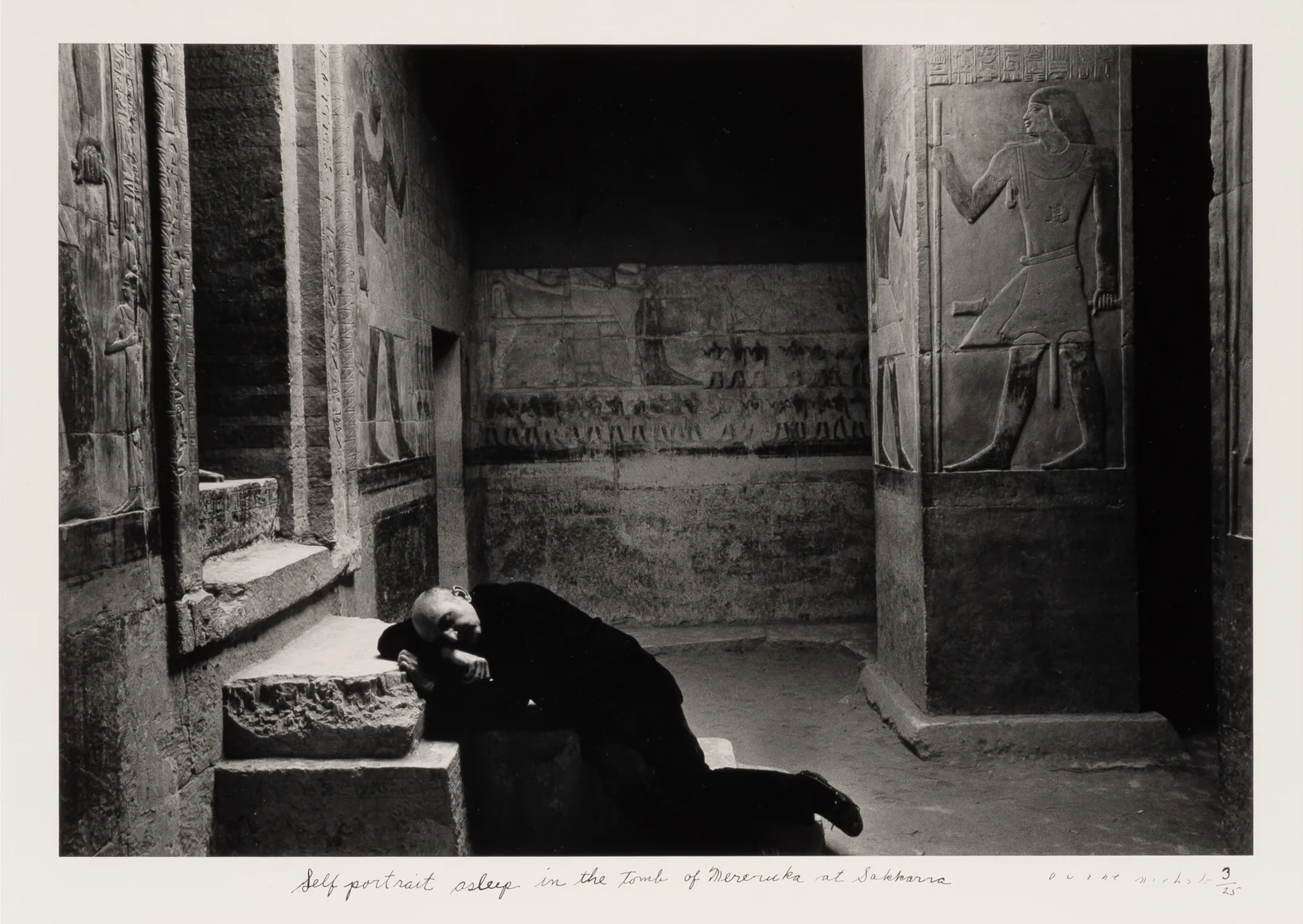
If the sequences stretched photography narratively, Michals’s handwritten texts broke it open rhetorically. Beginning in the 1970s, he wrote around and across his prints in order to say what the image alone could not carry. This was not an ornamental add-on. It was a direct challenge to formalist beliefs that the image should remain sovereign and self-explanatory. Michals’s text insists that photographs are never complete by themselves. They provoke thought, but they also require thought, memory, and contradiction from outside the frame.
That move now seems prophetic. The contemporary image economy is saturated with captioning, annotation, and context wars. Yet Michals’s use of language was more elegant and more dangerous than the current endless metadata haze. He did not use text to stabilize meaning. He used it to trouble it. Sometimes the writing sharpened an emotion that the photograph only suggested. Sometimes it undercut the image’s apparent clarity. Sometimes it pushed the work toward aphorism, dream, or joke. The point was always that human experience cannot be reduced to surfaces. Michals was not documenting the world; he was arguing with the terms on which documentation claims authority.
There is a reason younger artists keep circling back to him. Michals gave them permission to be impure. He made it possible to be literary without abandoning pictures, theatrical without abandoning intimacy, and philosophical without becoming pompous. That is a harder balance than it looks. Plenty of conceptually minded photography becomes bloodless. Michals almost never did, because the conceptual questions were anchored in mortal subjects: fathers, lovers, strangers, time, bodies, vanity, and grief.
Portraiture, celebrity, and private metaphysics
Michals’s commercial and portrait practice can obscure how strange he remained. He photographed celebrities, magazines, and public figures, but he never surrendered to the smoothness that usually accompanies that economy. Even when working with famous sitters, he often seemed more interested in vulnerability, self-awareness, or staged wit than in image management. The same artist who photographed René Magritte and made commercial pictures also produced some of the most quietly haunting meditations on intimacy in late twentieth-century American art. That double practice was not a contradiction. It was part of his intelligence about performance itself.
The DC Moore material underscores another important point: Michals kept changing. The late work moved into painted photographs, books, drawings, and other forms that might have looked undisciplined in lesser hands. In his case they feel like extensions of an old impatience with medium borders. That is why his career matters beyond photography departments. He belongs to a larger history of artists who saw the gallery not as a place to display a mastered form but as a place to test whether forms were still serving experience honestly.
Our own recent coverage of David Hockney’s death offers a useful parallel. Hockney and Michals worked differently, but both treated representation as an open problem rather than a settled grammar. Each refused the obedient version of his medium. Hockney bent perspective, scale, and technological tools to test how seeing works. Michals bent sequence, handwriting, and staged fiction to test how knowing works. That shared refusal helps explain why their losses feel larger than obituary culture usually allows.
What his death clarifies about the medium now
Michals leaves behind more than a body of work. He leaves a standard for skepticism. In an era defined by proliferating image tools, synthetic media, and industrial quantities of visual content, his art reminds us that the real question was never whether photographs were truthful. The question was what kinds of truth they could make room for. Michals answered by expanding the field toward ambiguity, self-division, and written thought. He made photography less obedient to optics and more answerable to consciousness.
That legacy looks especially urgent now because so much current image culture confuses flexibility with freedom. We have endless technical manipulation and very little existential risk. Michals was the opposite. His means were often simple, but the stakes were high because he wanted the image to carry embarrassment, longing, mortality, and metaphysical unease without hiding behind technical bravura. That is why the work still bites. It is not merely inventive. It is disobedient in the right places.
Obituaries often flatten artists into firsts and influences. Michals deserves better than that. Yes, he expanded the narrative potential of photography. Yes, he brought text into the print. Yes, he challenged the dogma of straight photography. But the deeper achievement was tonal. He made room for a voice inside the image: funny, melancholy, erotic, suspicious, and unfooled by the camera’s pretensions. Photography after Michals could no longer claim innocence. That is a substantial inheritance, and one the medium still has not fully finished absorbing.
His death also lands at a moment when the medium is once again arguing about what counts as photographic truth. Synthetic imagery, automated editing, and platform-driven circulation have made photography simultaneously more ubiquitous and less trusted. Michals anticipated that instability from the opposite direction. He did not wait for machine generation to expose photography’s slipperiness; he treated slipperiness as a constitutive fact and built an art around it. That makes him newly contemporary. Younger artists working with staged narrative, diaristic text, queer self-construction, and conceptual sequencing are still operating inside a space he helped clear.
The practical challenge now is institutional. Will museums, galleries, and teachers present Michals as a radical whose work still unsettles the medium, or as a lovable precursor who made room for today’s hybrids? Those are different futures. The second is safer, and therefore more likely. The first is truer. If the field wants to honor him seriously, it will need to keep the antagonism intact: the refusal of purity, the skepticism toward visual certainty, and the insistence that a photograph without thought is never enough.
That means showing the work in ways that restore its risk. Sequence pieces should not be treated as a quaint formal innovation before the digital age. The text works should not be domesticated into sentiment. The portraits should not be isolated from the larger metaphysical project. Michals mattered because he kept asking the medium to admit what it could not contain on its own. If retrospectives, teaching collections, and market presentations remember that pressure instead of simply canonizing his charm, his legacy will remain active rather than merely secure.