David Hockney Dies at 88, Leaving No Safe Version of Figuration
David Hockney dies at 88 after remaking figurative painting, queer visibility, and art-world scale on his own impatient terms
David Hockney’s Death Closes One of Modern Art’s Most Public Arguments
David Hockney died on June 11 at the age of 88, ending a career that had long since outgrown the ordinary scale of obituary writing. As The Art Newspaper reported, Hockney died at home after more than six decades spent remaking what figurative art could look like after abstraction, Pop, conceptualism, photography, and the internet had all supposedly changed the terms of picture-making for good. That simple fact matters because Hockney never accepted the idea that painting had to retreat into theory in order to remain serious. He made pleasure intellectually ambitious. He made clarity difficult again. He kept insisting that representation could still be radical if the eye doing the representing was sharp enough.
That is why his death lands differently from the passing of a merely famous painter. Hockney was not only a household name with museum-scale recognition. He was one of the rare artists whose visual language became public knowledge while staying tied to real aesthetic stakes. People who could not identify an art movement knew A Bigger Splash. Visitors who did not care much for mid-century British criticism still understood the authority of his double portraits. Younger artists raised on screens and software recognized in his iPhone and iPad pictures a model of technical curiosity that did not require surrendering to gadget worship. Hockney’s achievement was not that he made difficult art accessible. It was that he made accessibility look like a form of seriousness instead of a compromise.
From Bradford to California, Hockney Built a New Public for Looking
Hockney’s biography has been told so often that it can harden into legend: Bradford childhood, Royal College of Art, early London breakthrough, California light, pools, lovers, portraits, prints, stage design, Yorkshire roads, Normandy blossoms. The outline is familiar because it is unusually coherent. Yet the important point is not simply that he moved between places. It is that each move let him test a different visual regime. At the artist’s official press archive and across the sections of his own website, you can see how deliberately he treated medium as a way of thinking rather than a brand extension. Acrylic, drawing, photography, printmaking, fax, photocopier, iPhone, iPad, and multi-screen video were all folded into one longer argument about perception.
California gave that argument its most recognizable iconography. The pools, terraces, clipped shadows, and impossible stillness of Los Angeles let Hockney treat light as architecture and desire as a structure of space. Works such as A Bigger Splash at Tate now feel inevitable, but their confidence was hard won. Hockney used acrylic to paint a world of surfaces so exact that viewers could forget how strange the compositions really were. The empty chair, the absent diver, the splash without a body: these were not simply cool images of affluent leisure. They were pictures about timing, social performance, and the visible trace of someone who has already vanished from view.
At the same time, Hockney’s openness about queer life remains central to his legacy. Early works such as We Two Boys Together Clinging placed male intimacy into painting before British law had caught up with lived reality. He did not cloak desire in allegory because the culture demanded discretion. He forced viewers to register coded and uncoded forms of gay presence at a moment when public representation carried legal and social risk. It is easy to understate how important that was because later generations inherited a broader field of visibility. Hockney helped produce that field.
His Late Work Proved That New Technology Did Not Belong to the Tech Industry
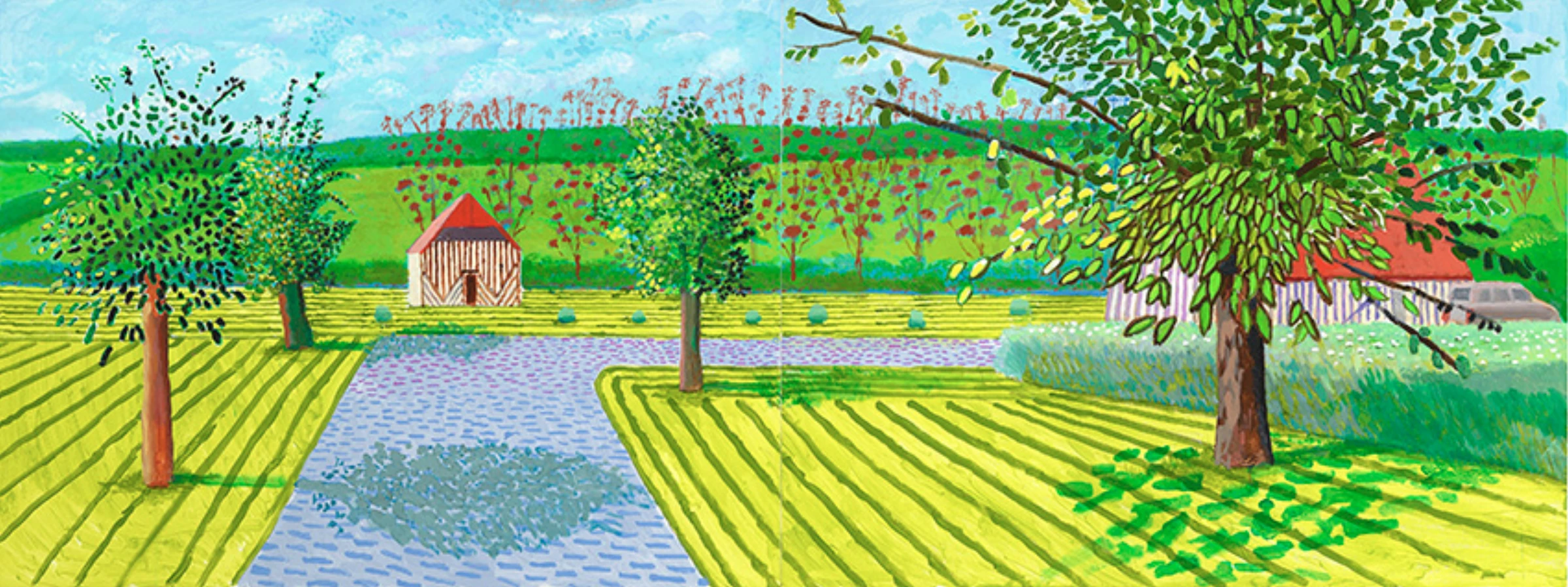
One of the least boring things about Hockney was his refusal to become a guardian of old media purity. Plenty of major painters survive long enough to become reactionaries about tools. Hockney did the opposite. He remained suspicious of dead-eyed photographic seeing, but he was thrilled by machines that could expand the hand’s capacity to register time, light, and sequence. His digital works, including the iPad and iPhone drawings collected in sections like the official digital works archive, were never convincing because they were novel. They were convincing because they preserved his appetite for looking while changing the tempo of execution.
This matters now because too much contemporary talk about art and technology is either breathless or defensive. Hockney offered a third position. Technology, in his hands, was neither salvation nor contamination. It was material. It could be used badly, sentimentally, lazily, or brilliantly, just like paint. That is why his late digital images still feel more alive than many recent tech-heavy art projects built around spectacle or novelty. Hockney understood that a new device does not give an artist a new eye. It merely exposes whether the artist still has one.
His final years also carried a kind of public generosity that should not be confused with softness. The Normandy works, the flowers, the changing seasons, and the recurring insistence that life and looking were inseparable all risked sounding simple. Often they were simple. But Hockney’s best late work used simplicity as compression rather than dilution. The question was not whether he had become conservative. It was whether he could still stage intensity without melodrama. Even critics who found some late shows thin had to admit that his appetite for making had not hardened into ceremony.
What Hockney Leaves Behind for Museums, Markets, and Artists
There is another way to measure that legacy, and it has to do with institutions that once treated figuration as something to be periodically rescued rather than continuously rethought. Hockney spent decades embarrassing that hierarchy. He was popular without being minor and formally alert without adopting the manners of difficulty that museums often reward. That tension feels newly relevant when so many public collections are rebalancing twentieth-century narratives around migration, identity, and transnational exchange. Hockney belongs inside that rewrite, not outside it as a comfortable exception. We touched a related institutional nerve in our report on Tate’s Van Gogh and foreign galleries debate, where canon formation was again shown to be less neutral than museums like to imply. Hockney’s career kept proving that the supposedly stable center of modern art could be redrawn by an artist who loved visibility, pleasure, and formal argument all at once.
That public dimension also explains why the loss will be felt well beyond specialist circles. Hockney gave nonexperts permission to care about looking closely without making them feel culturally late or intellectually unqualified. He treated visual pleasure as something worth defending in public language. In a period when art institutions are struggling to explain why close looking still matters amid spectacle, screens, and shrinking attention, that example becomes even more valuable. Hockney’s paintings, drawings, and digital works are not important because they are easy. They are important because they make exacting looking feel like a pleasure rather than homework. That is a rare civic gift from an artist, and it will not be easily replaced.
The museum world will spend the next several years stabilizing Hockney’s legacy into retrospective shape. That process has already begun in blockbuster exhibitions such as David Hockney 25 at Fondation Louis Vuitton, which positioned him not as a charming survivor from British Pop but as a world-scale artist with durable formal range. Expect that framing to intensify. Institutions like the Royal Academy, Tate, and major American museums already have the infrastructure to narrate him as both national treasure and transatlantic inventor. The challenge will be avoiding a version of Hockney that is all charm, no abrasion.
The market will also push for simplification because simple Hockneys are easy to sell. Pools, portraits, flowers, and bright landscapes convert quickly into familiar categories. But the more difficult Hockney is the one worth defending: the artist who treated perspective as a live problem, who kept testing how to picture time, and who refused to let seriousness become visually punitive. His legacy is not just a catalog of beloved images. It is a method of staying intellectually mobile while remaining legible to ordinary viewers.
That is also the lesson younger artists may take most usefully. Hockney did not survive every shift in fashion by predicting the next market move. He survived because he kept returning to first questions. How do we look. How does time behave in an image. What does intimacy feel like when turned into composition. How can new tools alter seeing without replacing it. Those are not nostalgic questions. They are the questions that return every time art risks becoming either too hermetic or too content-driven.
So yes, one of the most famous artists in the world has died. But the real loss is more specific than celebrity. Hockney kept open a lane in modern art for sensual intelligence, wit, gay visibility, technical restlessness, and public pleasure without embarrassment. That lane now belongs to history, but it also remains open as a demand. Whoever claims to inherit Hockney will have to do more than borrow his colors. They will have to risk making art that is lucid, popular, and formally exacting at the same time. Very few artists have ever managed that. Hockney did, and that is why the obituary cannot be small.