Cathy de Monchaux Gets First Major Survey at Palais de Tokyo
The 1990s sensation and Turner Prize nominee gets her first major survey in Paris, with a studio recreation and decades of erotically charged sculpture
A Career Resurrected
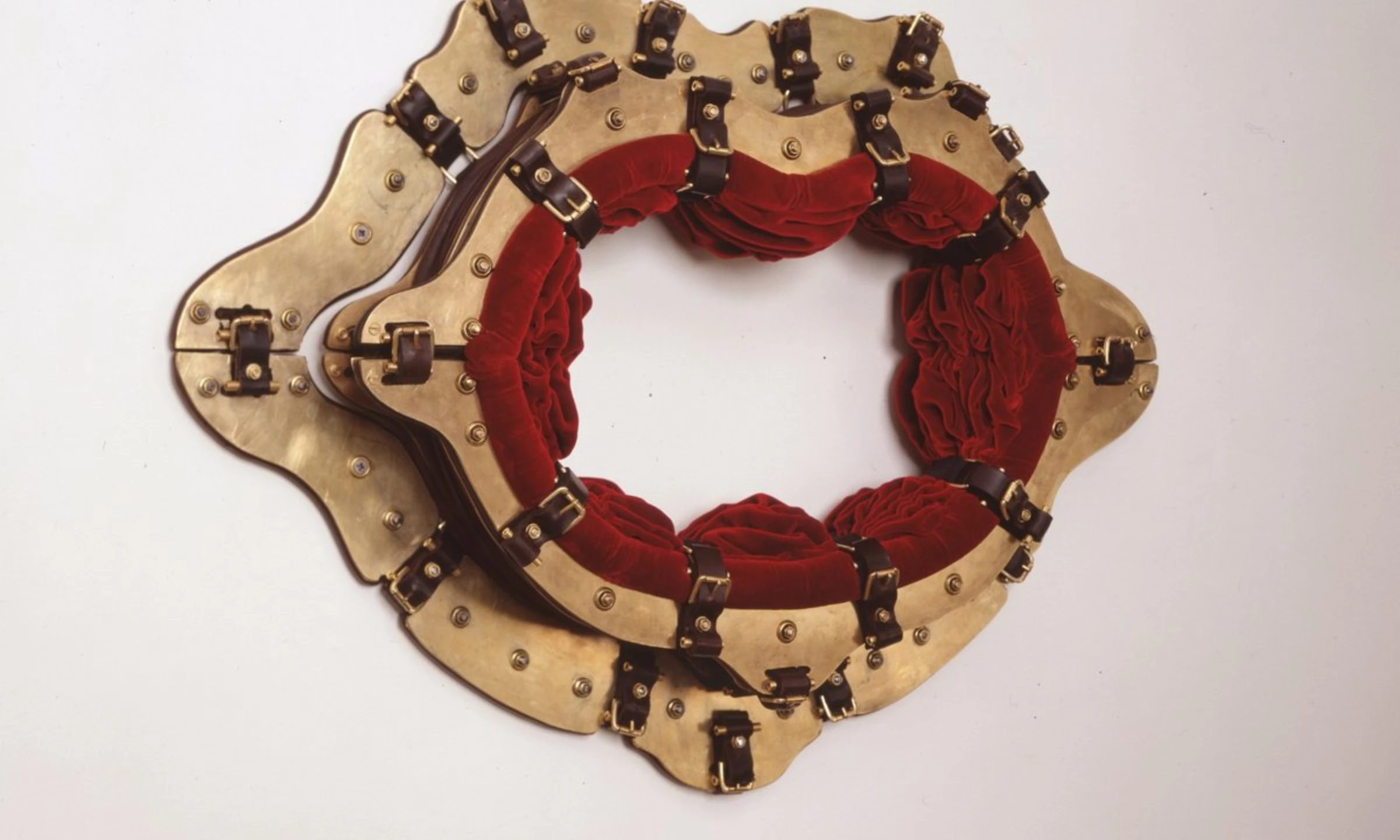
Cathy de Monchaux emerged in the early 1990s as one of the most distinctive sculptors of her generation, a Goldsmiths graduate whose erotically charged, intricately wrought work stood apart from her YBA contemporaries in attitude if not in ambition. Her 1993 show at Chisenhale Gallery featured elaborate wall pieces bristling with baroque spikes and curlicues, threaded with ribbons and seeping slivers of red velvet and folds of leather from between bolted metal plates. A Turner Prize nomination in 1998 confirmed her status. Then, by her own account, the phone simply stopped ringing.
Now the Palais de Tokyo in Paris has mounted Studio, Wounds and Battles: Desire is the Reiteration of Hope, the first significant exhibition of de Monchaux work in more than a quarter century. The survey covers work spanning decades, mixing pieces from her student years with recent creations completed in an improvised studio upstairs at the Palais de Tokyo during the run of the show. For anyone who followed British art in the 1990s, the exhibition is a reminder of how completely the art world can look away from an artist who stops playing its games.
The Work Itself
De Monchaux never stopped making work, raising her son as a single mother and supported by a handful of loyal collectors. The Palais de Tokyo show demonstrates what that quiet persistence produced. A life-sized unicorn made from cane and tissue paper, created when de Monchaux was a student, presides over recent works featuring dramatic wall-mounted chalky white tableaux of faceless pregnant women emerging from papery fissures. These figures perch on tumbling staircases or become part of forests, their wiry hair whipped aloft like branches, feet growing webs of arterial roots.
The exhibition also includes prominently genitaled cast silver frogs, framed monochrome forest scenes featuring more unicorns, and miniature battles raging in glades fashioned from wire, paint and sticking plaster. The massed ranks of pregnant female figures have become a motif in recent years. De Monchaux describes them as clearly mothers, noting that in her work the personal and political are always intertwined. The language of her work has evolved from the metal-and-leather constructions of the 1990s into something more organic and papery, but the meticulous hand fabrication remains. As she puts it, materials are evocative of her mood.
Her transformative skills with materials make it often difficult to know what her work is actually made from. Surfaces are rubbed, distressed, covered with dust or plaster, encrusted with paint. This near-alchemical mastery gives the sculptures an uncanny quality, as though they might have grown rather than been made. Links to Palais de Tokyo provide context for those planning to visit before the show closes on September 13.
A Studio Reconstructed
One of the most striking features of the exhibition is the laborious recreation of de Monchaux London studio space, described as a magical treasure trove of ephemera, offcuts and objects ranging from a mummified bat to strangely-shaped stones, scraps of fur and twists of metal, wire and paper. She describes these as her tool shelves of ideas and spells. Walls lined with open sketchbooks and papered with layered intricate drawings offer a total immersion into a unique imagination.
The studio reconstruction is more than a curatorial flourish. It speaks to the title of the exhibition, which places the studio at the centre of all her endeavours as a creative crucible of strife and struggle as well as refuge and solace. For an artist who worked in relative obscurity for 25 years, the studio was not just a workplace but a companion. The recreation gives viewers a sense of what sustained de Monchaux when the institutional art world had moved on.
Walking through the Palais de Tokyo galleries, the effect is that of a profane, pan-cultural cathedral where earlier abstract works inhabit the lofty architecture like ornate gargoyles or votive reliquaries. The scale of the space allows the work to breathe in ways that smaller gallery presentations could not accommodate. The unicorn, the pregnant figures, the cast silver frogs, and the miniature forest battles each occupy their own territory within the exhibition, creating a journey through an imagination that has been at work for decades without an audience.
The studio reconstruction is more than a curatorial flourish. It speaks to the title of the exhibition, which places the studio at the centre of all her endeavours as a creative crucible of strife and struggle as well as refuge and solace. For an artist who worked in relative obscurity for 25 years, the studio was not just a workplace but a companion. The recreation gives viewers a sense of what sustained de Monchaux when the institutional art world had moved on.
Why This Matters Now
The art world rediscovery cycle is familiar enough that it has its own rituals. A forgotten artist gets a survey, critics write think pieces about overlooked figures, the market adjusts. What makes de Monchaux case different is the sheer length of the gap and the quality of what was made during it. She was not forgotten because the work declined. She was forgotten because she did not promote herself, because the art world rewards visibility as much as talent, and because the infrastructure of support that exists for male artists who keep their heads down does not function the same way for women.
The Palais de Tokyo survey also raises questions about what the art world misses when it looks away. De Monchaux work from the 1990s stands up remarkably well against her more famous YBA peers. The pieces being shown for the first time, made during the years when nobody was watching, are if anything more ambitious and more personal than the early work that made her name. There is a lesson here about the difference between artistic achievement and art world recognition, and about how much of the 1990s narrative we got wrong by focusing on the loudest voices.
De Monchaux absorption of visual culture began in childhood. She remembers roaming through the Victoria and Albert Museum and the British Museum in London, absorbing everything from Elizabethan ruffs to musical instruments and Egyptian funeral figures. She and her friends would run wild, she recalls, treating the museums as a mental escape, looking at all these objects and trying to make sense of them. That encyclopedic visual appetite feeds directly into the pan-cultural quality of her work, which draws on religious reliquary, folk art, natural history and the decorative arts without hierarchy or deference.
The exhibition also demonstrates that de Monchaux obsessive, labor-intensive process has not diminished. She frequently works through the night and up to the last minute before a show opens, including for this one. The inventiveness of her approach to facture has resulted in a near-alchemical mastery of materials that makes it genuinely difficult to identify what her sculptures are made from. Surfaces are rubbed, distressed, encrusted with paint or covered with dust and plaster until the original material is transformed beyond recognition. This is craft in the service of something stranger than craft.
The question the show leaves hanging is whether this rediscovery will stick. De Monchaux has been here before, rising to prominence in the 1990s only to be dropped. The Palais de Tokyo survey is a major institutional gesture, and the work is strong enough to justify sustained attention. But the art world has a history of rediscovering artists for the duration of a single exhibition and then moving on. For de Monchaux, that pattern may be familiar enough to be almost comforting. She has never stopped making work, regardless of who was watching. The difference now is that someone is finally watching again. Read more about the artist and her work in our guide to understanding abstract painting.
Writing in The Art Newspaper, Louisa Buck notes that de Monchaux is only now getting her dues. The Palais de Tokyo show runs until September 13, and anyone interested in sculpture, installation or the untold stories of British art in the 1990s should make the trip. For broader context on the artist career, the Tate collection page provides background on her Turner Prize exhibition and acquired works.
The exhibition also includes prominently genitaled cast silver frogs, framed monochrome forest scenes featuring more unicorns, and miniature battles raging in glades fashioned from wire, paint and sticking plaster. The massed ranks of pregnant female figures have become a motif in recent years. De Monchaux describes them as clearly mothers, noting that in her work the personal and political are always intertwined. She sees these figures not as symbols but as manifestations of lived experience, the body as both battleground and source of creation. The tension between violence and tenderness in these pieces is characteristic of her entire output, from the barbed metal-and-leather constructions of the 1990s to the papery, spectral presences of recent years.
De Monchaux absorption of visual culture began in childhood. She remembers roaming through the Victoria and Albert Museum and the British Museum in London, absorbing everything from Elizabethan ruffs to musical instruments and Egyptian funeral figures. She and her friends would run wild, she recalls, treating the museums as a mental escape, looking at all these objects and trying to make sense of them. That encyclopedic visual appetite feeds directly into the pan-cultural quality of her work, which draws on religious reliquary, folk art, natural history and the decorative arts without hierarchy or deference to any single tradition.