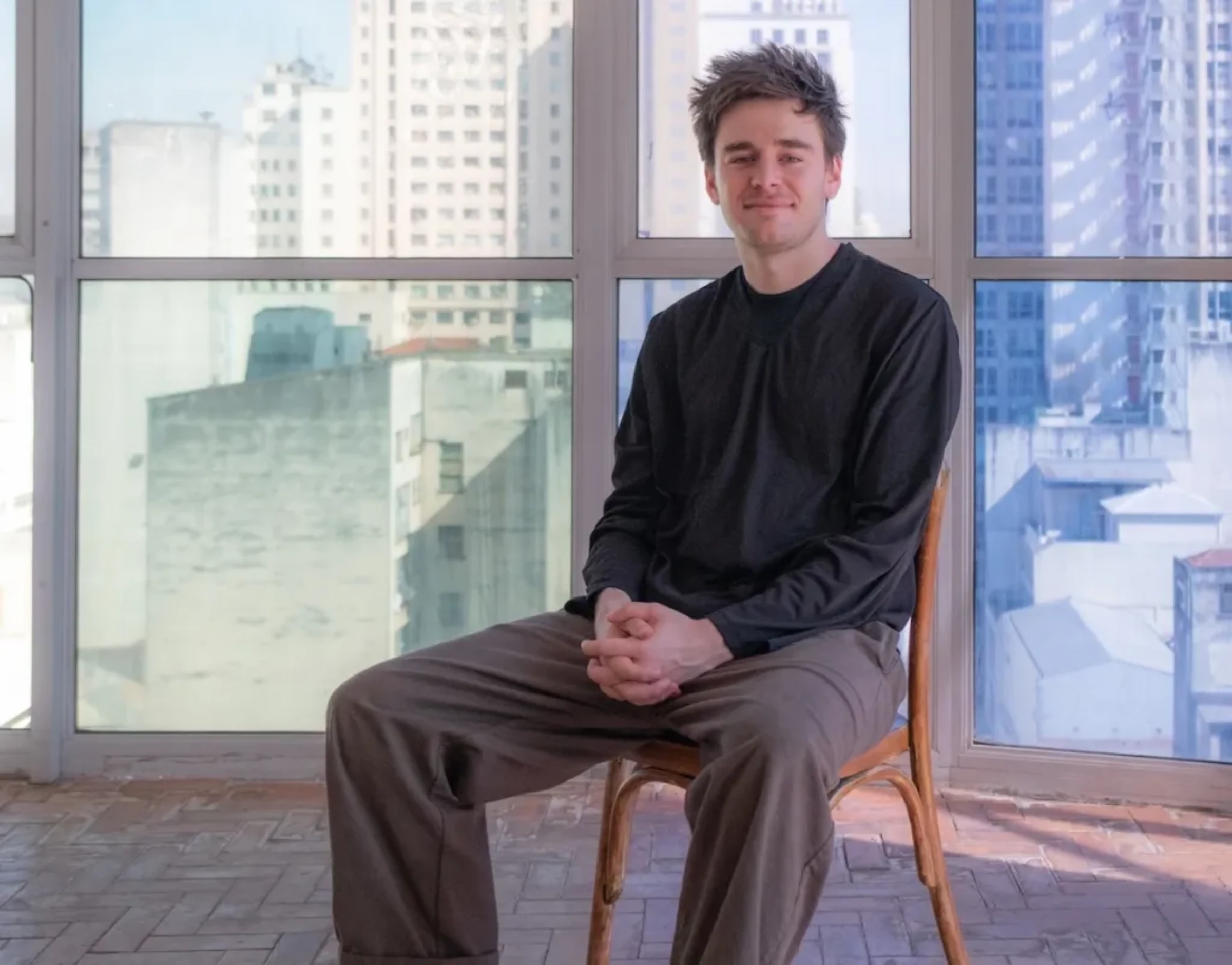
How a 31-Year-Old Dealer Reached the Whitney and Venice
David Pagliarulo's Chinatown gallery David Peter Francis has placed artists in both the Whitney Biennial and the Venice Biennale, a feat rare for any dealer
A Chinatown Gallery Punching Above Its Weight
In the current Whitney Biennial, two artists share a distinction that connects them to a single Chinatown gallery: Pat Oleszko, a 79-year-old performance artist whose brash inflatable sculptures have become one of the most talked-about contributions to the show, and Emilie Louise Gossiaux, whose drawings and sculpture pay tribute to her late guide dog. Both are represented by David Peter Francis, a gallery founded in 2024 by David Pagliarulo, who is 31 years old. Across the Atlantic, a third David Peter Francis artist, Carrie Schneider, is currently featured in the Venice Biennale.
Having artists in both biennials simultaneously is a rare achievement for any gallery. For a gallery that has mounted fewer than a dozen exhibitions, it is nearly unprecedented. Pagliarulo's program is built on a simple principle: he shows artists he believes in, regardless of whether their work will sell. "I really am motivated to do a good job for the artists," he said. "You just have to put your head down and do it, because for them, these are career-defining moments. They're trusting me to be the person in the sidecar with a beautiful scarf and a head wrap. I have to make it work."
The gallery's name carries a personal backstory. There is no real David Peter Francis. Pagliarulo borrowed the names from his father, Peter, and his grandfather, Francis. "My dad's not really an art person, my grandfather wasn't an art person, so I was like, 'I want to bring you guys into this in some way,' to implicate them," he said. He added, with a laugh, "It's weirdly Catholic."
The Pat Oleszko Bet
The story of how Pagliarulo found Oleszko reveals his approach to building a roster. He discovered her work through her inclusion in a 2020 group show at the now-defunct JTT gallery. Intrigued, he cold-emailed her about a potential solo exhibition. "She kind of brushed me off initially," he recalled. Oleszko said she was on residency outside New York. Pagliarulo persisted. "I was like, 'I want to come over to your house.'" After a couple of months, Oleszko relented.
The two hit it off, and Pagliarulo sealed the deal with a play on words, signing one of his emails "Day Bed" instead of David, charming Oleszko, who has a well-documented penchant for puns. The exhibition opened in June 2024, spread across two adjacent spaces. It was only the third exhibition Pagliarulo had mounted on his own. Oleszko hadn't had a New York solo show since 1990, so the built-in audience was limited. "I said, 'This isn't for me,'" Oleszko recalled. "So, the fact that he came up with the offer of a show was so far out of my comprehension. I was just kind of stunned."
That show became the foundation for Oleszko's current prominence. In January 2026, she filled SculptureCenter with a retrospective centered on her inflatable sculptures, including one resembling a woman's spread legs. Two months later, her 1995 sculpture Blowhard, a gigantic green face with a flaming tongue, took over a sizable gallery at the Whitney Biennial. Over the summer, she won the Biennial's $100,000 Bucksbaum Award. None of this would have happened without a young gallerist who cold-emailed an artist he believed in.
Building a Program With Conviction
Pagliarulo's path to gallery ownership was unconventional. He grew up in Tampa, Florida, which he describes as "not the culture capital of the world." His exposure to art came through an artist friend whose studio became a hangout spot. "Looking back on it, I'm like, 'Oh, those are early studio visits,'" he said. He studied visual culture at American University in Paris, minoring in art history, and graduated in 2018. After an internship at Fort Gansevoort, a gallery known for championing artists like Myrlande Constant and Shuvinai Ashoona, he worked at Chart and later became a director at Marinaro.
The decision to open his own space crystallized during a conversation with artist Elaine Reichek. In 2021, riding in an Uber after a gallery dinner, Pagliarulo mentioned that he was contemplating striking out on his own. "You know, you could do this yourself one day," Reichek told him. He took her advice in 2024, opening with a group show that featured Peter Hujar, Gonzalo Reyes Rodriguez, and Lucas Odahara. The latter two are now on his roster.
The program since then has displayed an ambition that is increasingly rare in New York's gallery landscape. In January, the gallery mounted "Snake, Turtle, Alligator," a group show centered around drawings by Bryan LaPlante, a security guard who watched over meetings about atomic weaponry held by the US government in the postwar era. In May, it staged a solo exhibition for William Scott, a self-taught artist whose drawings of an imagined majority-Black and -Brown city called Praise Fiasco are rarely seen in New York. In September, the gallery will present a show for Unglee, a French filmmaker and photographer whose work is virtually unknown in the United States.
The Economics of Conviction
Pagliarulo's approach raises an obvious question: how does a young gallery survive while showing artists with limited commercial track records? Many young New York galleries that specialize in challenging or under-recognized work struggle to maintain financial viability. Pagliarulo acknowledged the tension but framed it as a matter of priorities. "Someone said, 'There's a lot of poetics in the work here,' which I feel is true," he said of the gallery's curatorial identity. But poetics do not always translate into cash flow.
The gallery's growing institutional profile may help. Having artists in the Whitney Biennial and the Venice Biennale brings visibility that can attract collectors who might otherwise overlook a Chinatown space. The Biennial exposure also creates secondary market interest, which can benefit both gallery and artist over time. For Oleszko, the trajectory from a cold email to the Bucksbaum Award represents a career renaissance that few artists experience at 79. For Gossiaux and Schneider, the biennial placements provide institutional validation that can sustain careers for decades.
Pagliarulo's relationship with Drew Sawyer, a co-curator of the Whitney Biennial, has drawn some attention. Their relationship began after Sawyer was appointed curator in 2024 and the Biennial's artist list was announced at the end of 2025. Pagliarulo declined to discuss the relationship in detail. The Biennial's selection process involves multiple curators and external advisors, and there is no indication of impropriety, but the connection illustrates how personal and professional networks in the art world inevitably intersect. What matters more, from an institutional perspective, is the quality of the work. Oleszko's Blowhard is one of the Biennial's most discussed pieces, and Gossiaux's tribute to her guide dog has generated genuine emotional responses from visitors. The work earns its place regardless of who represents the artist.
What This Means for the Gallery Landscape
David Peter Francis represents a model of gallery practice that has become less common as the art market consolidates around large multinational operations. Pagliarulo is not trying to build a mega-gallery. He is trying to build a program that matters to the artists he shows, and the results are visible in the institutional recognition they are receiving. The fact that a 31-year-old dealer working from Chinatown can place artists in the world's two most prominent biennials suggests that the art world's attention mechanisms still have room for bets made on conviction rather than market calculation.
The broader context is less encouraging. Rising rents, consolidating collector bases, and the dominance of a handful of large galleries have made it harder for young dealers to survive in New York. Pagliarulo's success may be replicable, but the conditions that enable it are fragile. Whether David Peter Francis can sustain its momentum depends on whether the institutional exposure translates into the sales and collector relationships that keep galleries afloat.
For now, the gallery's trajectory is a reminder that the art world's center of gravity can shift quickly when someone is willing to take risks on artists that established galleries have overlooked. Pagliarulo's next exhibition, the Unglee solo in September, will test whether his model can extend beyond the artists who have already broken through. "I have to make it work," he said. The art world will be watching to see if he can sustain the standard he has set.
The broader implication of David Peter Francis's early success is that the gallery system, despite consolidation and rising costs, still has room for conviction-driven dealers who prioritize artistic vision over market strategy. In an era when many young galleries have pivoted toward sure-fire commercial propositions, Pagliarulo's commitment to under-recognized artists represents a counter-narrative. The Whitney and Venice placements prove that institutional curators are still paying attention to small spaces with strong programs. For more on how young dealers are navigating the current market, ARTnews market coverage regularly tracks emerging gallery openings and artist placements. For those interested in the Biennial selection process itself, the Whitney Museum's exhibitions page provides institutional context on how biennial artists are chosen and presented, and how small galleries can compete for institutional attention in a consolidating market.