David Hockney Changed How Painting Learns to See
A new Hockney reassessment shows how perspective, collage, landscape, and digital tools became one lifelong campaign against static vision
Hockney's legacy is bigger than the pool paintings everyone remembers
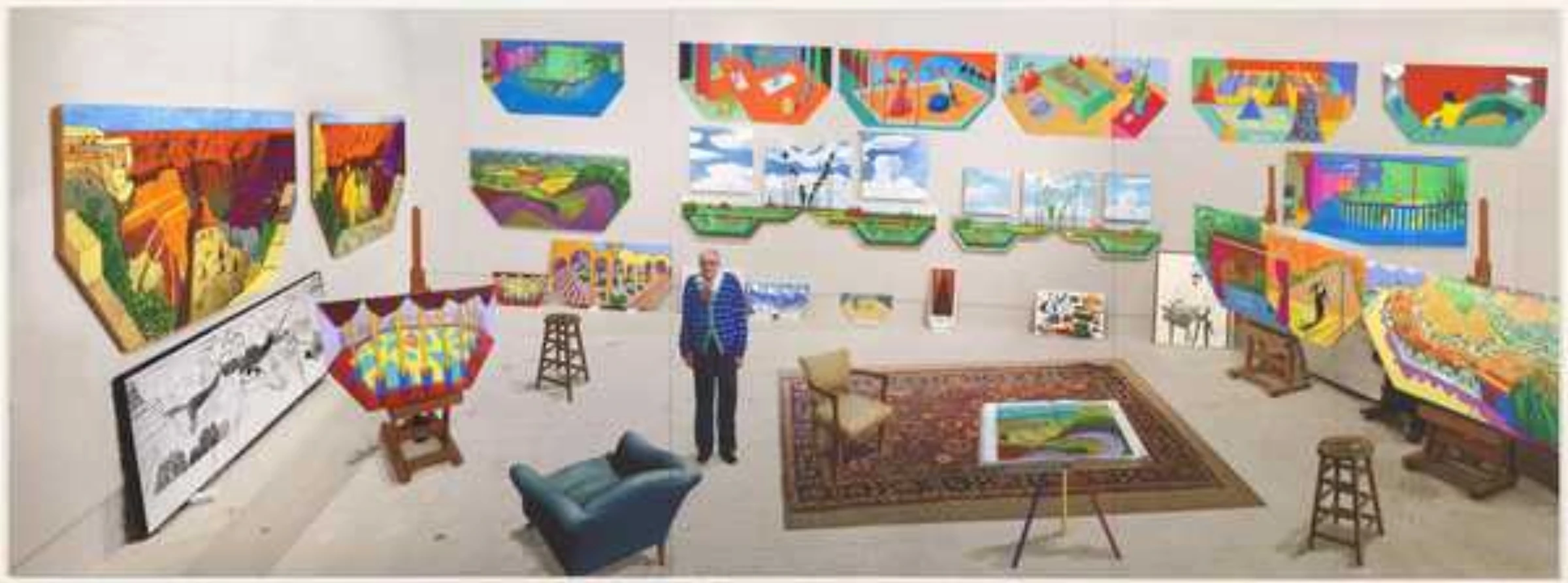
It is tempting to let David Hockney harden into a sequence of instantly recognizable motifs: Los Angeles pools, double portraits, Yorkshire woods, and those late iPad drawings that split viewers between delight and annoyance. But the more important claim about Hockney is broader and stranger. He changed how painting learns to see. A recent reassessment of his career emphasizes the many ways he dismantled static perspective, merged painting with photography, treated technology as a live tool instead of a threat, and kept searching for formats large enough to hold moving attention. That account is persuasive because it returns Hockney to the problem that links the famous work to the less easily packaged work: how to represent a world that no human being experiences from one fixed point.
That problem matters now because Hockney risks being remembered as a brand of brightness instead of a structural innovator. The official pages most readers will encounter first, from Tate's artist overview to collection entries for canonical works like A Bigger Splash, are useful because they remind us how quickly a once-disruptive artist can be converted into educational consensus. Hockney deserves the canon, but he also deserves the trouble he caused inside it. He made perspective behave less like a neutral tool and more like an ideological choice.
Perspective was never technical for Hockney. It was political about the viewer
One of Hockney's deepest objections to traditional one-point perspective was that it flattened lived experience into a neat fiction of control. Human seeing is not static, and he knew it. You move. You circle. You remember. You register space across time. That is why works like Pearblossom Hwy. remain central. They show Hockney refusing the single authoritative viewpoint in favor of composite vision assembled from multiple glances, intervals, and fragments. The work is often discussed as a meeting of painting and photography, but what really matters is the epistemology inside it. Hockney is saying that looking itself is cumulative and unstable.
That challenge runs backward and forward across the career. The California pictures only look effortless because the surfaces are so clean. In fact they are carefully staged arguments about what modern life should feel like when translated into paint. The famous pools are never just water and leisure. They are tests of how painting can render light, architecture, reflection, and desire without collapsing them into dead geometry. His later landscapes and digital works continue the same inquiry by other means. If critics missed that continuity, it was often because they mistook stylistic reinvention for inconsistency rather than recognizing a sustained attack on fixed seeing.
There is also a social dimension here. Perspective organizes the viewer's relation to the world. By unsettling inherited perspective, Hockney unsettled inherited hierarchies about what kind of subject matter deserved scale, tenderness, and formal invention. Domestic interiors, lovers, roadsides, dog portraits, and local landscapes all became worthy of grand visual thinking. That democratizing move was never simple populism. It was a reallocation of artistic seriousness.
It is worth staying with that point because Hockney's apparent accessibility has often hidden how revisionist he really was. He painted things many viewers thought they already understood: a lawn, a road, a sitter, a patch of water, a corner of room. Then he rebuilt the terms on which those things could be seen. He asked whether the clarity promised by representation was actually a form of simplification. He asked whether memory and duration could be made structural rather than anecdotal. He asked whether painting had to defend itself against photography or whether it could cannibalize photographic logic and still remain painting. Those are not decorative questions. They are field-shaping questions.
The Hockney that matters most, then, is not simply the charming modern master with a prolific hand. It is the artist who kept refusing to let a successful pictorial solution harden into doctrine. Once a way of seeing began to feel too easy, he found another angle, another tool, another scale, another system of assembly. That stubbornness is what made the career feel so alive over such a long span. It is also why younger painters, photographers, and installation artists continue to find usable permission in his work: permission to distrust the first convincing image.
He used photography and digital tools without submitting to them
Many artists flirt with new technologies only long enough to update their image. Hockney did something more demanding. He asked whether a new tool could extend his argument about vision. His photocollages did not merely prove that he could work with photographs. They used photography against its own promise of singular capture. His iPad drawings did not matter because they were digitally produced. They mattered because they tested whether immediacy, serial revision, and luminous color could create new relations between eye, hand, and surface. The medium changed; the underlying pressure on seeing did not.
That is why the cheap dismissal of his late digital work as novelty always felt lazy. Hockney was not abandoning craft for gadgets. He was continuing a long habit of examining how tools reorganize visual thought. The same could be said of his stage designs and immersive projects, including the later large-scale environments that pushed viewers into moving through image rather than facing it squarely. What he borrowed from technology was not trendiness but freedom from inherited pictorial obedience.
Our recent obituary analysis of Hockney's death touched on that formal restlessness. What becomes clearer now is how disciplined the restlessness really was. He did not chase media for their own sake. He kept returning to the same unsolved question: what kind of image is honest to moving consciousness? That consistency is what separates artistic experimentation from simple career maintenance.
What survives after the legend
Once the sentimental haze around Hockney inevitably thickens, the field will need to decide which version of him to teach. There is the friendly public version: bright colorist, chronicler of pleasure, indefatigable worker, late adopter of shiny new tools. Then there is the harder version: an artist who kept arguing with the terms on which Western art organized sight, desire, and pictorial authority. The second version is the one worth defending because it explains why the work still feels alive rather than merely beloved.
It also explains why Hockney keeps speaking to younger artists working across painting, photography, installation, and screen-based media. He offers a way to think beyond purity. You can borrow from cameras without becoming a photographer. You can use digital tools without surrendering to digital culture's speed and thinness. You can paint pleasure without becoming shallow. You can make beauty and still be critical of the habits of seeing that beauty normally reinforces.
The practical stakes of that legacy are institutional now. Museums will keep mounting crowd-pleasing Hockney surveys because they know the pictures work. The better question is whether those surveys preserve the argument at the core of the work or smooth it into nostalgia. If they do the latter, Hockney becomes décor for a canon that no longer feels threatened by him. If they do the former, he remains what he actually was: an artist who taught painting to distrust the single, static, obedient eye.
That choice will shape more than scholarship. It will shape how broadly the field understands the relation between painting and new media. Hockney is one of the few artists with enough popularity to reach viewers who might otherwise never care about debates over perception, technology, or representational authority. That reach is valuable only if institutions use it well. The safest version of Hockney tells audiences that great art can be friendly, colorful, and endlessly inventive. The truer version tells them that great art can also make familiar vision feel inadequate. If future exhibitions keep that discomfort intact, Hockney's work will remain more than beloved. It will remain instructive.
It will also remain useful against the current flattening of visual culture. At a moment when platforms reward instant readability and rapid emotional payoff, Hockney offers another rhythm: composite attention, delayed understanding, and pleasure that becomes more complex the longer you stay with it. That may be his most contemporary gift. He reminds painting that it does not need to imitate the speed of screens in order to speak to a screen-shaped age. It can answer that age by slowing, splitting, and complicating sight itself. That is a serious inheritance, and one the field should be careful not to turn into mere affection.
The consequence is that Hockney should be read less as a reassuring master than as a continuing challenge. He asks viewers to accept that the world arrives in fragments, overlaps, and returns, and that art has to build forms equal to that instability. That challenge extends beyond painting departments. It matters to photographers, installation artists, curators of digital work, and anyone trying to think about attention after the age of seamless images. If his legacy is framed at that level, it will keep generating work rather than merely inspiring tribute.
That is the real measure of endurance. Not whether an artist remains famous, but whether the work continues to unsettle the habits of its own admirers. Hockney passes that test whenever we stop using him as shorthand for brightness and start noticing how rigorously he dismantled visual habits that most viewers never knew they had. If the next wave of retrospectives, textbooks, and museum displays can keep that dismantling visible, then the career will continue to matter as living method rather than settled monument. That is a better fate than canonization without pressure, and Hockney earned it.