David Hockney's Queer Vision Still Looks Radical
A fresh reassessment of David Hockney's queer imagery shows how intimacy, coded wit, and domestic pleasure changed what gay life could look like in major art
David Hockney's afterlife is moving from obituary into argument
Less than a day after the art world absorbed the fact of David Hockney's death, the critical fight over what exactly he changed is already becoming more interesting than the ritual grief. A sharp reassessment of Hockney's queer imagery argues that his deepest radicalism did not lie in explicit provocation but in the normalization of beauty, tenderness, and desire between men. That is a useful correction. Hockney is often memorialized through pools, California light, late digital experiments, or auction statistics. All of that is real. But the force of his work also came from a quieter revolution: he made gay domesticity, flirtation, and pleasure visible in high art without asking permission from the moral order around him.
That point lands differently in 2026 than it might have a decade ago. Hockney now risks being turned into a friendly cultural monument, the painter of bright surfaces and lifestyle aspiration. The queer-life reading resists that soft focus by returning to works like We Two Boys Together Clinging, Cleaning Teeth, Early Evening (10pm) W11, and Peter Getting Out of Nick's Pool. These are not simply charming period artifacts of gay modernity. They are tactical images, built with code, wit, and formal seduction at a time when directness could invite censorship or worse. Hockney understood that representation did not need to shout to be insurgent. It needed to alter what viewers could recognize as ordinary and worth loving.
He changed queer visibility by making intimacy look livable
The strongest case for Hockney's importance is that he shifted the terms of queer representation away from tragedy and scandal toward lived texture. In his paintings, men swim, shower, brush their teeth, sit, wait, desire, and inhabit rooms. That sounds modest until you remember the legal and cultural conditions under which much of this work was made. In early 1960s Britain, gay life was surveilled, criminalized, and forced into indirect forms of self-description. Hockney's response was not to retreat from representation but to invent oblique visual languages that sympathetic viewers could read. The Walt Whitman quotation in We Two Boys Together Clinging is one example. The camp suggestiveness of toothpaste tubes in Cleaning Teeth is another. These are paintings that know how to speak in public while addressing a private frequency.
That strategy matters because it broadened what political art could look like. Hockney was not a protest muralist, and he was not an activist iconographer in the mode later associated with Keith Haring or David Wojnarowicz. He worked through pleasure, surface, and style. For some critics that can make the politics look diluted. In fact it made them durable. By making same-sex intimacy feel ambient rather than exceptional, Hockney altered the symbolic weather. His paintings did not merely demand tolerance. They proposed desirability, elegance, and emotional ease as conditions gay life could claim for itself.
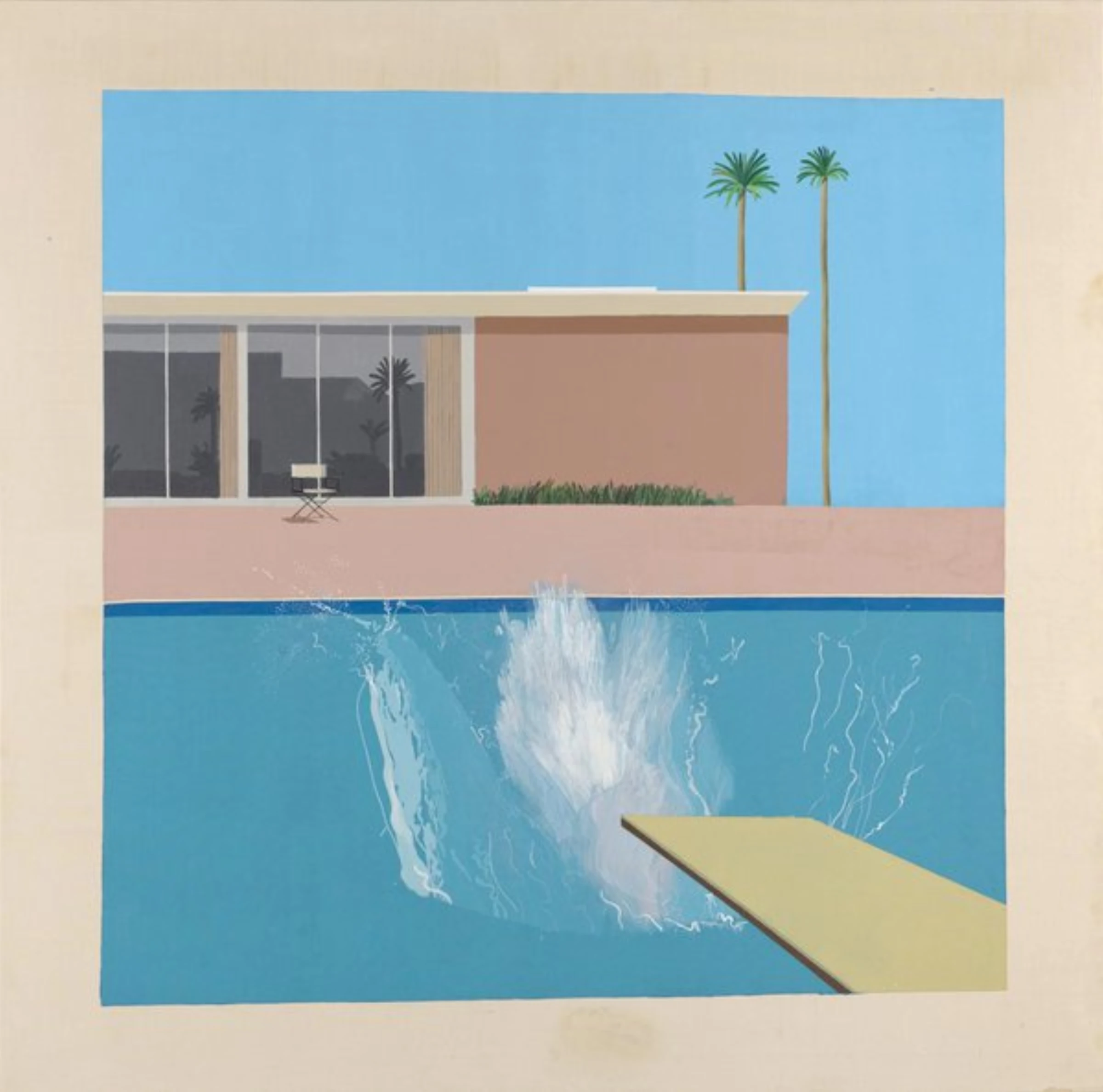
Tate's pages for A Bigger Splash and the broader artist overview are useful reminders of how fully the institution has absorbed what once looked dangerous. The pictures are now canonized, teachable, almost soothing. Yet their afterimage still depends on charged absences, stylized domestic arrangements, and the California fantasy Hockney helped build into an international iconography of freedom. It is a beautiful body of work, yes, but beauty here is inseparable from coded liberation.
Decoration, style, and camp were part of the breakthrough
Hockney's detractors have long underestimated the intelligence of his decorative instincts. Pattern, saturated color, and visual ease were not secondary flourishes. They were part of the intervention. Mid-century high art institutions often treated decoration as unserious, feminized, commercial, or queer in the pejorative sense. Hockney turned precisely those terms into strength. Floral curtains, tiled pools, patterned interiors, and stylized landscapes became vehicles for emotional and erotic attention. He showed that the decorative could carry seriousness without becoming solemn.
This is where Hockney's relation to queer culture feels especially contemporary. Camp in his hands is not merely irony. It is a method of survival and recognition. It lets the work oscillate between openness and discretion, between broad visual appeal and insider address. That double register helped his paintings circulate more widely than a great deal of overtly polemical art from the same period. It also explains why reproductions of Hockney have remained fixtures in queer homes for decades. People do not keep returning to those images only because they are attractive. They return because the pictures stage a world in which gay life is materially inhabitable and aesthetically self-possessed.
Another way to see the radicalism is through comparison. The official archive of Hockney's early and late work, from Mr and Mrs Clark and Percy to later landscape and digital projects, shows that he was never interested in making queer life legible through one single iconography. He worked through portraiture, staged space, coded language, and ordinary routines. That variety made the politics harder to quarantine. Hockney was not asking to be tolerated in a corner. He was claiming the full formal range of modern painting.
That claim matters because visibility is often misunderstood as a purely numerical issue: more images, more openly gay artists, more recognizable symbols. Hockney's achievement was subtler and more demanding. He changed the emotional temperature of what visibility could mean. Instead of presenting queer life only as conflict with the world, he made room for flirtation, comfort, boredom, elegance, and self-styling. Those conditions are easy to overlook precisely because they now seem imaginable. In the early decades of his career, they were not given. They had to be painted into cultural plausibility.
There is also a class and taste dimension to this transformation. Hockney understood that what counts as refined, cultivated, or properly decorative has always been policed in gendered and sexualized ways. By turning patterned interiors, leisure spaces, and carefully arranged domestic scenes into major art, he challenged the old split between serious painting and supposedly minor sensual pleasure. That move broadened not only what queer art could depict but what high art itself could admit as worthy of attention. It is one reason the work still feels unusually modern: it does not beg entry into the canon so much as force the canon to widen its own standards.
What this reassessment changes about Hockney now
The point of revisiting Hockney's queer imagery is not to narrow him into an identity category. It is to restore pressure to a legacy already in danger of becoming frictionless. Museums and markets love artists they can describe as groundbreaking while quietly sanding away the conditions that made the breakthrough necessary. Hockney's career should not be remembered only as a sequence of formal inventions by a singularly productive painter. It should also be remembered as a campaign to make gay pleasure and companionship legible inside institutions that had little reason to welcome them.
There is a useful parallel here with our recent assessment of Hockney's death and artistic legacy. That piece argued for his restless experimentation across media. The queer-life reading deepens that argument by showing what all that formal restlessness was often serving: the effort to see intimacy, freedom, and self-invention from new angles. Whether he was working in painting, collage, photography, stage design, or digital drawing, Hockney kept returning to the problem of how lives look when they are allowed to become fully visible.
That matters now because the current politics of visibility are less settled than liberal art history likes to imagine. Rights can regress, public language can harden, and representation can become market-friendly while losing social edge. Hockney's work offers a reminder that visibility is strongest when it is bound to form, not just message. He did not paste identity onto otherwise conventional pictures. He changed the structure of looking so that queer life appeared as atmosphere, relation, and beauty.
What comes next will depend on how institutions stage this part of the work. If they isolate it as a celebratory side chapter, the radicalism shrinks. If they treat it as central to his remaking of modern painting, the legacy becomes sharper. Hockney still looks radical not because he shocked the culture more loudly than others, but because he made another way of living look not marginal, not tragic, but vividly, stubbornly real. That is a harder achievement to absorb than the poster versions of the work suggest, which is exactly why it remains worth defending.
For younger artists and viewers, that defense is not only historical. It is strategic. Hockney offers a model of how formal pleasure can carry social intelligence without becoming didactic. He shows that coded imagery, decorative beauty, and emotional softness can do political work when the surrounding culture insists those things are trivial or unserious. In a period when identity can be flattened into branding almost instantly, that lesson matters. Hockney's paintings remain radical not because they are louder than the present, but because they are more exact about how desire enters ordinary life and changes what can be seen there.
That exactness is what keeps the work alive after the immediate historical emergency has passed. Viewers do not need to know every legal detail of mid-century Britain to feel the strange confidence of these pictures. They can sense that another arrangement of intimacy has been made visible and treated as worth painting beautifully. That remains a demanding artistic and political act. It asks not just for recognition, but for a reordering of taste, sympathy, and attention. Few reputations survive that test. Hockney's does.