Christie’s London Sale Reprices South Asian Art
A £18.9 million white-glove sale led by Ganesh Pyne, Abanindranath Tagore, and K.K. Hebbar points to a deeper global repricing of the category.
A white-glove sale with consequences beyond one evening
Christie’s first London sale of South Asian modern and contemporary art in seven years realised £18.9 million and sold through every lot, a result that reads as more than auction-house spin. Artnet reports that all ninety-three works from a single private collection exceeded their presale estimates, with major prices for Ganesh Pyne, Abanindranath Tagore, Kattingeri Krishna Hebbar, and V.S. Gaitonde. The market likes to call every strong category sale a breakthrough. Most are not. This one matters because it signals a broader repricing already underway: South Asian modernism is being treated less like a regional specialty and more like a field whose historical underpricing is becoming difficult for international buyers to defend.
That shift has been visible for a while, but this result sharpens it. Christie’s own artist pages for Ganesh Pyne and related category material present these figures inside the standard global machinery of auction visibility rather than as peripheral inventory requiring ethnographic explanation. The optics of platform matter. Auction houses do not only record markets; they manufacture their hierarchies through editorial framing, specialist staffing, estimate strategy, and how insistently they place certain names in front of international capital. London, in this case, functioned as more than a venue. It functioned as a declaration that the category deserves a broader stage.
Ganesh Pyne’s results point to a deeper hunger for difficulty
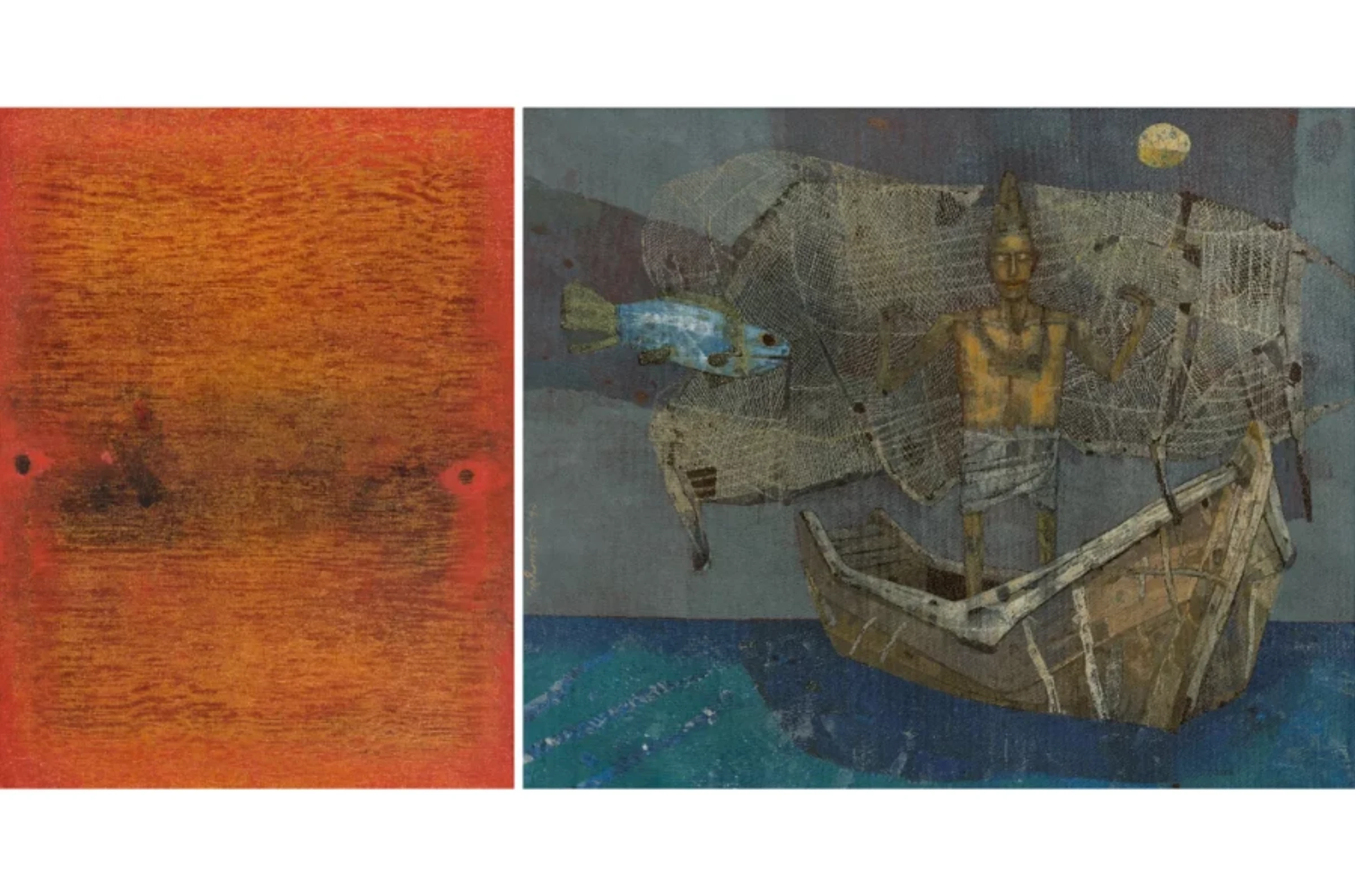
The headline lot was Ganesh Pyne’s The Fisherman from 1979, which sold for £3.8 million, roughly ten times its high estimate. Two other Pyne paintings also soared, including Under the Red Cloud and Woman the Serpent. Pyne is a telling bellwether because his work does not flatter casual global taste. His paintings are dark, psychologically charged, and steeped in Bengali myth, mortality, and estrangement. They do not fit the old stereotype that international collectors will engage South Asian art only when it arrives as decorative color or easily exportable modernism. The Pyne result suggests that buyers are pursuing conceptual density and historical specificity, not just geographic diversification.
That matters because auction narratives often reduce category growth to numerical inevitability. Prices rise, specialists expand their client lists, and then everyone retroactively declares the field overdue. But markets do not move on numbers alone. They move because collectors learn how to desire works they previously felt unqualified to read. Pyne’s ascent indicates that a more educated collector base is now willing to treat South Asian art history as an arena of serious connoisseurship rather than opportunistic arbitrage. That is a healthier signal than the crude language of trend.
It also underscores the difference between momentum and maturity. A maturing market does not simply reward the most legible names. It starts distributing value across artists whose work requires deeper historical grounding. Pyne’s surrealism, with its haunted figures and dense symbolic charge, demands that kind of grounding. The fact that he led the sale so decisively suggests the category is no longer being priced only through familiarity.
Records for Tagore and Hebbar change the shape of the field
Abanindranath Tagore and K.K. Hebbar each set new auction records, and those outcomes may prove as important as the Pyne fireworks. Tagore’s 1922 portrait of Gandhi sold for just over £1 million against a £50,000 high estimate, while Hebbar posted a pair of major results that indicate sustained collector appetite rather than a single-bid anomaly. These names expand the conversation in useful ways. Tagore anchors a foundational moment in Indian modernism, while Hebbar’s career speaks to a broader traffic between regional idiom, modernist experiment, and social observation. When both artists break upward in the same sale, the market is not merely rewarding trophy lots. It is widening the canon through price.
That widening matters because the category’s older international framing was narrow and repetitive. A handful of recognized names stood in for an enormous, internally diverse history. Record results for Tagore and Hebbar do not solve that problem, but they do weaken it. They show that buyers are willing to move past the comfort zone of the usual globally circulated masters. Auction houses will follow where confidence goes. Expect specialists to build more robust historical narratives around adjacent figures once these prices make the commercial incentive impossible to ignore.
There is also a symbolic charge to these records being set in London. The city remains entangled with the histories that shaped the circulation, collection, and misreading of South Asian art in the first place. A sale like this does not undo those asymmetries. But it does force the metropolitan center to acknowledge value formations it long helped sideline. The point is not moral redemption. The point is that the old assumptions about which modernisms count as globally legible are breaking down in full public view.
The single-owner structure gave the market a clean test
This was a single-owner sale, and that detail is central. Single-owner auctions generate coherence, and coherence helps buyers feel they are purchasing judgment as well as objects. As advisor Varun Kaji told Artnet, the collection had been assembled with conviction. That is dealer-speak, but in this case it points to a real mechanism. Buyers trust category-building sales more when the material reads as a collection rather than a warehouse dump. The narrative of careful formation makes aggressive bidding feel like participation in historical recognition rather than speculative opportunism.
At the same time, single-owner sales can exaggerate confidence. They compress quality, scarcity, and story into one evening, which can make a category look more uniformly liquid than it really is. The better reading is not that every corner of South Asian modern and contemporary art has suddenly reached escape velocity. It is that top-tier material with persuasive provenance, strong scholarship, and institutional-grade names now attracts global competition at a level that auction houses can no longer treat as exceptional. That distinction matters if the field wants durable growth rather than one more round of breathless market branding.
For a useful comparison, look at our recent report on the AI-assisted rediscovery of an F.C.B. Cadell painting. That story showed how scholarship, provenance, and narrative can amplify value in a thinner market. Christie’s South Asian result is different in scale, but the underlying lesson is related. Price follows confidence, and confidence is built through stories that convince buyers they are not merely chasing heat. The strongest sales convert historical framing into market legitimacy.
What this sale changes next
The most important consequence of this auction may be offstage. Strong results in London strengthen the case for more ambitious institutional lending, more scholarship around undercirculated artists, and more aggressive consignor outreach by competing houses. They also put pressure on museums. If auction prices continue to rise across a broader set of South Asian modernists, institutions that delayed acquisitions on the assumption of relative affordability will look slow and possibly negligent. Markets do not determine art history, but they do alter the cost of historical indifference.
There is still reason for caution. White-glove language flatters auction houses, and no one should confuse a successful sale with a fully transformed ecosystem. Yet this result is difficult to dismiss as noise. It confirms that international appetite for South Asian art is not confined to a narrow collector pool or a single season of enthusiasm. More significantly, it suggests the category is entering a phase where underestimation itself becomes a market error. Once that happens, repricing tends to accelerate. London just made that acceleration harder to ignore.
The museum implications are especially sharp. When auction houses succeed in building global confidence around artists long treated as category specialists, curators lose the luxury of assuming there will always be time to catch up. Acquisitions become more expensive, yes, but also more urgent, because the canon will otherwise be rewritten primarily through private capital. That is a familiar pattern in modern art history, and it rarely ends well for public access. If South Asian modernism is now being repriced in earnest, institutions that care about comparative twentieth-century narratives need to act before the next round of estimates normalises these levels as the floor rather than the exception.
Collectors, meanwhile, should resist the fantasy that this market is valuable because it has finally been validated by London. The better reading is the reverse. London was forced to acknowledge a depth of scholarship and collecting that had already matured elsewhere. That distinction matters if the category is to avoid another cycle in which metropolitan recognition is mistaken for origin. The strongest outcome from this sale would not be more hype. It would be a more historically literate market, one that understands why these artists matter before the numbers tell it to.
That literacy will be tested quickly. Whenever a category moves from underpriced to internationally competitive, weaker material follows stronger material into the market, and buyers start paying a premium for affiliation rather than discrimination. The houses will welcome that broadening because it generates volume. Serious collectors should do the opposite and become more selective, not less. If Christie’s has proven anything with this sale, it is that quality, conviction, and historical framing still matter. The field will remain healthy only if the next wave of consignments is judged by that standard rather than by momentum alone.