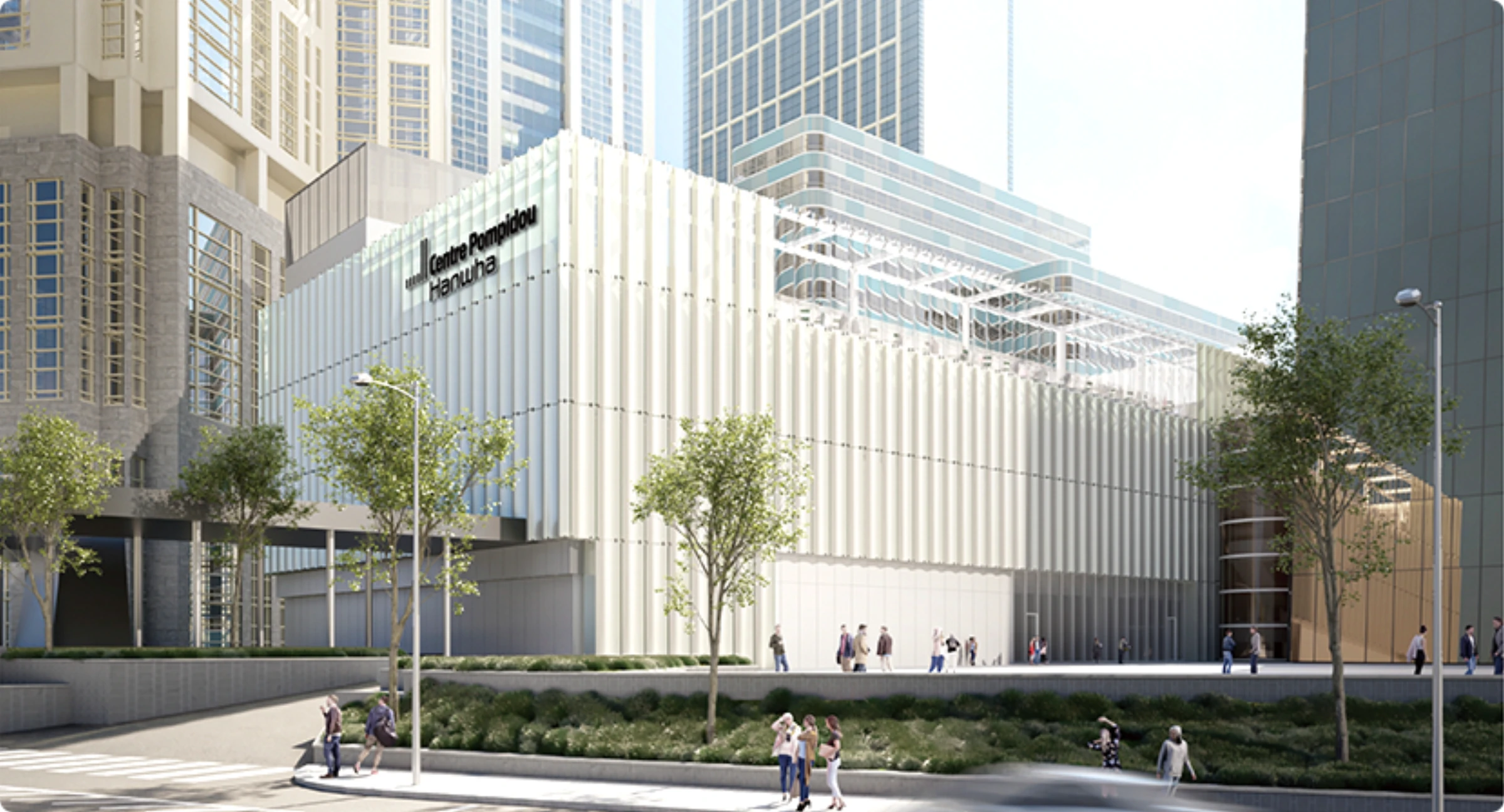
Centre Pompidou Hanwha Opens Into Seoul’s Museum Arms Race
Centre Pompidou Hanwha opens in Seoul with real curatorial promise, but also with licensing politics, corporate baggage, and familiar branch museum asymmetries.
Seoul Is Getting More Than a Museum Opening
Centre Pompidou Hanwha opens to the public on 4 June, but the real story is larger than a new venue in Yeouido. Seoul is fast becoming a proving ground for the next phase of international museum expansion, one in which global brands no longer arrive as occasional touring partners but as semi permanent fixtures woven into the city’s cultural real estate. As The Art Newspaper reports, the project is structured as a four year partnership between Centre Pompidou and the Hanwha Foundation of Culture, with two exhibitions a year drawn from the Paris museum’s collection. The official Hanwha Foundation page describes the venture in more aspirational terms, promising a cultural bridge between Korea, France, and the wider international art community. Both framings are true, but neither is complete.
The incompleteness matters because branch museum stories are always about two layers at once. On the surface there is programming: what will be shown, who will curate it, and whether local audiences get something intellectually alive rather than a packaged prestige product. Underneath that there is infrastructure and power: who licenses whom, who gets symbolic benefit, how local institutions are repositioned, and what it means when a conglomerate backed foundation becomes the vehicle for importing one of Europe’s most recognizable museum brands. Seoul is not passively receiving a cultural gift here. It is negotiating a new hierarchy of attention inside an already aggressive regional art ecosystem.
The Curatorial Promise Is Real, and So Is the Risk of One Way Prestige
There is enough in the announced program to take seriously. The opening exhibition, The Cubists: Inventing Modern Vision, brings more than 90 works by around 40 artists, and Hanwha says the presentation will give overdue attention to artists such as Sonia Delaunay, Natalia Goncharova, Suzanne Duchamp, and María Blanchard. That is not nothing. It suggests an attempt to present Cubism as a broader field rather than a museum shop version of Picasso and Braque. The foundation also says one of the two main galleries will focus on global contemporary art with a twenty first century Korean emphasis, beginning with a Korea Focus section that connects Western Cubism to artists including Kim Whanki and Yoo Youngkuk. If that commitment holds, the institution could become more than a branch terminal for French art history.
But this is precisely where skepticism is useful. The modern branch museum model often promises reciprocity while operationally rewarding asymmetry. Centre Pompidou brings the internationally ratified collection, the name that draws foot traffic, and the aura of European canonical legitimacy. The local partner supplies the building, the political permissions, the corporate capital, and the local public that will validate the experiment through attendance. Reciprocity only becomes real if the Korean side meaningfully shapes interpretation, scholarship, and future traffic in both directions. Seoul has reason to ask for that. The city is no longer a peripheral stop in the global art circuit. It is a place where major galleries, fairs, and institutional actors now compete to define what Asia’s museum future looks like.
The timing sharpens the issue. Centre Pompidou’s Paris building closed in 2025 for a five year renovation, and the institution has been expanding its international constellation accordingly. That makes Hanwha useful not only as a partner but as a temporary outward facing stage for the Pompidou brand. There is nothing improper about that. It is strategic and rational. But readers should resist the soft language of exchange when one party is actively managing its global relevance during a closure period. artworld.today noted similar strategic calculations in our coverage of the new M+ and Pompidou partnership. The Seoul opening belongs to the same broader map of institutional mobility, except here the relationship is more spatially fixed and more vulnerable to local political pressure.
Hanwha’s Corporate Context Will Not Stay Outside the Gallery
One reason the project cannot be read as a neutral cultural upgrade is Hanwha itself. The Art Newspaper notes domestic criticism of the reported cost of the partnership and renewed scrutiny of the conglomerate’s ties to defense industries. Protesters from Artists Solidarity Against Censorship reportedly used the museum preview to denounce what they called genocide artwashing. That phrase is polemical, but it names a problem museums and foundations increasingly face when culture is financed by entities whose wider business interests are politically charged. A museum can insist on operational independence. Publics can still read sponsorship as image management. Both things can be true at once.
Locally, the politics are even more specific than the international criticism. Former National Museum of Modern and Contemporary Art curator Chung Joonmo, quoted by The Art Newspaper, worries that the project could deepen cultural dependency by turning Korean audiences into consumers of imported Western masterpieces while encouraging other corporations to chase their own foreign museum tie ups. That is a serious critique because it is not anti internationalism in any crude sense. It is a warning about resource allocation and symbolic deference. Why spend heavily on licensing a foreign brand if the same money could build local curatorial infrastructure, commission scholarship, and expand Korean institutions on their own terms? The answer, from Hanwha’s perspective, is obvious: the Pompidou name compresses years of trust building into a single gesture. Whether that gesture is worth the price is another matter.
The Hanwha Foundation’s defense is familiar and not unreasonable. It stresses that the museum is designed as a platform connecting Korean culture with the world, and it points to existing support programs such as the Youngmin International Artist Residency Grant and Space ZeroOne in New York. Those are tangible initiatives, not empty talking points. Yet even if one grants the foundation good faith, the structural question remains. Can a branded satellite attached to a corporate headquarters avoid teaching local audiences that international validation still arrives most powerfully through imported institutional names? That is the challenge Centre Pompidou Hanwha will have to answer in practice, not in mission statements.
One further test will be how the institution handles criticism once the opening glow fades. If curators engage the politics around sponsorship, the asymmetry of branch branding, and the place of Korean art within the program as substantive matters rather than public relations noise, the museum could build trust even among skeptics. If it treats dissent as background static while leaning on attendance and imported masterpieces, the project will look intellectually thin no matter how polished the installation shots appear. In Seoul, legitimacy now has to be argued for, not merely announced.
Seoul’s Museum Boom Is Becoming a Competition Over Who Gets to Define Globality
The opening also lands in a crowded field. Busan has already signed its own memorandum with Centre Pompidou for a future branch, while reports suggest the Victoria and Albert Museum is exploring a Seoul outpost. Layer on top of that the city’s commercial rise around Frieze Seoul, the growing weight of Korean collectors, and the aggressive positioning of private and public foundations, and the result is not just growth. It is a competition over authorship. Who gets to define what a globally connected Korean art city looks like? A municipal museum? A national institution? A corporate foundation? A foreign partner? Probably all of them, which is exactly why this opening feels less like a debut and more like a territorial marker.
That territorial quality is not necessarily bad. Global cities are shaped by overlapping institutions, conflicting ambitions, and uneven funding structures. Seoul is mature enough to absorb those tensions. The better question is whether the city’s new museum infrastructure will generate arguments or merely absorb brands. If Centre Pompidou Hanwha develops exhibitions that genuinely reframe modernism through Korean and broader Asian histories, it could become a site of productive friction. If it settles for brand reinforcement plus occasional local garnish, it will confirm the worst fears of its critics. The announced Korea Focus strand is therefore not a side feature. It is the measure of whether this museum understands the burden of its own premise.
What Success Would Actually Look Like
A successful first year would not simply mean strong attendance. It would mean that local critics, artists, curators, and students come away with the sense that the institution is willing to complicate the Pompidou canon rather than merely host it. It would mean Korean artists are not folded into a diplomatic annex but used to revise how imported narratives are read. It would mean future programming develops outward from Seoul rather than only downward from Paris. Ideally it would also mean transparency about cost, governance, and curatorial authority, because the more expensive and politically exposed the project becomes, the less sustainable vague rhetoric will be.
There is an art historical opportunity here that should not be dismissed. Korean modernism and contemporary art have long been under narrated in mainstream Euro American museum structures except when framed as regional supplements or market stories. A sustained partnership with a museum the size of Pompidou could shift that imbalance if loans, research, and curatorial authorship flow both ways. But the opening week will not settle that question. What it will settle is whether Centre Pompidou Hanwha enters Seoul as an intellectually ambitious institution or as a very expensive symbol of cultural aspiration. The distinction is harsh, but it is fair. Branch museums do not get judged by their promises for long. They get judged by whether they can turn borrowed prestige into local consequence. They also get judged by whether local artists, scholars, and audiences feel newly addressed rather than merely newly marketed to.