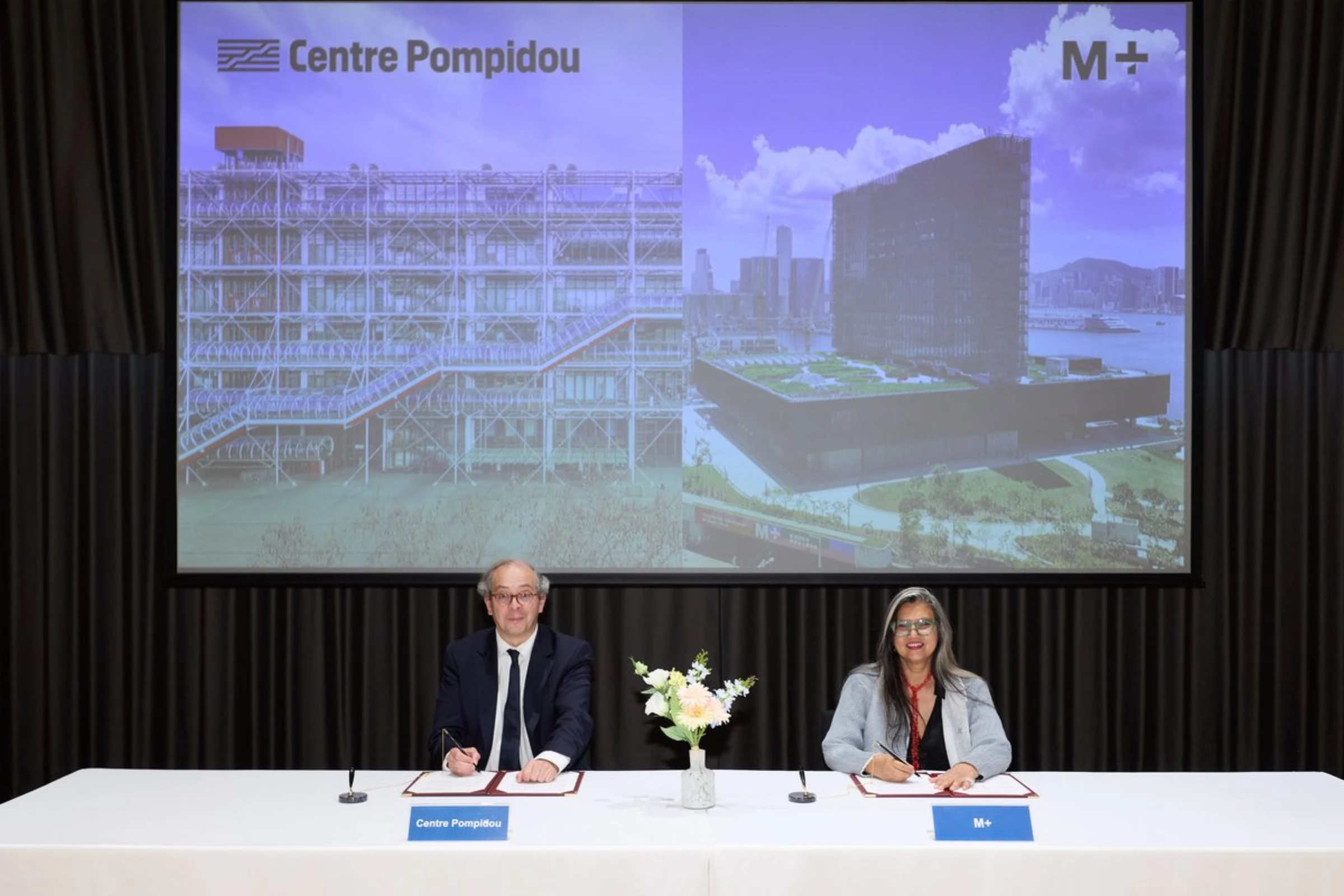
M+ and Pompidou Lock In a Five-Year Pact
M+ and Centre Pompidou have turned a memorandum into a long runway for co-curation, loans, and research - a move with real geopolitical and curatorial stakes
M+ and Centre Pompidou Are Formalizing More Than a Friendly Exchange
Plenty of museums announce partnerships. Far fewer announce one detailed enough to change how exhibitions are researched, where collections circulate, and which institution gets to shape the intellectual terms of the relationship. That is why the new five year agreement between Hong Kong's M+ and Paris's Centre Pompidou deserves more attention than the usual press office language about exchange and dialogue. As ARTnews reported, the alliance begins next year and culminates in a major exhibition at the Pompidou after its reopening. The official M+ announcement goes further, laying out four specific pillars: joint curatorial research, exhibition development and sharing, co commissions and artwork displays, and collection exchange.
That specificity matters because Centre Pompidou is not entering the relationship from a position of static stability. Its Paris building is in renovation mode, and the institution has openly described international partnerships as part of its metamorphosis before reopening in 2030. M+, meanwhile, has moved rapidly from ambitious newcomer to major node in the global museum network, backed by the institutional scale of West Kowloon and by a collection strategy designed to argue that Asian visual culture should not be treated as a regional supplement to Euro American narratives. Put bluntly, this is not a junior museum borrowing prestige from Paris. It is a negotiation between two institutions that each need something tangible from the other.
Why the Deal Is Structurally More Serious Than the Average Museum MoU
The easiest mistake is to read the announcement as a standard loans arrangement dressed up in high minded language. The details suggest otherwise. M+ says the museums will co curate a major exhibition using both collections, stage a sequence of jointly developed exhibitions in Hong Kong from 2027 onward, and launch long horizon research initiatives that include a four year postdoctoral fellowship funded by the Huo Family Foundation. That fellowship is not an accessory. It indicates that scholarship is being built into the machinery of the partnership rather than appended after the fact. Research, in other words, is not simply a justification for exhibitions. It is one of the products the partnership is meant to generate.
The program of co commissions is equally revealing. The institutions plan to commission moving image works for both the M+ Facade in Hong Kong and the Centre Pompidou Francilien site in Massy. That means the collaboration is not confined to shipping existing masterpieces back and forth. It extends into the production and framing of new work in public space, where audience, language, and civic context are different in each setting. Museums often claim to be global while outsourcing the hard work of translation to wall labels and public programs. This deal appears to recognize that translation must be built into the curatorial structure itself.
There is also a power question that should not be brushed aside. Historically, collaborations between European institutions and Asian museums have often been narrated as one way transfers of expertise, collection authority, or validation. M+ is trying to invert that hierarchy. Its statement explicitly describes the partnership as a chance to build new narratives about the interconnected histories and contemporary realities of global visual culture. That is smart language, but it will only matter if the resulting shows do more than place Asian and European works beside one another as diplomatic décor. The intellectual challenge is to produce exhibitions where each collection changes the reading of the other.
Hong Kong, Paris, and the Politics of Cultural Positioning
The partnership also lands in a charged political environment. West Kowloon has spent years presenting Hong Kong as an East meets West cultural center with global ambitions, and the M+ statement repeats that mission almost verbatim. Centre Pompidou, for its part, has been expanding its constellation model through partner sites and international branches, treating mobility as both survival strategy and cultural diplomacy. When those agendas converge, the result is not neutral cooperation. It is strategic positioning. Hong Kong gains a deeper tie to one of Europe's most recognizable modern and contemporary art institutions. Pompidou gains an Asian partner with serious infrastructure, significant foot traffic, and a collection that can meaningfully complicate Paris centered narratives.
That does not mean the arrangement is cynical. It means it is real. Museums now operate today symbolic capital, scholarly credibility, tourism, philanthropy, and geopolitical messaging are inseparable. The better partnerships admit this by producing something more durable than a single marquee exhibition. The worse ones hide behind universalist rhetoric and then deliver a shallow exchange of trophies. M+ and Pompidou are promising the harder version. If they succeed, the collaboration could become a model for how collecting museums work across continents without reducing one another to satellite platforms.
The possibility of failure is just as instructive. Partnerships collapse into vagueness when one institution becomes the lender of famous names and the other becomes the venue of strategic optics. They also falter when research timetables, conservation needs, and local publics are treated as afterthoughts. M+ has wisely foregrounded long term curatorial work and collection exchange rather than just blockbuster spectacle. But the measure of seriousness will be whether audiences in Hong Kong see more than imported prestige, and whether audiences in Paris encounter a reframing of modern and contemporary art that cannot be absorbed back into familiar European chronologies.
What the Sector Should Watch Between Now and 2030
The announcement also shows how much museum partnerships have shifted from one off exhibition diplomacy toward shared infrastructure. Research fellowships, coordinated loans, co commissions, and reciprocal displays create obligations that survive headline cycles. That matters because the strongest international collaborations are not those that borrow prestige for six months. They are the ones that alter how institutions plan, hire, budget, and imagine their publics. If Pompidou and M+ follow through, curators on both sides will have to build exhibitions knowing that interpretive choices made in Hong Kong can echo in Paris, and vice versa. That is a higher bar than most memorandums of understanding ever set for themselves.
For artists and scholars, that higher bar could be genuinely productive. A sustained exchange between these two collections has the potential to challenge some stale habits of modern art storytelling, especially the tendency to treat Asia as a late addendum to European and American developments. M+ has been explicit about wanting new narratives, and Pompidou has reasons of its own to broaden the terms on which its reopened museum will speak to global audiences. The important thing now is not to mistake duration for depth. Five years on paper sounds impressive. Five years of hard curatorial argument, asymmetrical compromise, and visible change in what audiences see would be the real achievement.
The institutional asymmetry is also more interesting than the polite wording suggests. Centre Pompidou brings one of Europe's most recognized modern and contemporary collections plus the urgency of a building in transition. M+ brings a younger but highly assertive curatorial identity, deep regional ambition, and a public platform that includes the facade commissions and the wider West Kowloon ecosystem. The WestK announcement stresses the district's strategy of “bringing in” and “going global,” which makes clear that the partnership is part of a broader institutional program rather than an isolated museum event. That wider frame should make readers less willing to accept generic talk of exchange and more attentive to the strategic infrastructure behind the deal.
There is a practical collection question here as well. Loans between major museums are never just gifts of visibility. They require conservation planning, insurance confidence, legal precision, and an agreement about narrative emphasis once works arrive. If M+ and Pompidou follow through on coordinated displays and collection based research, then audiences may start to see fewer token gestures and more sustained reinterpretations of how twentieth and twenty first century art moved across regions. That is the optimistic outcome. The weaker version would be a rotation of recognizable names with little conceptual risk. The partnership's value will be measured by whether it produces arguments that could not have been made by either institution alone.
The near term milestone is the run of exhibitions beginning in 2027 at M+, followed by the jointly organized major exhibition at Centre Pompidou after reopening. Those shows will reveal whether the partnership is really research led or simply carefully branded. Watch the artist lists, the interpretive framing, the balance between loans and co commissions, and the extent to which the museums surface differences rather than smoothing them over. Real collaboration creates friction, and friction can be productive when it forces curators to abandon habitual categories.
The longer horizon question is whether this agreement nudges the global museum map away from the older model of center and periphery. M+ has spent its short life arguing that contemporary visual culture in Asia is not a regional chapter in a larger Western story. Pompidou's willingness to build a multi year framework with co authored scholarship suggests that at least one major European institution understands the stakes. That alone does not guarantee a new canon. But it raises the standard. After this, a museum partnership that offers only ceremonial handshakes and borrowed masterpieces will look thin. M+ and Pompidou have promised something denser. Now they have to prove they meant it.