Benton End Returns as a Living Art School Site
The Garden Museum's Benton End exhibition treats the Suffolk house as a live case study in art education, horticulture and artist-house revival.
The Benton End story is finally being told as more than a Lucian Freud anecdote
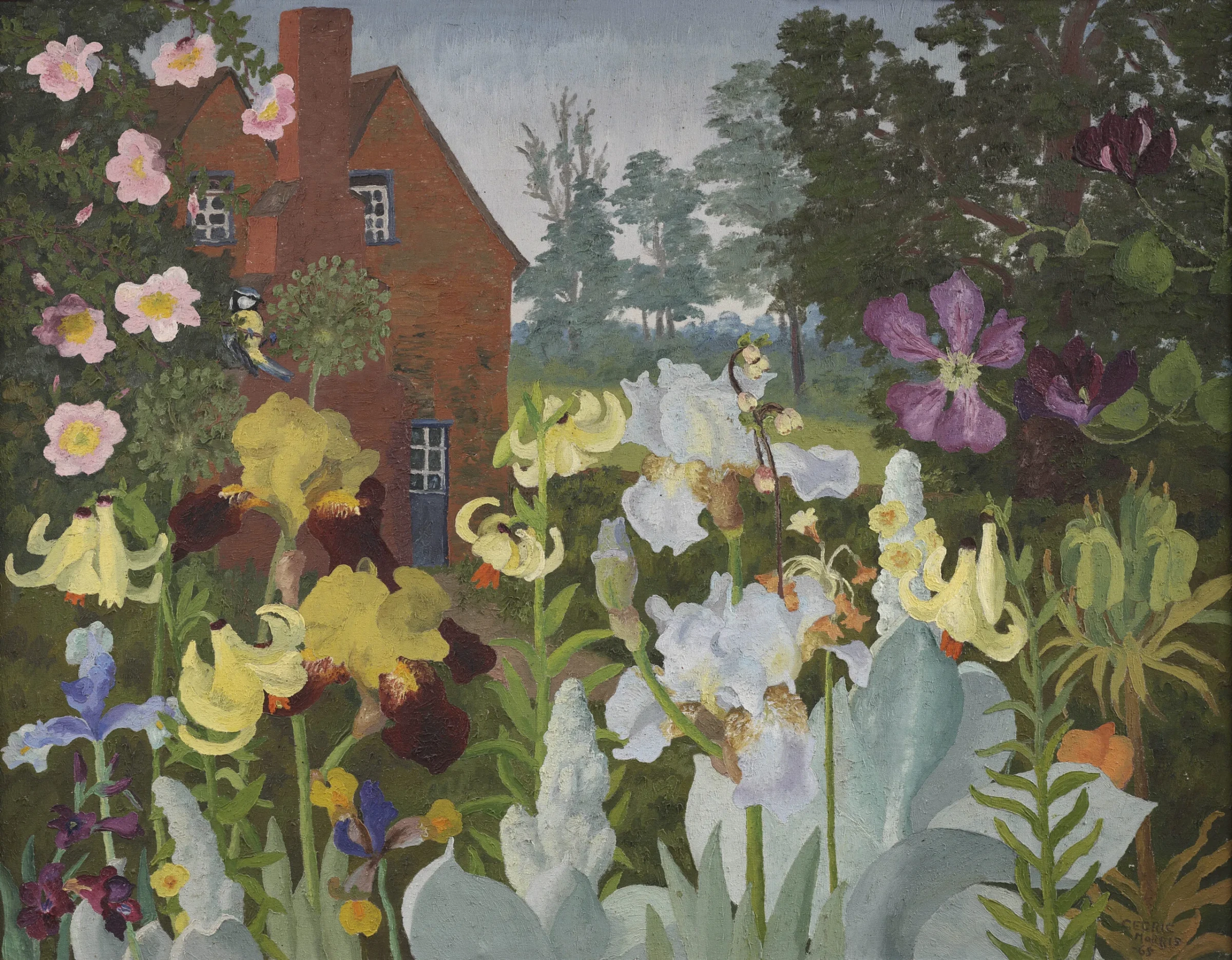
Benton End has usually survived in art-world memory through one irresistible piece of gossip: the teenage Lucian Freud may have burned down the East Anglian School of Painting and Drawing's earlier home in Dedham with a careless cigarette. It is a good story, which is precisely the problem. The anecdote has long overshadowed the richer fact that the school's relocation to Benton End in Suffolk created one of the strangest and most generative art environments in mid-century Britain. As The Art Newspaper reports, the Garden Museum's new exhibition Benton End: A Paradise of Pollen and Paint tries to correct that imbalance.
That correction matters because Benton End was never just a backdrop. Under Cedric Morris and Arthur Lett-Haines, the sixteenth-century manor became a hybrid site where painting, gardening, cooking, hospitality and informal pedagogy were allowed to bleed into each other. The East Anglian School operated there from 1940 into the 1970s, drawing students such as Freud and Maggi Hambling into a structure that favored observation and independence over rigid instruction. That sounds almost quaint now, but it was also a serious alternative model of art education: intimate, domestic, materially grounded and deeply suspicious of academic stiffness.
The Garden Museum is not staging a period piece. It is building a claim on the future of the site
The most important institutional fact in this story is that the Garden Museum is no longer merely interpreting Benton End from afar. The museum was given ownership of the property in 2021 by the Pinchbeck Charitable Trust and has been working to convert it into a cultural centre. That changes the exhibition from a commemorative gesture into part of a longer strategic argument. The museum needs audiences, funders and heritage stakeholders to see Benton End not as a charming relic, but as a place worth restoring, programming and keeping in use.
Seen that way, the multisensory approach described in the article makes perfect sense. Guest curator Patricia Hardy is not just assembling paintings and archival material. She is reconstructing rooms, atmospheres, smells and patterns of life. Original photographs, letters, furniture and personal belongings are meant to show the house as an inhabited world rather than a static shrine. That is smart curatorial thinking. Historic creative sites often die when they are reduced to reverent biography. They survive when visitors can grasp how work, sociability and environment were braided together there.
The upcoming reopening of Benton End's walled garden pushes the point further. The exhibition in London and the revived garden in Suffolk are being positioned as complementary experiences, one interpretive and one spatial. Browse the museum's wider programme at the Garden Museum and you can see why Benton End suits its identity. This is an institution interested in the overlap between horticulture, design, history and lived practice. Benton End is not just another artist house. It is a place where the garden was part of the intellectual method.
The exhibition also sharpens how we understand Cedric Morris and Arthur Lett-Haines
Morris often gets remembered through his flowers and his connection to famous students, while Lett-Haines can recede into the supportive role assigned to partners in many art-historical narratives. The six-person emphasis in the exhibition, which includes Morris, Lett, Freud, Joan Warburton, Elizabeth David and Beth Chatto, helps widen the frame. It suggests Benton End mattered because it functioned as a networked ecology of influence, not simply as the home of one great painter with a gifted student roster.
That is especially valuable in Britain, where house museums and creative heritage sites can become overly centered on singular genius. Benton End offers a better model. It was collaborative without being collectivist, informal without being unserious and domestic without retreating from ambition. Morris's cultivation of irises and other plants was not decorative background to the art. It shaped looking itself. Students were being taught, directly and indirectly, that attention to the natural world was inseparable from aesthetic discipline. That is a more radical educational proposition than the cozy legend of bohemian country life sometimes suggests.
The inclusion of Man in Black Scarf, the portrait publicly attributed to Freud through evidence in the Tate archives, is another pointed curatorial move. It uses the celebrity magnetism of Freud, but not lazily. Instead the work becomes a way to think about authorship, contested attribution and early formation. The painting matters less because it may be a newly authenticated Freud than because it helps pin Benton End inside the artist's apprenticeship rather than at the edge of myth.
This is also a test case for how to revive artist houses without embalming them
Britain does not lack historic cultural properties. What it often lacks is a convincing plan for how they should function once rescued. Too many revivals lean on atmosphere and donor sentiment without clarifying what contemporary use will justify the restoration bill. The article notes that Benton End is heading toward a £5 million capital project for repairs to the house and grounds. That is enough money to demand more than nostalgia. It requires a programme, a public and a reason the site should matter beyond heritage tourism.
In that sense Benton End belongs in the same conversation as wider debates over historic-house stewardship, adaptive cultural reuse and whether experience-led exhibitions can deepen rather than cheapen interpretation. We have been tracking that problem across the sector, and readers may want to compare this case with our guide to museum infrastructure announcements. The strongest revivals are honest about operations, money and programme. The weakest rely on mood. So far, the Garden Museum looks closer to the first category.
There is a broader cultural reason this matters now. Formal art education remains expensive, professionalized and frequently detached from everyday material life. Benton End represents a counter-memory: a school built around intense looking, shared labour, food, plants and sustained conversation. That model cannot simply be revived intact, nor should it be romanticized. It had its own exclusions and depended on personalities as much as principles. But as an imaginative resource for thinking about how artistic communities are made, it still has force.
There is a subtle corrective in this approach to English cultural memory as well. Too often the national story of modern art gets told through metropolitan institutions, isolated masterpieces and a tidy lineage of singular talents. Benton End interrupts that script by insisting that creative seriousness can emerge from hospitality, shared meals, gardens, teaching and the slow construction of atmosphere. It suggests that artistic formation is not merely a matter of instruction or talent, but of how a place organizes attention. That may sound soft, but it is actually a hard institutional lesson. If museums and schools want to foster artistic life rather than simply certify it, they have to care about the environments in which people learn to see.
The exhibition also arrives at a moment when heritage institutions are under pressure to justify why a saved building should matter to people who never knew its original world. Benton End's answer cannot be pedigree alone. It has to show that the house still offers forms of knowledge unavailable elsewhere: about artists and gardeners, about queer domestic collaboration, about non-academic modes of teaching and about the relation between landscape and aesthetic discipline. If those ideas remain active, restoration becomes more than conservation. It becomes a way of keeping a useful model of cultural life in circulation.
That is why the show has stakes beyond one corner of British modernism. It asks whether institutions can present artistic heritage as a set of usable practices rather than a sealed inheritance. Benton End was once a place where people learned through attention, cultivation and company. If the Garden Museum can preserve that texture without turning it into costume drama, it will have done something rarer than restoration. It will have made the past available as method.
That future-facing burden may be the exhibition's most persuasive quality. It does not pretend Benton End can simply be restored to an untouched golden age. Instead it suggests the site can be reactivated through new publics, new scholarship and new forms of care that still respect what made it unusual in the first place. That is a more honest model for heritage work now. The goal is not immaculate recovery. It is meaningful continuity under changed conditions, which is harder and much more worth doing.
What comes next depends on whether Benton End can stay alive outside the exhibition frame
The immediate exhibition will almost certainly succeed on atmosphere. The harder question is what happens when visitors leave London and the capital campaign begins in earnest. Can Benton End operate as a serious cultural centre in Suffolk rather than a periodic site of pilgrimage? Can it support research, residencies, horticultural work, education and interpretation without flattening itself into branded heritage? Those are the real stakes behind the show.
If the Garden Museum gets this right, Benton End could become a rare example of an artist house restored not just to be visited, but to be used as a living argument about how creativity happens. That would be a better legacy than another season of Freud gossip. The site deserves to be understood as a place where art and cultivation were mutually shaping practices. The exhibition finally gives that proposition room to breathe. Now the institution has to prove it can sustain it in the world beyond the gallery.