Blue-Chip Sales Return as Riskier Art Stalls
New York's May auctions revived demand for top-tier modern trophies, but buyers still look wary of younger artists and inflated primary-market prices.
New York's marquee sales brought the money back, but not the breadth
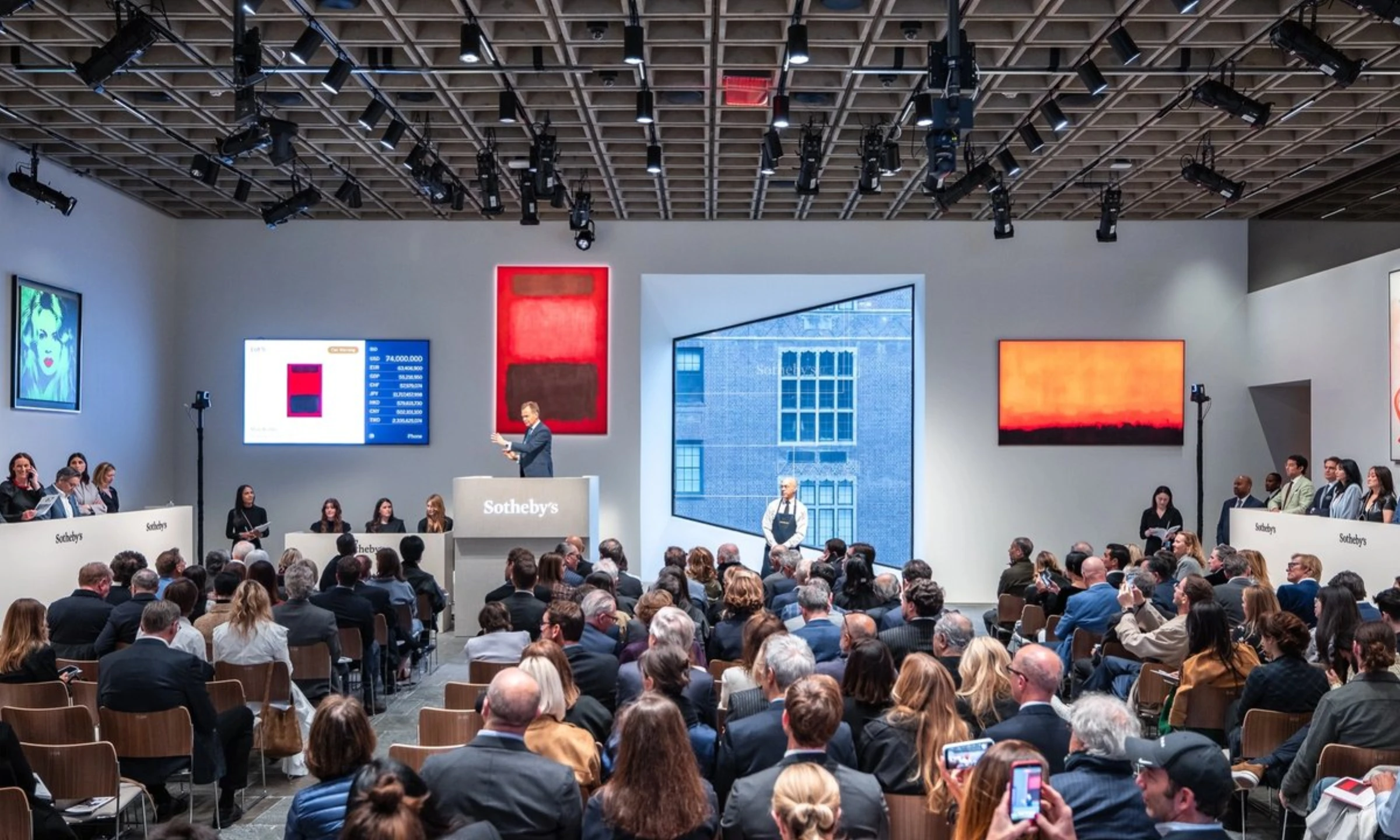
New York's May auctions delivered the kind of headline totals that make the art trade sound healthy again. According to The Art Newspaper\, Christie's and Sotheby's were finally able to assemble the trophy lots that had been missing for much of the past two years, largely because major estates and older collectors have become more willing to consign. The result was a season of big names, big guarantees and prices that looked reassuringly familiar at the very top. Christie's sold Jackson Pollock's Number 7A for $181 million and Constantin Brancusi's Danaide for $108 million, while Sotheby's placed Mark Rothko's Brown and Blacks in Reds at $85.7 million. Those are not marginal corrections. They are statements about where serious money still feels safest.
But the market signaled something harsher at the same time. The same sales that made room for nine-figure modernist trophies offered almost no faith in younger work. Sotheby's 45-lot Now & Contemporary auction included only two artists under 40. Christie's equivalent evening sale included one. Phillips, once the preferred arena for fast speculative flipping of young painters, managed only a single under-40 lot in its evening sale. In other words, the season was not really a broad recovery. It was a concentrated reopening of one lane: wealthy buyers competing for canonized twentieth-century works with established provenance, institutional familiarity and enough scarcity to justify price insulation.
The great wealth transfer is helping auctions, but it is not solving the market's structural problem
The most persuasive explanation for this rebound is not a renewed appetite for risk. It is mortality, succession and balance-sheet housekeeping. Valuable collections built by baby boomer and late twentieth-century buyers are beginning to move into the market through estates, trust planning and strategic downsizing. That gives auction houses exactly what they need: fresh inventory with a story, a legacy and a pre-sold sense of importance. Christie's framed the S.I. Newhouse consignment as precisely that kind of event. Sotheby's had the Robert Mnuchin estate. The top end of the market thrives when supply is both rare and socially legible, and estates provide both.
Yet that same mechanism exposes the problem underneath the strong totals. Estate-driven supply can revitalize auctions without proving that the art market has rediscovered confidence in contemporary production. A Pollock from 1948 and a Rothko from 1957 are not growth stories. They are security assets in cultural form. Buyers know how to explain them to trustees, lenders, spouses and heirs. They come with scholarly infrastructure, museum validation and a deep secondary market. None of that tells us whether collectors believe in the next generation strongly enough to sustain galleries, nurture careers and absorb new work at primary-market prices.
The divergence shows up clearly in the confidence data cited by The Art Newspaper from ArtTactic. Secondary-market confidence for contemporary art remains far above confidence in the broader economy and still ahead of the primary market. That gap matters because it describes two different art worlds operating under one banner. On one side are buyers who want works with known resale behavior and social consensus. On the other are galleries trying to maintain pricing for living artists while storage, staffing, fair participation and real estate costs keep rising. When those two worlds drift apart, the glamour of auction week can mask real fragility in the system that produces new art careers.
Why younger artists are getting squeezed even when good work still sells
The collapse of speculative heat around so-called red-chip names was overdue, but the correction has not landed evenly. During the early 2020s, a large share of attention and liquidity flowed to very young artists whose markets moved faster than institutions or criticism could keep up with. That environment encouraged flipping, made fair booths feel like day-trading desks and let mediocre work ride the coattails of a few breakout names. That phase is now largely over. As collector Alain Servais told The Art Newspaper, the speculative froth has been taken off most of the market. From a cultural standpoint, that is not necessarily bad. From an economic standpoint, though, it leaves galleries with a brutal mismatch between operating costs and what buyers are actually willing to pay.
Servais's comparison between an $85,000 gallery offer and a similar $5,000 auction buy is devastating because it captures the trust problem in one sentence. If collectors believe they can get better, earlier or simply cheaper examples on the secondary market, the primary market starts to look inflated rather than supportive. That inflation is not always greed. Sometimes it reflects the actual cost of maintaining a gallery programme, paying staff fairly, producing ambitious shows and underwriting artists before museums catch up. But buyers do not reward noble overhead for long. They punish it by waiting, shopping around or exiting the segment altogether.
There are still exceptions, and they matter. Josh Lilley's sell-out exhibition of new Nick Goss paintings suggests that serious, mid-career artists with coherent reputations can still sell well when pricing feels tethered to reality. Buyers have not stopped caring about living artists. They have become much less patient with pricing that assumes momentum will do the work of judgment. Readers who worked through our guide to marquee auction headlines will recognize the pattern: strong results at the top often conceal a narrower, more conservative buyer pool underneath.
The season's real lesson is that the market wants conviction, not novelty for its own sake
The temptation after a week like this is to say that the market is simply returning to quality. That is only half true. Plenty of younger and politically urgent work is high quality. What the market is returning to is recognizability. A blue-chip trophy comes with consensus built in. A buyer does not need to argue too hard for a Rothko, a Pollock or a Brancusi because the market, the museum sector and art history have already done the legitimizing. Newer work requires more imagination, more patience and more willingness to accept that cultural significance may not map cleanly onto resale security. In a shaky economy, fewer buyers want that burden.
This helps explain why Banksy hovers in the piece as a strange outlier. He remains suspect to parts of the establishment, yet his work carries broad public recognition and political legibility. When Loic Gouzer sold Girl and Balloon on Found Landscape for $18 million, he was not reviving the old speculative market for hot young artists. He was proving that a contemporary name can still command money if the work feels instantly readable and socially charged. The bar for that kind of confidence has simply become much higher than it was four years ago.
The deeper question is whether a market organized around inheritance, liquidation and a shrinking circle of trophy hunters can support the next serious generation of artists. Auction houses can live comfortably off estates for a while. Galleries cannot build a future on caution alone. If collectors spend the next cycle treating living artists as optional and dead masters as mandatory, the field will keep producing spectacular totals and weaker ecosystems. That is the contradiction embedded in this season's success.
There is another reason this split matters. Museums, advisers and private collectors often look to marquee auction weeks for cues about what kinds of art feel culturally inevitable. When the week is dominated by familiar twentieth-century names, the market sends a conservative message far beyond the sale room. It tells living artists that patience will be required, tells galleries that institutional validation still may not overcome price resistance and tells collectors that consensus is safer than curiosity. That may stabilize turnover for a season, but it can also flatten the field's imaginative range. The market is healthiest when it can reward conviction about the present, not just confidence in the already certified past.
For auction houses, that selective confidence is still profitable. For the ecosystem around them, it is a warning. A market that can celebrate nine-figure wins while offering almost no room for younger artists is not broadening, it is narrowing with style. The optics are bullish, but the cultural distribution of belief remains tight. Until buyers show they are willing to back difficult, living work at sustainable prices, every great blue-chip week will carry the same aftertaste: relief for the top tier, anxiety for everyone else.
What comes next for the market after the feel-good totals
The next six to twelve months will show whether May was a real reset or a temporary concentration of prestige supply. Watch whether more important estates come forward, whether galleries recalibrate prices for living artists and whether major fairs such as Art Basel and Frieze Seoul can produce conviction beyond the same familiar names. Also watch whether institutions keep backing younger artists with acquisitions, commissions and museum solo shows. Without that infrastructure, collector caution will harden into a self-fulfilling hierarchy.
For now the verdict is blunt. The top end of the art market is alive, liquid and capable of spectacle. The middle and forward edge of the market remain far less secure. That is why this was not a simple comeback story. It was a stress test that the most famous dead or canonized artists passed easily, while the broader contemporary system still looked thin. The money is there. The confidence is selective. Those are not the same thing, and pretending otherwise is how bad market reading starts.