Art Dubai's emergency edition finds buyers
Art Dubai's postponed 2026 edition opened with strong sales, showing how regional institutions and collectors stabilized a fair rebuilt in just eight weeks
Art Dubai did not return to normal - it rebuilt itself under geopolitical pressure
Art fairs are built on choreography: flights booked months ahead, shipping schedules locked early, VIP calendars coordinated, and enough confidence in the surrounding political weather to make a temporary commercial city appear on cue. This year's Art Dubai had that choreography blown apart. The Art Newspaper reports that the fair's 20th anniversary edition was derailed by the US-Israel war in Iran, moved from April to May, and reduced from its original plan after around 75 exhibitors dropped out. Yet the fair opened at Madinat Jumeirah with roughly 50 exhibitors, a brisk first wave of sales, and a format that many visitors described as more intimate and legible than the larger show that had first been imagined. That matters because it turns the fair from a resilience cliché into something more concrete: a case study in how regional art infrastructure behaves when the normal machinery of global fair-making stops cooperating.
The first thing to say plainly is that this was not success in the ordinary boosterish sense. The fair did not triumph by pretending nothing had changed. It survived by shrinking, adapting, and leaning harder on the local ecosystem. Executive director Benedetta Ghione and newly installed director Dunja Gottweis described a process of starting over, re-opening conversations with galleries, redrawing the floor plan, and rethinking the event almost from scratch. The resulting fair was smaller, more regionally weighted, and less invested in the grandiloquent language of international scale. In a market that still loves bigness for its own sake, that is notable.
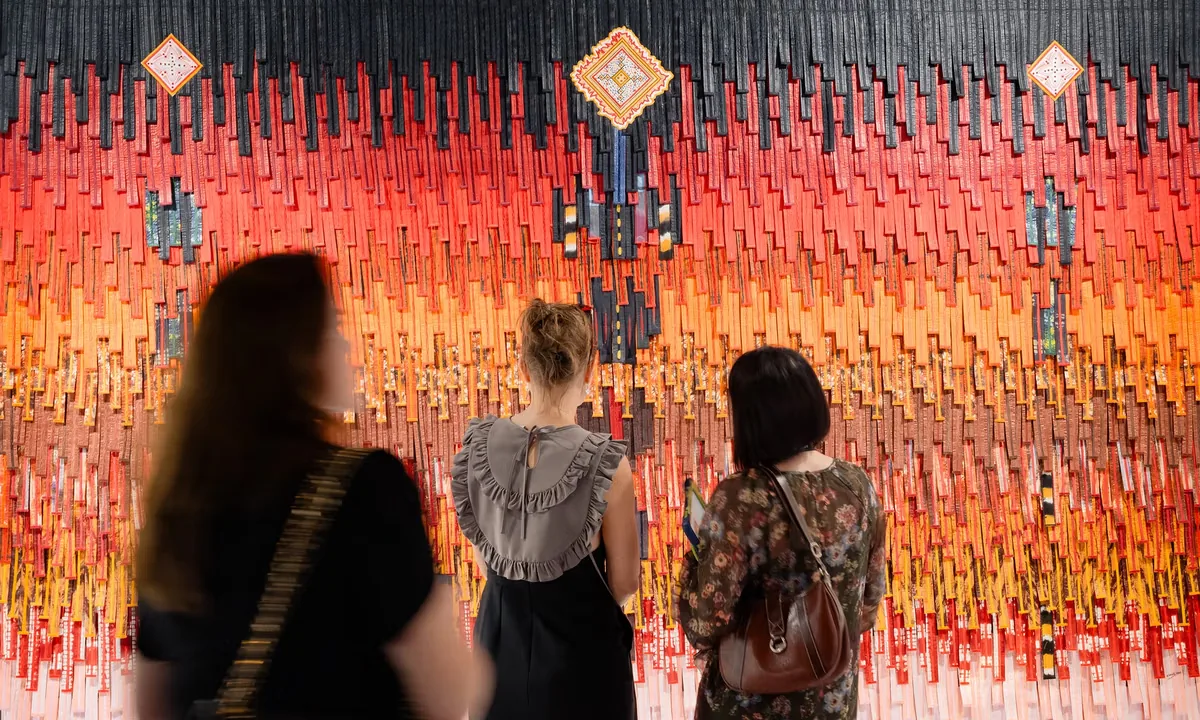
Visitors and collectors quoted in the report did not frame the compactness as failure. Some saw it as relief. A more compressed floor made it easier to spend time with work, easier to read the conversations between commercial booths and institutional presentations, and easier to understand what sort of fair Art Dubai becomes when it is not trying to mimic the overwhelming density of other mega-events. There is a lesson in that. Plenty of fairs now suffer from hypertrophy. They become so eager to signal relevance through size that they weaken their own capacity to produce attention. Art Dubai's constrained edition exposed a stronger logic underneath the spectacle.
The opening sales support that reading. Gallery One from Ramallah moved works by Samira Badran and Mostafa Al Hallaj. Iris Projects drew interest in younger Gulf artists including Safeya Sharif and Alyazia Al Nahyan. Taymour Grahne Projects reportedly sold out its solo presentation of Roudhah Al Mazrouei, while Zawyeh Gallery sold works by Nabil Anani including one priced at $360,000. Those are not trivial signals. They suggest that even in a compressed edition, buyers were willing to transact around regional narratives and not merely use the fair as a symbolic show of attendance.
The fair's strongest message was about regional self-reliance, not global glamour
When global fair culture talks about the Gulf, it often does so in a stale register: luxury buildout, new wealth, destination branding, and the fantasy of infinite cultural expansion. That language has always missed what is actually interesting about Art Dubai, which is its role as an interface between regional art histories, institutional ambitions, diaspora collectors, and a broader South-South conversation that does not fully depend on Europe or the United States for validation. The emergency edition brought that deeper function into focus because the fair no longer had the luxury of disguising itself as just another stop on the international fair calendar.
The embedded digital section, the revival of DXB Store, and the prominence of UAE-based participants all reinforced that shift. Rather than reading like afterthoughts, the fair's non-commercial and hybrid components looked central to the event's identity. DXB Store, which returned for the first time since 2014, assembled newly produced editions and design objects by more than 70 UAE-based creatives. Institutional displays from the Dubai Collection and Barjeel Art Foundation gave the fair a museum-grade backbone that many fair organizers elsewhere would envy. These elements made the fair feel less like a damaged marketplace patched together in a hurry and more like a regional platform with enough depth to keep going when imported glamour thins out.
That is why the fair's compactness should not be dismissed as emergency downsizing alone. It also clarified which constituencies were most capable of carrying the event. Local and regional institutions stepped up. Local and regional collectors showed up. Local artists and designers were not relegated to decorative programming. In effect, the fair was forced to reveal its actual support structure. It turned out that support structure was stronger than many outside observers probably assumed.
This matters beyond Dubai. Many art fairs claim to support local ecosystems while in practice extracting attention from them. Art Dubai's revised edition suggests a more credible model, one where the fair can remain commercially active while also functioning as a civic and institutional meeting ground. The Alserkal-linked moving-image program, large-scale installations, and collection-based displays mattered precisely because they showed that the fair was not only trying to preserve sales, but also trying to preserve cultural momentum.
What the opening says about the market - and what it does not
It would be easy to overread the sales and call this a return of confidence. That would be sloppy. What the opening actually shows is narrower and more interesting: serious buyers will still act in uncertain conditions when the fair presents a coherent value proposition and when the work on offer is tied to stories, places, and institutions they already care about. That is a different thing from saying the market is healthy across the board. It is better described as selective confidence under pressure.
The buyers cited in the report were not behaving like tourists of abundance. They were behaving like participants in a field that understands the symbolic importance of continuation. One Lebanese collector explicitly framed attendance in terms of cultural necessity. That language can sound lofty, but in this context it has practical force. Art fairs in politically stressed regions do not survive on transactions alone. They also survive on a public willingness to insist that interruption will not become cultural erasure.
There is a funding lesson inside that behavior. When collectors, institutions, and local patrons show up decisively in a reduced edition, they are not only buying works. They are underwriting continuity for galleries that chose to stay visible under difficult conditions. Regional ecosystems remember that sort of support. Dealers remember who turned up. Organizers remember which partners were flexible. Artists remember whether they were treated as essential or expendable. In crisis years, market participation becomes a form of cultural infrastructure, not just a transfer of ownership.
At the same time, fairs should not romanticize crisis. The galleries that dropped out did so for real reasons: logistics, safety, cost, timing, uncertainty. A smaller fair can feel more elegant, but it is still a record of loss. What distinguishes this edition is not that adversity magically improved everything. It is that the organizers used constraint to build a more legible and locally grounded event than the bloated version many fairs would have insisted on staging.
Readers following how art institutions and markets adapt when crisis forces structural improvisation may also want to read artworld.today's recent analysis of Tehran Museum of Contemporary Art's conflict-era reopening. The scale is different, but the underlying lesson rhymes: good cultural operators under pressure stop pretending that normality is available and instead turn contingency into form.
What comes next for Art Dubai after this compressed success
The important question now is whether the fair treats this edition as a one-off survival story or as evidence that a tighter format may sometimes serve it better. Bigger is not always stronger. A 20th-anniversary edition that had to be rebuilt in eight weeks ended up producing a more persuasive image of Art Dubai's social purpose than many lavish fair campaigns manage in calmer years. Organizers would be smart to study which parts of the revised format felt necessary, which felt newly energizing, and which absences no one particularly mourned.
They will also need to think carefully about how to preserve the balance between market activity and institutional seriousness. The fair's distinctiveness rests in part on that mix. If future editions revert to pure size metrics, this year's hard-won clarity could evaporate. If instead Art Dubai keeps investing in collection displays, moving-image programs, regionally grounded presentations, and room for slower looking, it may come out of the crisis with a stronger identity than before.
There is also a reputational dividend available here. International fairs spend years trying to convince visitors they are indispensable. Art Dubai, by contrast, has just demonstrated usefulness under hostile conditions. It kept galleries visible, gave institutions a platform, and preserved a venue where regional artistic conversations could still happen in person. That is a stronger claim than prestige alone, and if the organizers are smart they will build next year's edition around that earned seriousness rather than around restored scale for its own sake.
That would be the real achievement. Not resilience as public-relations wallpaper, but institutional learning. This year's opening suggests Art Dubai has the chance to become less dependent on the inflated script of global fair prestige and more convincing as a platform shaped by its own region, its own publics, and its own sense of what continuity looks like when the world stops behaving. In 2026, that is a far more serious kind of success.