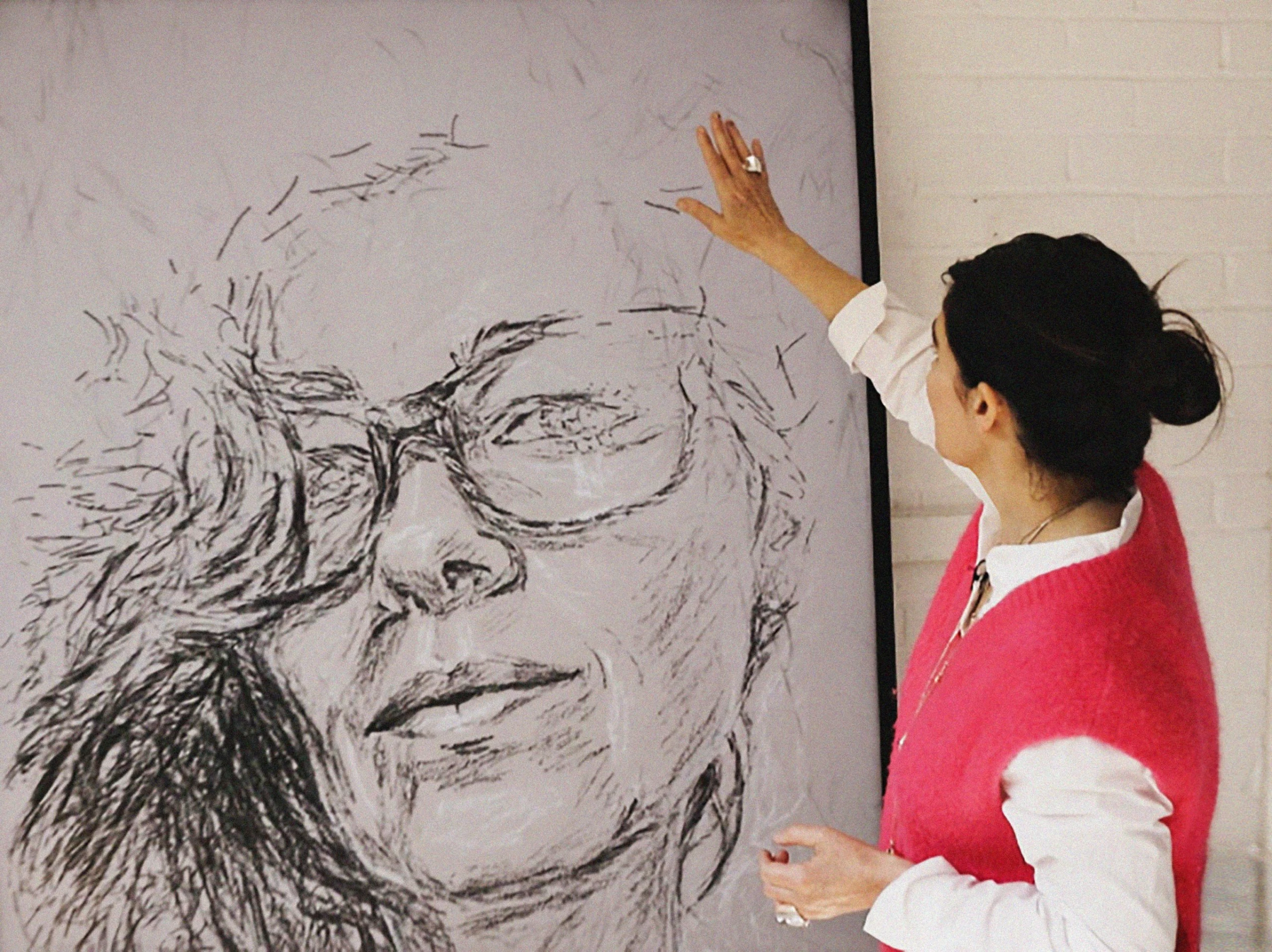
Es Devlin's National Portrait Experiment
Es Devlin's new National Portrait Gallery project invites every UK resident into a live collective portrait, testing how museums stage identity and participation
Es Devlin's new portrait project asks who a national collection is actually for
The National Portrait Gallery has spent generations building a visual history of Britain through monarchs, politicians, military figures, writers, celebrities, and officially sanctioned faces. That is the institution's power and its problem. A collection like this can claim to picture a nation while leaving most of the nation outside the frame. Artnet reports that Es Devlin's new installation, A National Portrait for the National Portrait Gallery, will run through 27 October and invites all 69 million UK residents to upload a selfie that is then transformed through a model trained on Devlin's own charcoal and chalk drawings. The results are displayed in a continuous stream inside the museum. That makes the project more than a crowd-pleasing interactive. It is an institutional test of whether a national museum can move from representing the public to admitting the public into its representational machinery.
Devlin is an ideal figure for this experiment because her practice has always been built around scale, spectatorship, and collective imagination. She became widely known through theatre and concert design, then moved decisively into museums and public installations where architecture, image systems, and civic participation meet. In this case she is not merely decorating the National Portrait Gallery with contemporary tech. She is exploiting one of the museum's core contradictions. Portrait collections claim to show who matters. By opening a live portrait stream to everyone, Devlin turns that claim into a pressure point.
The museum is clearly aware of the stakes. The project sits in the History Makers gallery, a placement that matters because it puts everyday participants into dialogue with the gallery's established hierarchy of notable figures. The gesture is democratic, but it is not innocent. It asks whether inclusion now means accession, display, algorithmic transformation, or simply the temporary pleasure of seeing yourself validated by the institution. Museums love the language of access. Devlin's work asks what access actually changes when the collection itself still rests on older forms of gatekeeping.
The project also arrives at a politically charged moment for the idea of British identity. Questions of immigration, cultural belonging, regional fracture, and social legitimacy continue to shape public life in the UK. A museum that stages a constantly updating portrait of the country cannot pretend it is operating outside those debates. That is part of why this work matters. It treats portraiture not as a static archive of the already-famous, but as an unstable social argument about who gets pictured and under what terms.
How the work uses participation and machine vision without hiding the politics
There is an obvious temptation to describe this as an AI portrait project and stop there. That would be lazy. The more interesting fact is that the system was trained on Devlin's own drawn marks in collaboration with Google engineers and technicians. In other words, the machine output is being framed not as generic automation but as an extension of an authored hand. That move matters because it tries to hold onto artistic signature even while scaling participation to a national level. Readers can compare the institutional framing with the broader Google Arts & Culture ecosystem, which has become increasingly important in museum-facing experiments around digitization, public engagement, and computational image culture.
Still, the politics do not disappear just because the model is grounded in an artist's mark-making. A selfie upload pipeline carries its own assumptions about visibility, consent, interface literacy, and who feels invited to participate in the first place. Digital inclusion projects often flatter institutions by making participation look frictionless. But a national portrait built from uploads still depends on broadband access, comfort with self-exposure, and a willingness to enter a tech-mediated representation system run by a major cultural institution in partnership with a global technology company. Some people will see that as thrillingly open. Others will see it as inclusion on institutional terms.
That tension is precisely what makes the work serious. The National Portrait Gallery is not just displaying finished likenesses. It is allowing the process of conversion itself to become visible: a face enters, an authored style is applied, and the museum exhibits the result as part of a collective stream. The work therefore stages a chain of mediation rather than pretending to offer unfiltered public presence. In that respect it is more honest than many participatory museum projects, which often rely on the fantasy that uploading equals empowerment.
Devlin has approached similar questions before. Her refugee-focused project Congregation and other public works have repeatedly turned portraiture into a question of assembly rather than individual prestige. Here that strategy is scaled to the level of national branding. The crucial question is whether the work remains analytically sharp once it is absorbed into museum programming and family-friendly workshops. The National Portrait Gallery says visitors can also join drawing sessions, which is a smart extension of the installation because it shifts portrait-making back toward embodied looking rather than leaving everything to automated transformation.
Why this matters for museums that keep promising participation
Museums everywhere now promise some version of the same thing: participation, community, relevance, dialogue. Most of the time those promises are weakly operationalized. The public is invited to post, respond, vote, or contribute, but the institution remains structurally unchanged. Devlin's project may not solve that problem, yet it does expose it unusually clearly. A national museum is temporarily widening the representational threshold without pretending that the collection itself can be rewritten overnight. That makes the project less radical than a true redistribution of institutional authority, but more honest than a generic outreach campaign.
It also extends a larger shift in what portrait museums think they are for. The old answer was memory and greatness. The newer answer is encounter, identification, and social reflection. That evolution can produce empty populism if the institution simply chases visibility. But when done well, it can force collections to face their own blind spots. Readers interested in how institutions frame identity under pressure may also want to revisit artworld.today's report on the Kremlin-era rebranding of Moscow's Gulag Museum, where memory politics move in the opposite direction: narrowing public narrative instead of multiplying it.
Another reason the project matters is that it refuses the dead language of inclusion statements. Devlin is not saying the museum should become more representative in the abstract. She is engineering a public mechanism that dramatizes the gap between a fixed historical collection and a changing social body. Whether the work finally resolves that gap is almost beside the point. Good institutional art does not always solve contradictions. Sometimes it makes them impossible to ignore.
There is also a governance lesson here. Museums increasingly rely on tech partnerships to deliver public-facing innovation, but too often those partnerships are either opaque or conceptually thin. This project works best when the museum treats the technology as part of the artwork's argument rather than a neutral delivery system. If the National Portrait Gallery can maintain that clarity through programming, interpretation, and public discussion, then it will have done more than stage a popular installation. It will have used a participatory artwork to interrogate its own representational logic.
That matters for future collecting too. If a museum can publicly acknowledge that portraiture is not just about preserving great names but about negotiating who gets visible membership in a national story, then commissions, acquisitions, and interpretive priorities start to look different. Even if no immediate policy shifts follow, the installation creates an evidentiary record of public appetite for a wider and less ceremonial image of British life. Museums often claim they need proof before changing. Projects like this generate the proof while also revealing how much caution still governs the institution around it.
What comes next for the gallery, and for the idea of a national portrait
The immediate next step is practical: how many people participate, who participates, and how the institution narrates the results. Numbers alone will not tell the story. A huge upload count could still mask demographic skew, novelty participation, or unequal access. The more revealing question is whether the museum uses the project to think harder about future collecting, commissioning, and curatorial framing. If the collective portrait remains a temporary spectacle with no structural afterlife, the work risks becoming a beautifully branded concession. If it affects how the institution understands portraiture itself, then it may prove consequential beyond its run.
Devlin's project should also be read against the wider museum field, where portraiture is being rethought through archives of migration, vernacular photography, oral history, and digital publics. The best version of this work pushes the National Portrait Gallery toward that broader terrain. The weaker version leaves the collection intact while borrowing a temporary aura of openness. Right now the project contains both possibilities, which is exactly why it deserves attention.
What the museum has done, at minimum, is admit that a national portrait cannot credibly be a closed hall of achievement anymore. It has to be argued over, refreshed, and placed under pressure by the people it claims to picture. That is not a final democratic victory. It is a serious beginning. And for a museum built on the authority of the already-recognized, a beginning like that is more disruptive than it may first appear.