Tehran Museum Reopens by Turning War Into a Curatorial Question
Tehran's museum of contemporary art has reopened with conflict-focused displays, showing how collections care and public programming operate under active risk.
The reopening of the Tehran Museum of Contemporary Art after weeks of bombardment would have been news on procedural grounds alone. Any institution charged with protecting one of the most important collections of Western modern art outside Europe and the United States commands attention when it moves from emergency closure back to public programming. But the museum's decision to reopen through a rotating Art and War programme makes this more than a resilience story. It turns wartime collections care into a curatorial argument about what museums owe their publics when ordinary cultural time has broken down.
The Art Newspaper's detailed report provides unusual operational texture: emergency retrieval of loaned works, rapid dismantling of a photography exhibition, registration efforts through UNESCO channels, and the extraordinary problem of how to stabilize Noriyuki Haraguchi's oil-based installation under the threat of shockwaves and fire. Those details matter because they show an institution doing what good museums are supposed to do under pressure: preserving objects, documenting decisions, and then translating that emergency experience into public meaning instead of pretending the crisis never happened.
The programme's premise is as strong as the logistics. Rather than reopening with business-as-usual spectacle, TMoCA is staging a sequence of conflict-focused displays that ask how artists have pictured war, grief, endurance, and aftermath across time and geography. The current grouping around Spain, including works related to Picasso's Weeping Woman cycle and other responses to the Spanish Civil War, is not simply thematic programming. It is an attempt to build a public language for living through rupture while the possibility of renewed violence remains present.
That is what gives the reopening broader importance. Museums are often told to choose between protection and relevance during crisis. Tehran's example suggests the better institutions refuse the choice. They protect the collection precisely by redefining relevance through the conditions of the emergency itself.
How the museum protected a collection under bombardment
TMoCA's collection is famous because it compresses an improbable art-historical map into one institution: Picasso, Pollock, de Kooning, Warhol, Hockney, Van Gogh, Renoir, and many others acquired during the Shah's era and then preserved, mostly intact, through revolution and decades of geopolitical isolation. A collection like that is not only valuable in market terms. It is operationally difficult. Large works, fragile works, and unusual installations all demand different emergency responses.
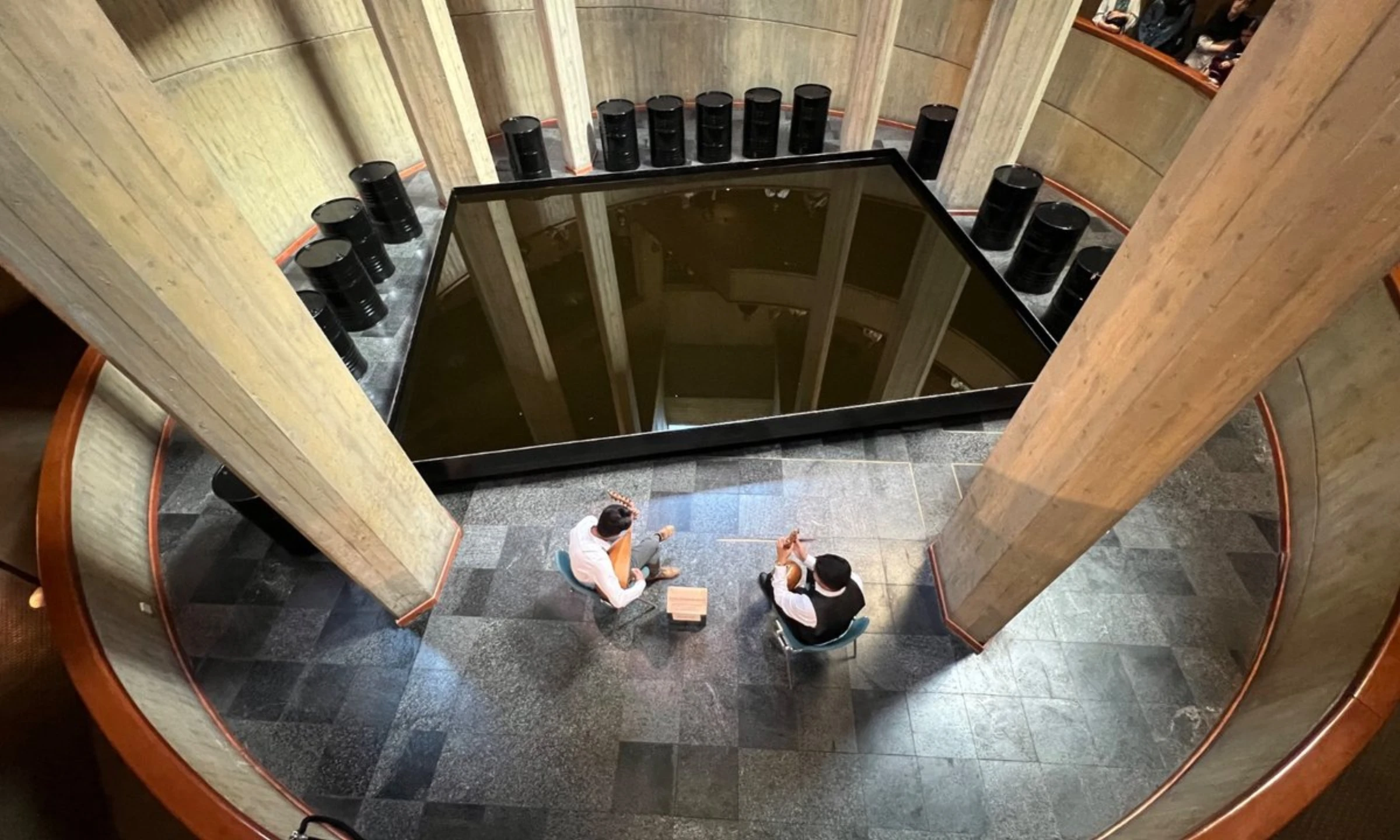
The reported handling of Haraguchi's Matter and Mind is a case in point. An installation containing thousands of litres of oil becomes a hazard in wartime for obvious reasons, but emptying it entirely would also alter the work. The museum's solution, removing most of the oil while leaving enough to preserve the work's appearance, shows the kind of compromise crisis conditions force on conservators and administrators. Purity is rarely available. Responsible stewardship becomes a matter of choosing which risks can be reduced without destroying the work's basic integrity.
The same principle appears in the treatment of outdoor sculpture. Leaving works in place may sound passive, but under bombardment and material scarcity it can be the least damaging option. Coverings can vibrate, trap moisture, or create new problems if suitable materials are unavailable. Emergency collections care is not a movie version of heroics. It is a sequence of constrained judgments made with incomplete information and no guarantee that conditions will stabilize soon.
One reason the Tehran case is so instructive is that it rejects the fantasy of perfect preparedness. The museum was still improvising under duress: sourcing pumps and barrels, coordinating a reduced staff, and maintaining internal communication while fear and exhaustion were constant. Yet the institution also appears to have relied on the habits that separate serious organizations from fragile ones: inventory thinking, role clarity, and a capacity to make decisions without waiting for ideal conditions.
Why the Art and War programme is more than symbolic repair
Many museums reopen after crisis by trying to reassure the public that normality has returned. TMoCA has done something smarter. It has acknowledged that the institution and its audience are still inside the event. The director's description of remaining in "war mode" is important because it names the transition honestly. The museum is open, but not restored. The programme therefore becomes a bridge between emergency management and civic reflection.
That curatorial move matters because wartime publics do not need empty uplift. They need forms that can register fear, memory, and contradiction without collapsing into propaganda. By grouping works around specific historical conflicts, the museum can stage indirect conversations about the present while grounding them in art history rather than in sloganized messaging. This is one of the most valuable things museums can do in unstable conditions: create a space where reflection remains possible even when direct speech is constrained by politics, trauma, or uncertainty.
The international art world should also notice the restraint of the display strategy. The limited number of works is not a weakness. It reflects the museum's continued need to remain movable if conditions worsen. That kind of curatorial minimalism has a lesson in it. When risk remains live, quality of argument matters more than scale. A tight, legible presentation can carry more institutional intelligence than a grand reopening full of logistical bravado.
The programme also reframes the collection itself. TMoCA's holdings are often discussed through their market value or through the geopolitics of how such works came to Tehran in the first place. The Art and War structure pushes viewers to read them differently, as tools for historical comparison and emotional orientation. That is a stronger use of a museum collection than merely reminding the world that valuable masterpieces survived.
What museum leaders elsewhere should learn from Tehran
First, crisis planning has to include partial operation scenarios. Too many museums prepare only for normal function or full shutdown. Tehran's experience suggests that the harder and more realistic mode lies between those poles: reduced staff, unstable supply chains, incomplete access, and programming that must remain reversible. Institutions should drill for that middle condition because it is where many real emergencies now sit.
Second, collections care and curatorial programming should not be treated as separate departments of meaning. The most persuasive public programme often emerges from the emergency itself, because the institution has learned something concrete about vulnerability, labor, and value. TMoCA did not wait for a distant, polished retrospective on wartime experience. It turned recent operational knowledge into a live curatorial structure.
Third, international solidarity has to move beyond generic statements. If museums abroad want to support peers in conflict zones, they should focus on emergency conservation advice, digitization, backup hosting, staff exchanges, translation support, and public amplification of documented institutional needs. Bodies such as UNESCO's culture-in-emergencies work and the broader frameworks of Blue Shield show what practical cultural protection can look like when it is treated seriously.
Fourth, donors and trustees should recognize that resilience spending is curatorial spending. Inventory systems, emergency packing materials, conservation labor, and secure communication networks do not sit outside mission. They are mission. A museum that cannot protect its collection under stress will eventually find its intellectual ambitions hollowed out by operational fragility.
The Tehran reopening should also sharpen debates about museum neutrality. There is nothing neutral about deciding which works to move first, what narrative to offer after a ceasefire, or whether to reopen at all. Institutions make value judgments every time they assign risk, visibility, and public meaning. What matters is whether those judgments remain legible and defensible. On the evidence reported so far, TMoCA has responded with an uncommon degree of coherence.
Another useful lesson is temporal. The museum did not wait for full symbolic closure before speaking through exhibitions. That matters because post-crisis culture often gets trapped between memorialization and denial. If institutions reopen too quickly with empty normality, they insult lived experience. If they wait for perfect distance, they surrender the public arena to propaganda and rumor. TMoCA's rotating format suggests a third route: provisional interpretation that can change as conditions change.
That approach deserves close study from curators everywhere. It treats programming not as a decorative add-on after conservation work is done, but as part of the museum's social response. The institution is effectively saying that audiences need a place to think through conflict while the collection is still being protected. That is a difficult balance to strike, and it is precisely why the case matters beyond Iran.
There is a governance lesson buried inside that curatorial choice. Institutions under stress need leaders who can authorize provisional decisions without pretending they are permanent. A rotating display, a reduced checklist, a reversible installation plan, and a modest public format can all be signs of strength when they are clearly reasoned. The museum world often equates scale with confidence. Tehran suggests that confidence may instead lie in disciplined limitation.
Readers interested in how museums behave when political pressure reshapes cultural space may also want to see artworld.today's coverage of Russia's recasting of the Gulag Museum. The contrast is stark. In Moscow, memory is being narrowed by the state. In Tehran, a museum under active risk is using programming to widen reflection inside the crisis it has just lived through. That does not make the Iranian case simple or pure. It makes it serious. And seriousness, right now, is worth paying attention to.